The Forgotten Cemetery
A neglected North Philly graveyard. A vanished fortune. And a two-year quest to answer a single haunting question: What do we owe the dead?
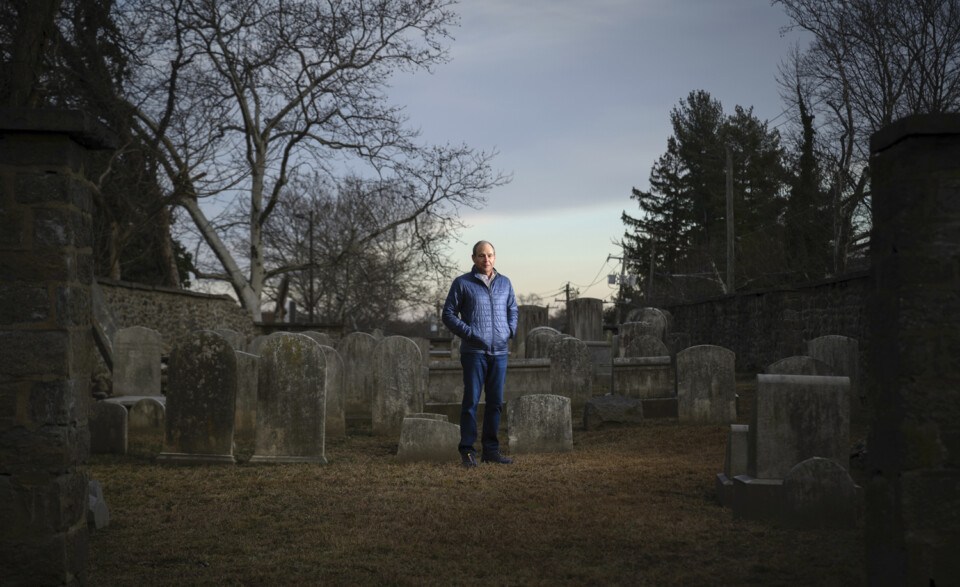
The author at his family’s burial ground in West Oak Lane. / Photograph by Kriston Jae Bethel
It was almost dusk when I decided to jump the gate. Looking up and down the street, I saw no one — this was going to be easier if I didn’t have to explain myself. Tall trees, lush in the June air, leaned over the north wall like slowly collapsing fans. Securing a foot on the gate, I hoisted my other leg up, but the chain lock gave way, already broken, and the old wrought iron gate swung open. I had every reason to believe I was the first relative to enter our small family burial ground in over 100 years.
One glance told me the property had been grossly neglected. Syringes, sandwich wrappers, and condoms were strewn throughout the thigh-high grass. Jagged bits of glass glinted as the streetlights came on. Vines as thick as my arm overgrew the cracked walls. I stumbled on a dead cat, hard as a cinder block. Several dozen headstones, drowning in overgrowth, could be seen listing this way and that, losing their battle with nature and time. Some had fallen over. I pulled away weeds to read the inscriptions, some from over 200 years ago — the shallow chiseling of names and dates, faint with age or entirely illegible. High on a stone wall was a plaque, not yet reached by the rioting green beneath it, that read “The deBenneville Family Burial Ground. Established 1758.”
Alone in the cemetery, I wondered: How did this happen? Why such squalor where my ancestors lay in this obscure walled lot on Broad Street, five miles north of Center City? I’d discovered this place — a little gem, I thought — while researching my genealogy back home in Boston. A 50-year-old black-and-white picture I’d found online showed a slightly overgrown cemetery, but what lay before me was desecration by neglect. My sense of hopeful discovery quickly curdled to disappointment. In that moment, I felt charged to act.
My trip to Philadelphia on that June day in 2023 had begun as an adventure, born of a desire to learn how my unusual middle name — deBenneville — had come into my family. Discovering the cemetery had felt like a clue and gave me a reason to return to the area. I’d been raised on the Main Line. My father had been CEO of Janney Montgomery Scott; my mother was a Pew from the Sun Oil dynasty. I spent 13 years at Episcopal Academy, where my worldview was shaped and my self-confidence grew in a way that the well-loved take for granted.
Still, I was itching to get away from the Main Line and my sense that it was rote, a carousel of the same old families going around and around. Harvard provided my first glimpse of a larger world; after graduation, I landed in ABC’s documentary unit, traveling the globe for 10 years. After that, I moved around as the CEO of several startups and public companies (I later became a venture capitalist), eventually settling in Boston with my wife and three sons. Until I learned about the deBenneville family burial ground, I’d never felt compelled to return to the Philadelphia area that shaped me.
Now, though, as I wandered among the remains of ancestors I’d only just learned of, I felt an unexpected desire to honor them. Along Green Lane, the skinny street that borders the cemetery to the south, a half-dozen houses overlooked the grounds; in my dismay, I knocked on doors to see what I could learn. No one answered, though in one or two windows I could see wary faces peering out at this impatient stranger. They’d see me a lot over the next two years. Breaking into the cemetery that day was the beginning of a long, weird, winding and — surprisingly personal — adventure.
The idea for a family burial ground — along with a $500 endowment for its “perpetual” maintenance — came from George deBenneville, my seventh great-grandfather and the first preacher of Universalism in America. In 1741, he was the first of my deBenneville ancestors to migrate from Europe to the Philadelphia area, purchasing 132 acres of farmland in the Oley Valley, some 50 miles northwest of the city. Later, he also bought a farm in Branchtown — now part of the city’s West Oak Lane section — and allocated a half-acre of it for a burial ground. His instructions hinted at the strange immortality that attends cemeteries:
AND WHEREAS I have set off from my said plantation on the Old York Road which I purchased from Joseph Spencer a small piece or strip of ground three perches wide and twenty perches in depth for the purpose of a graveyard or burial place for myself and family and have marked or fixed the boundaries thereof by three stones. Now my will and desire is that this strip or piece of ground shall not be sold by my executors but always exempted and reserved out of the sale of the plantation and be and remain the property of my family to and for a burial place forever and to and for no other use and purpose whatsoever.
George deBenneville was born into an aristocratic French family of Huguenot, or Protestant, landowners. The family fled to London shortly before George was born to escape King Louis XIV’s repression of non-Catholics. George’s mother died giving birth to him, leaving behind eight additional children (four sets of twins) and a grieving husband, who himself died soon thereafter. George’s godmother, who just so happened to be Queen Anne, who was married to Prince George of Denmark, agreed to raise George in the royal court.
By early accounts, he was an unruly handful. From his autobiography:
When arrived at the age of twelve years, I was very wild, believing myself to be of a different mass from mankind in general. As it was designed that I should learn navigation, I was sent to sea in a vessel of war belonging to a little fleet bound to the coast of Barbary with presents, and to renew the peace with Algiers, Tunis, and Tripolis.
In 1719, after four years at sea, he returned to England and promptly fell into a year-long depression. Saved by a mystical call from God, he began to preach at age 17. The Calvinist Church in England roundly rejected him as a heretic. His sermons found no better reception when he tried his luck in France, where he was condemned to death for his unorthodox beliefs. (King Louis XV’s last-minute pardon saved him from hanging.) He decamped to Germany, where he studied herbal remedies and was certified as a doctor, even as he continued to preach radical ideas that routinely got him thrown out of churches.
I suspect all of this would be lost to time but for what happened next.
In Germany, George came down with a fever, was pronounced dead, and was placed in a coffin. Almost two days later, he revived, claiming to be possessed by a new vision, a gospel of “boundless love for the entire human race.” Over time, he pieced together the notion of universal forgiveness largely from other religions and his own beliefs, and emerged as the spiritual founder whose history future Universalists sought to preserve.
Still, none of his new sermons on universalism (“Honor the ocean of love …”) were well-received. With the means to continue pursuing the messages of his trance, he took his steamer trunk of beliefs and rejections to America, bearing his inchoate view of universal forgiveness. He arrived in Philadelphia, where he married Esther Bertolet, from a similarly high-ranking Huguenot family, and befriended many Native Americans, from whom he learned healing methods based on local herbs and plants. He opened an apothecary in Philadelphia and continued to preach and practice medicine. His marriage produced eight children, many of whom are buried with him in the family plot. He died in 1793.
For several generations, the deBenneville name came and went, resurfacing in my line through my great-great-grandmother, Esther deBenneville Keim (1827–1889). My father, George Bell, was given deBenneville as his middle name and passed it down to me.
He never mentioned the existence of a family burial ground. Nor did my grandfather, John C. Bell Jr., who for many years was chief justice of the Supreme Court of Pennsylvania (and the shortest-termed governor in state history, serving just 19 days). Nor did his brother, my great-uncle deBenneville “Bert” Bell, the second commissioner of the NFL and owner of the Philadelphia Eagles. (The Maxwell Memorial Football Club still awards the Bert Bell Trophy annually to the NFL’s most outstanding player.) These prominent men, along with other deBenneville relatives, were in and out of the city throughout their lives. Many went to Penn, worked downtown, and may have passed by the family burial ground from time to time. All are long gone, buried in their favored churchyards with members of their own families, a few miles from one another. I’ve convinced myself that they knew nothing of the cemetery because I don’t want to believe that they turned their back on it — this sweet, hidden place.
And now that I knew about it, I couldn’t turn my back on it either.
As one of the country’s oldest cities, Philadelphia has several hundred unmarked and abandoned cemeteries, according to the Philadelphia Archeological Forum. High infant mortality rates and short life expectancy meant that graveyards filled up fast. Many burial pits sank or were simply plowed under. Today, construction projects are the usual cause of their discovery, when backhoes hit layers of stacked bodies, sometimes with jaw-dropping results. Back in 2018, for example, while excavating a building site in the 200 block of Arch Street, PMC Property Group hit the old burial ground of the First Baptist Church, unearthing 400 bodies; the remains were then transferred elsewhere. Several years ago, PAF created a free, comprehensive database of burial grounds for architects and building contractors to try to prevent construction machinery from tearing into more human remains.
Meanwhile, even well-known cemeteries battle neglect and vandalism. The problems at the sprawling Mount Moriah in Southwest Philly, for example, are legendary (and now include the January arrest of a man who allegedly looted mausoleums there for bones). Other burial grounds fall into disrepair when maintenance funds dry up. Nationwide, there’s a market for cemetery mergers and acquisitions, sporting its own networks of lawyers, surveyors, and tax specialists. For a time, I’m told, Laurel Hill Cemetery, the beautifully tended 265-acre National Historic Landmark, was interested in buying the deBenneville burial ground, but the idea went nowhere.
This is just so darn rare, to have a chance to revive all this. It comes along once in hundreds of years.” — David Rowland, president of the Old York Road Historical Society
The grave markers in the deBenneville cemetery are oddly distributed. At the east end of the property lie most of the deBenneville stones, gathered in small groupings, as a clan might if they stood together informally, leaning this way and that. It reminded me of how families depend on one another. George deBenneville’s is a large, flat slab, like a tablet, flush with the ground. The middle of the cemetery is open grassy space, and to the west lie two graves that differ from the others. They are the resting places of General James Tanner Agnew, one of only four British Revolutionary War generals buried on American soil, and Lieutenant Colonel John Bird, both felled in the Battle of Germantown on October 4, 1777. The two were first interred in Germantown’s Lower Burying Ground, but a year later, British General Sir William Howe, fearing the desecration of their graves after the British withdrew from Philadelphia, secured a secret agreement with deBenneville to move the bodies to the family burial ground. It was known that deBenneville cared for the wounded on both sides, true to his belief about universal love and forgiveness. “Deeds, not creeds,” he had often preached.
My cemetery research benefited greatly from meeting David Rowland, president of the Old York Road Historical Society, whose mission is to preserve the history of communities along the Old York Road from Philadelphia to New Hope, a geography that encompasses the deBenneville cemetery. Rowland, a Dickensian character, was visibly excited as we explored the society’s archives at the 19th-century Alverthorpe Manor in Jenkintown. I wandered around as Rowland, who seemed to know by memory where everything was located, went in search of the deBenneville records. Within minutes, I heard him yell, “Got it!” as he triumphantly emerged with a fat binder containing birth and death records of all 114 occupants of the deBenneville cemetery, each sheathed in protective plastic.
I was puzzled by the number because there are not 114 headstones there. I suspect that some graves simply sank over time; one marker in the northwest corner is already half buried. I pointed it out to Rowland when we visited the cemetery together.
“This is just so darn rare,” he said, visibly moved as we walked among the headstones, “to have a chance to revive all this. It comes along once in hundreds of years.”
I had never pondered the question of who owns or maintains a cemetery. But as I grew more knowledgeable about the pressing needs of the deBenneville graveyard, I realized it would be best to control it legally, which would also allow me to explore state and federal grants to help with restoration. Traveling to Philadelphia every few months and working on Zoom, I investigated its ownership. The bureaucracy was dense, but I was surprised to discover that greed appears to have played a significant part in the cemetery’s decline.
On one spring visit, I met Shirley and Ed Parks, who have lived in a small, stand-alone house overlooking the cemetery for 40 years. “Damn,” said Ed, when I told him what I was up to, “you mean someone’s finally going to care about this?”
He said the grass used to be cut regularly, but in the last few years, no one had shown up to do anything. He himself used to get paid $100 now and again by someone, name long forgotten, to clear fallen limbs and report damage. “But that train came to a stop a long time ago,” he chuckled. “We used to love the view here, very peaceful, and there was a bench inside the gate that we could sit on. But these past three, four years, they just stopped.”
Two trusts govern the property. The first holds George deBenneville’s grant of land and his $500 gift, made in 1758, more than 30 years before his death. The second holds a $2,000 gift for cemetery maintenance made in 1911 by Anna deBenneville Michener (whose family founded the Michener Art Museum in Doylestown); evidence shows that she was dissatisfied with the cemetery’s condition even back then. She is the last person to be buried there, and her grave sits close to George’s: two deBenneville relatives who never knew each other, now separated by just 20 yards, both silently carrying forward a family legacy. In 1924, a recorded deed shows the sale of the western portion of the burial ground for $14,000. That sum, and Michener’s gift, were the only additions to the initial bequest that George deBenneville had set aside in his will.
I discovered that the burial ground falls under the supervision of the Orphans’ Court of Philadelphia; technically, it is still a family-owned burial ground, but, over the past 100 years, no family member has chosen to serve as trustee. In such cases, the court has the obligation to appoint another trustee, often a bank or trust company, which is what happened with the deBenneville graveyard when the court appointed the Pennsylvania Company for Insurance on Lives and Granting Annuities, an early, pioneering bank in life insurance and trust services.
After that, the succession of responsibility for the cemetery trusts was passed along through bank mergers like a discarded heirloom: First Pennsylvania Bank, CoreStates, Wachovia, and First Union all supervised the cemetery at various times. By the time I arrived, 265 years after the burial ground was established, Wells Fargo was the trustee with fiduciary authority.
So it was Wells Fargo I needed to contact — but what would I say, even if I could identify the right trust officer? Please cut the grass? I already had my answer in the condition the cemetery had lapsed into. Clearly, Wells Fargo had lost interest. One reason for the cemetery’s derelict condition was, I assumed, that the money from the trusts had run out, but I soon discovered, after records were shared with me by order of the court, that they still held $300,000.
I was initially pleased, but then I did some math.
If George deBenneville’s original $500 had earned four percent interest, compounding annually since his death in 1793, it would be worth over $12 million today, not including the compounding of Anna deBenneville Michener’s gift. Somewhere along the way, a fortune had evaporated.
My guess is that the culprit was fees: annual bank fees for trust administration, investment oversight, and maintenance supervision. I wish I had a better answer, but I never got one from Wells Fargo officials, who didn’t return my calls. For a bank of their size, $300,000 is no more than a coin behind the couch cushion. But for my ancestors, it was all that was left of their thoughtful legacy.
Finally, I petitioned the court to take over both trusts. Wells Fargo didn’t object. I represented myself, stubbornly unwilling to spend a single dollar of cemetery money on lawyers while the dead lay neglected. It took a year, but I was appointed sole trustee. As for the funds, when they were finally transferred to accounts I had set up, they were smaller still — one last round of legal and accounting fees shaved them down. Time, it seems, when in the hands of influential bankers, can build or destroy a fortune.
After I became the deBenneville trustee, I asked Judge Ramy Djerassi, who’d overseen the case, if he wanted to meet one afternoon and walk around the cemetery. I knew he had a keen interest in the city’s history and had served on the bench for over 30 years. “Oh, my wife and I have already visited it,” he said, surprising me, “but I’d love to walk it with you.”
On the day we were to meet, I came down from Boston early to inspect the cemetery myself. I knocked on Ed and Shirley’s door; by then we’d become cemetery buddies. Ed answered as he always does, with a smile. Shirley was right behind him. I explained that Judge Djerassi, who appointed me trustee, would be here in a few minutes. Would he and Shirley like to meet him?
“You mean the Judge Djerassi?” Shirley asked, stunned.
“That’s the guy,” I said.
“I worked for him for 12 years in the courts!” she said proudly. “And he’s coming here right now?”
“He’ll be here in 10 minutes.”
“Oh boy,” she said, turning away with excitement, “I’ve got to change my clothes!”
Soon afterward, she and Djerassi had a long hug on the front steps. They fell into updating each other and reminiscing, and as we all walked across the street to the cemetery gate, I was tickled to think of the dead reuniting the living.
On my visits, as soon as I see the gravestones, I feel the exhale of relaxation, the relief of knowing the graveyard is still here, as if it might have been snatched away in a tablecloth trick played by time, gone as quietly as it came. I have a strong sense of returning to something that was lost and found again, and also the peace of being among all these relatives I never knew. A strange intimacy allows me to imagine them here, in black garb from another age, honoring one another as they lowered their dead into the ground — their graveside prayers, their hopes for their children, their foibles and failed dreams, their urge to love that seems almost palpable as windblown leaves dance upward in an October sky.
At this point, I’ve spent more time in this graveyard than any other. My parents and my younger brother are buried together at St. Christopher’s Church in Gladwyne; they lie among hundreds of others, all marked by identical white marble stones arranged in rows in an open field outside the church. In comparison, the random, unkempt feeling at the deBenneville cemetery, bordered by teeming Broad Street, seems more alive, with its imperfections, its old symmetries abandoned. Somehow, with age, the burial ground has lost its formality. To weave among these headstones is to feel lightness in the face of death, to attend a church where no one minds soft voices talking throughout the service.
After I became the cemetery’s sole trustee, its enchantments and worries became mine. I lay awake at night imagining that George deBenneville’s hand and my hand ran over the same odd depression in that granite capstone on the east wall, that I walked the grassy margins just as he did over 250 years ago. One who sought salvation here, one who sought it elsewhere — one coming, one going. As I stand on the large granite slab of his grave, I’d like to think our kinship is growing, that sometimes I can hear his intentions in the earth.
I’m drawn to the walls and the headstones of children — one in particular, low to the ground in a half-moon shape, marked only “Little Hettie.” The rocks in the walls and the gravestones age with puzzling variety; it’s like trying to understand time itself. I can sense how the cemetery’s sepulchral quiet was slowly invaded as the city grew louder and more populous around it, the flow of cars and buses increasing, their emissions eating into the marble gravestones. The beautiful border walls of Wissahickon schist, bright with flecks of mica, have, in places, dulled to the color of dust. With my finger, I scrape at the weakest parts and come away with a hunk of powdery stone. Failing to be carried on in family stories, I’ve come to believe, the burial ground simply stopped being discussed. It went mute, rarely visited, the tombstones mere relics from a forgotten age that disappeared under the weight of other things.
Today, an auto repair shop and the Precious Angels preschool and daycare center share the cemetery’s border. Of all the things that might occupy this spot, a historic cemetery must be among the least likely. We have a long way to go to bring it back to what my seventh great-grandfather envisioned.
Yet it has survived hundreds of winters, the blight of the industrial age, and the exhaust from the ceaseless traffic that runs along North Broad Street. It occurs to me that it’s done so by turning its back on everything but its own dignity and existence. It speaks to me of patience even as I wonder how to preserve it structurally, legally, and spiritually for another 268 years. I hadn’t expected to gain much from simply wanting the cemetery to look less lousy. Yet already it’s given me a greater capacity for forgiveness and a reminder of the twin forces of silence and time. There’s still time to make it right, I remind myself whenever I visit. There’s still time.
Published as “The Forgotten Cemetery” in the March 2026 issue of Philadelphia magazine. A version of this story was originally published last year on the Hidden City Philadelphia website.