
There Was Only One Choice for Most Philly Athlete of All Time: Allen Iverson
The defiance. The swagger. The resilience. No one embodied Philadelphia more than AI.
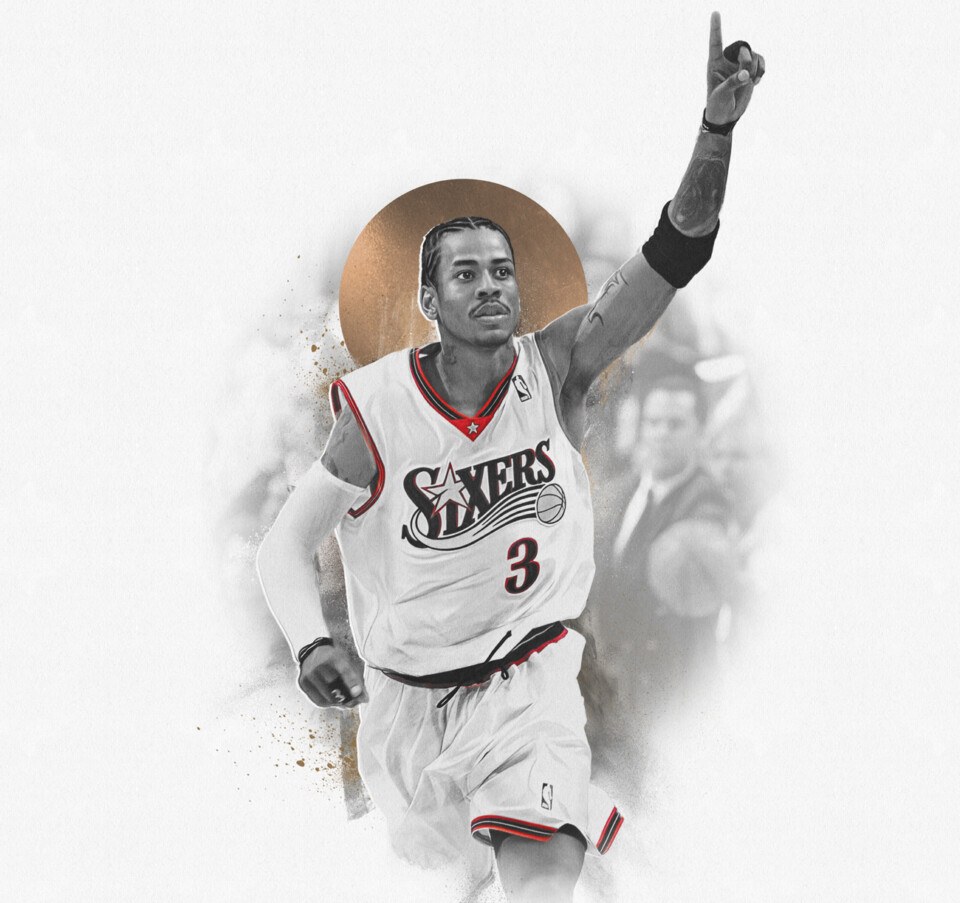
Allen Iverson is our Most Philly Athlete of All Time. / Photo-illustration by Neil Jamieson; photograph via The Sporting News/Getty Images
Thug. Drug dealer. Ex-con. That’s what you heard, nearly three decades ago. Columnists and sports-talk yakkers let it be known that a bad actor had hijacked center stage in Philly, what with his stint in jail at all of 17 and those scowling, hooded friends — his “posse,” remember? Never mind that the prison sentence would later be overturned; Allen Iverson might as well have been from another planet, not just Newport “Bad” News, when the storied Sixers franchise was handed to the 21-year-old prodigy in 1996.
In Newport News he’d been cared for by drug dealers, abandoned by his biological father, raised by another man who was in and out of prison for dealing crack. He’d seen his first murder before his eighth birthday; one summer, eight friends were felled by gunshot wounds. How would this Biggie Smalls rap lyric come to life fare in Philly, where Dr. J’s Philly Sound crossover-era moves had spawned the unthreatening commercialism of Michael Jordan, whose league Iverson would upend?
We know now what followed: the scoring titles, the MVP trophy, the perpetual psychodrama with his old-school coach, Larry Brown, whom Iverson, denied his freedom at a young age, saw as a threat to it on the court. Not to mention the infamous “We talkin’ ’bout practice” rant after the premature close to his 2002 season, during which he’d won another scoring title at 31.4 points per game. All of it — Iverson as rebuke to the Jordan era — became the stuff of hoops and hip-hop folklore.
Iverson would go on to become the game’s greatest small player ever, a blur on the court, the progenitor of the most lethal weapon in the game. He did for the crossover dribble what the Doctor had done for the dunk in the ’70s: turn it into a weapon of intimidation.
The team listed him at six feet, but it was more like five-10. Yet there he was, catapulting himself at behemoths like Shaq and then turning to his co-conspirators in the stands and cupping hand to ear, feeding off their rabid reaction.
It was his defiance that turned Iverson into a pop culture icon, the most Googled name on the planet in 2001 when he led the Sixers to the NBA Finals against Shaq’s Lakers. David lost to Goliath in the end, but the series would be remembered for Iverson’s swagger. He was the first NBA player to wear cornrows, the first to adorn his body with tattoos, the first to fire Michael Jordan’s agent, David Falk (“I felt like the prey,” he said), and one of the first to lay down rap tracks, although his profane lyrics sparked outrage and led to the cancellation of his debut album. (Okay, Kendrick Lamar he was not: Come to me with faggot tendencies/You be sleeping where the maggots be.)
Visits to the Sixers postgame locker room were a case study in culture clash. The media pack, mostly middle-aged white men, seemed unable to fathom the poverty he’d grown up in or his newfound riches. No wonder the 20-plus tattoos — he’d just tell his own story on his body. Each paid homage to his Virginia roots or to Cru Thik, his boys from back home who had looked after his mom and sister when he was sent away on that bogus “maiming by mob” charge. When the NBA airbrushed his tattoos out of a league photo, he saw it as erasure and refused to abide by the league’s — and Brown’s — dress code.
But Iverson — who titled his recent autobiography Misunderstood — wasn’t a rebel without a clue so much as an artist on the court. Jordan was a craftsman, committing midrange jumpers to muscle memory every day. Iverson awaited his muse, imagining possibility in the moment and then acting it out. That helps explain his boredom at practice, which he’d sneak out of to scarf down Taco Bell in the hallway, or where he’d lie on his belly next to Brown while coach and team did push-ups. He’d lie unmoving while loudly grunting so Brown would think he was participating, his teammates giggling.
But come game time, no one played harder, which is ultimately why Philly swooned. He was raw and unfiltered, but his most visceral emotion was a type of I’ll die for you obsession to win. He’d take hits that would topple bigger men and stagger to his feet, Balboa-like. He’d dive after loose balls into the stands, collecting high fives from the suits sitting courtside.
Few knew he was just as creative off the court as on, a caricaturist with sketch pad at the ready. In it, his drawings would wrestle with the contradictions of his own self-image. So many had invested so much in the meaning of Allen Iverson. Main Line matrons wanted to mother him; Philly cops had arrested him; blue-collar workers marveled at his competitive fire; playgrounds were full of kids wearing protective sleeves on their arms as a style statement. All had their narratives. Which was it? Thug? Hero? Antihero?
The answer, it turns out, had something to do with the artistic credo of showing and not telling. “If someone’s smart,” he once told me, “they know. I’m that guy that you see out there.” He pointed to his canvas, a basketball court, where he’d spent a career showing us just who he was all along.
>> Click here to return to The 25 Most Philly Athletes of All Time
Published as “The 25 Most Philly Athletes of All Time: Allen Iverson” in the March 2026 issue of Philadelphia magazine.