To Stave Off Gentrification, Kensington Becomes Its Own Landlord
How one special sliver of the city is redefining what smart neighborhood development can look like in Philadelphia … and far beyond.
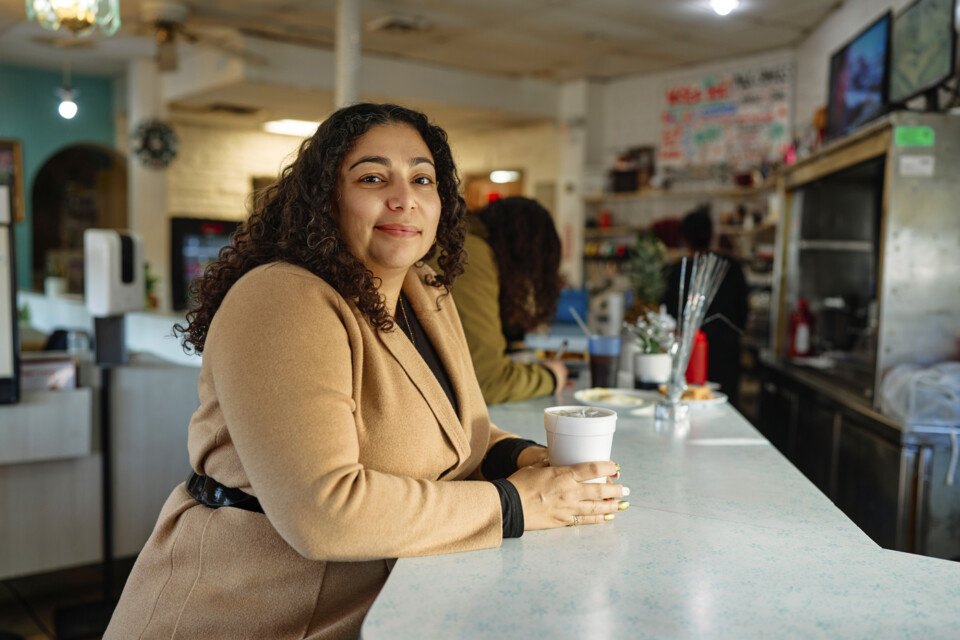
Kensington Corridor Trust executive director Adriana Abizadeh-Barbour / Photography by Gene Smirnov
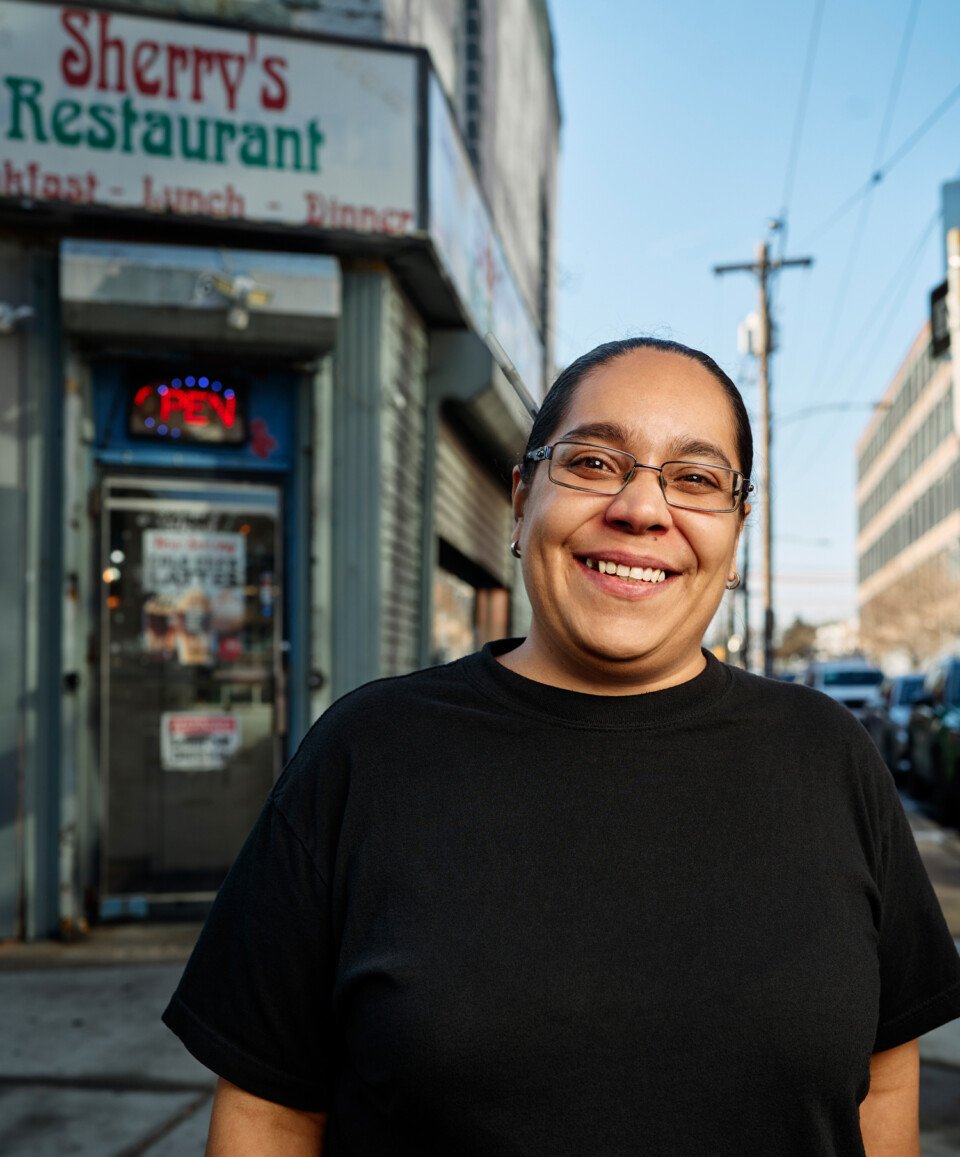
It’s closing time at Sherry’s Restaurant. The last few diners are still finishing up their home fries and eggs as Yolanda Del Valle sinks into a brown vinyl booth, winding down a shift that started before the sun came up. She flips off the neon sign buzzing in the window beside her and rises to ring up one last regular, urging him to have his mother join him the next time she’s in town.
“Bring her down to Kensington,” Del Valle shouts as the customer heads for the door. “Let her see how things really are.”
Sherry’s has stood for decades on the corner of Kensington Avenue and East Ontario Street. Del Valle isn’t sure exactly when it opened; she’s not even certain who Sherry was. But she knows everything else there is to know about the place. She was 17 when she picked up her first shift, 27 when she came on as a regular. Eventually she became enough of a fixture that customers started asking if she slept on a cot in the back. So when the former owner decided to retire in the spring of 2024, leaving the fate of the diner up in the air, it felt only right that she take over.
“I come with the building,” she says. “That’s how long I’ve been here.”
Across all those years, Del Valle developed a close relationship with the restaurant’s previous owner. Its longtime landlord, though, was a different story. He’d owned the property as far back as she could remember — a “really old-school” type, she says. Everything was transactional. Pay the rent and come back next month. And good luck getting help with repairs.
Under those conditions, reopening would have been a challenge. One rent increase, Del Valle feared, would force her to raise prices, turning off the locals who had been coming to Sherry’s their whole lives for the familiar atmosphere and affordable breakfast.
But months before Del Valle took ownership, Sherry’s caught a lifeline. In 2023, a new landlord bought out the old guy for $330,000, intent on keeping the diner going. It ran for a spell under her old boss, then shuttered for five months. During that pause, the new landlord helped Del Valle navigate code compliance with the city and connect with vendors in time to welcome customers back by Thanksgiving. The owner printed her new menus and offered to restock the refrigerator to get her off on the right foot. And now they’re helping her remodel the restaurant, free of charge. (The homey vibe won’t change, she promises, even if the muddy beige tiles and turquoise paint do.) Most importantly: Her rent is perpetually locked in at a below-market rate, so Sherry’s can stay Sherry’s for as long as people keep coming.
It’s all possible because those people — the residents of Kensington’s 19134 zip code, her customers — are Del Valle’s landlord. The new owner of the Sherry’s property is the Kensington Corridor Trust, a first-of-its-kind experiment in collective ownership that launched in 2019 with a mission to preserve intergenerational affordability in a neighborhood staring down displacement and gentrification.
The trust buys up real estate along a small segment of Kensington Avenue — so far, it owns 31 assets worth roughly $10 million, according to executive director Adriana Abizadeh-Barbour — then puts it in the hands of residents, who greenlight incoming businesses. The properties are placed into a perpetual purpose trust, meaning that they’ll be permanently owned by the neighborhood itself, outside of the speculative market. No matter what else happens along the avenue, the trust’s commercial and residential tenants will pay below-market rent and get the same type of support Del Valle received when she took over Sherry’s.
The model is rooted in the premise that “within capitalism, those who amass land amass wealth, and those who amass wealth amass power,” Abizadeh-Barbour says. With that in mind, the trust is a study in returning power to a community and putting faith in its own members to harness that power for good. That sounds awfully idealistic, sure, but the block is — so far, anyway — living proof that this model might just work as a blueprint for self-preservation and growth.
And, the thinking goes, if it can work here in Kensington, with its bucketload of challenges, well … where can’t it work?
You know this story: Once upon a time, Kensington was a vibrant industrial neighborhood, a bustling mecca of the American textile industry at the turn of the 20th century, home to carpet factories and tanneries and the working-class people who kept them running. Like so many American neighborhoods, though, it was crushed by post-war deindustrialization. As manufacturing moved out, economic opportunity dried up and investment evaporated. In the absence of a stable economic foundation, Kensington was eventually and increasingly buffeted by drugs, prostitution, and homelessness. But even as those issues have worsened, many residents have maintained a deep sense of pride in what their neighborhood once was and in some ways still is — and, increasingly, what it could be.
Darlene Burton has lived here for 29 years, ever since she moved from North Philly to build a better life for her four children. She still remembers Kensington Avenue’s commercial corridor as a beacon, the type of place where every business decorated for the holidays and a family could shop for everything they needed — shoes, clothing, groceries. There was even a roller rink where she could skate, right there on the avenue. Back then, she says, “it was absolutely gorgeous.”
Over time, Kensington has lost much of what first attracted Burton. Local businesses have closed, including the roller rink and any source of fresh food. Properties stand vacant and decaying. The sense of safety and security has been whittled away. The community has been through it.
“Your power loses its luster,” Burton says. “It’s like trauma. You go through so much, you don’t know sometimes if you’re coming or going.”
But Kensington is still full of fighters, she says, and the Kensington Corridor Trust has shown Burton and her neighbors that they have another tool at their disposal in the effort to rebuild their neighborhood, beyond policing and other community investments: “You can fight with real estate.”
Of course, in a community where the city’s statistics show 39 percent of residents living in poverty, where the household median income is two-thirds the citywide average, that’s easier said than done. But this is where KCT comes in, investing in real estate with the community’s best interests in mind.
The idea for the trust started not here in Philly but in Rhode Island, with a neighborhood on the west side of Providence called Olneyville — another textile hub whose economy collapsed after World War II, leaving behind dilapidated and deteriorating buildings. In the early 2000s, however, that neighborhood enjoyed a rebound, led by neighbors, nonprofits, and a community development corporation that replaced vacant lots with affordable housing, turned a toxic dump site into a beloved park, and rejuvenated the local elementary school.
As a result of that community-driven renaissance, the historically Latino community saw an influx of white residents and the onset of gentrification. Rents spiked and inequality grew more than 10 percent, according to the Gini index, which measures the distribution of wealth within a community. Low-income residents were pushed into precarity. The neighborhood was transformed, yes, but it wasn’t protected.
People who really made this their home, their community, don’t get to reap the benefits of positive change in any way. How is that fair? How is that equitable?” — Jasmin Velez, Kensington Corridor Trust
For Joseph Margulies, a professor of the practice of government at Cornell University who first began studying Olneyville in 2017 because of its approach to police reform, it was an all-too-familiar story: Residents refuse to accept less than they deserve and fix up their neighborhood, “and then it becomes irresistible to capital,” he says. “And then capital sweeps in and threatens to wash it away.”
In the spring of 2019, Margulies offered an alternative vision in the Stanford Social Innovation Review: the neighborhood trust. By ensuring local ownership and control of assets and the decommodification of property, his model — a blend of community development corporation and community land trust — could both transform and protect a community, he argued. It could help residents restore their neighborhoods and remain in place to benefit from their efforts. It could, the theory goes, help places like Kensington avoid Olneyville’s fate: so many families pushed out just as soon as the sun started shining on them again.
“That’s the tragedy,” Margulies says. “That’s the moral obscenity.”
And so, inspired by Margulies, leaders from four Philly organizations decided to join forces and launch KCT: the community development corporation Impact Services, the B Corp developer Shift Capital, the small business incubator IF Lab, and PIDC, the city’s public-private economic development corporation. With a grant from the Philly-based Barra Foundation, KCT stood up its operations and brought on Abizadeh-Barbour, a Camden native who had worked in affordable housing and was running the Latin American Legal Defense and Education Fund. The organization developed a novel legal framework Margulies describes as “a complicated beast” — a 501(c)(3) that secures and transfers assets to a perpetual purpose trust governed by community residents — and secured its first loans from the Patricia Kind Family Foundation for $350,000.
Much like a community land trust, KCT operates an independent legal entity that purchases and stewards property for the benefit of a beneficiary: the neighborhood itself. That property is owned in perpetuity, so it can serve the community without risk of being sold out from under them. Unlike other trusts, the neighborhood trust is governed directly by Kensington residents and local business owners. They staff KCT’s nine-person nonprofit board and a stewardship committee that decides how each property is used and whether to expand the trust’s footprint, ensuring that the neighborhood is revitalized in their own image. It’s early days still — and pioneering a model for collective ownership is cumbersome and complicated — but already there are signs of early returns.
To concentrate its influence, KCT has focused on a four-block stretch of Kensington Avenue, beginning north of Allegheny Avenue. On one October morning, the corridor is convivial. John Zerbe, an artist who runs Vizion Gallery in one of KCT’s 10 commercial properties, is painting a mural with his boombox on high. Asters bloom in a KCT community garden full of native pollinators that replaced derelict buildings and an encampment.
Reminders of the neighborhood’s struggles aren’t hard to find — the odd decrepit building, the nod of someone in addiction. But on this portion of the avenue, at least, the mood is bright. Shopkeepers sweep up their sidewalks and prop open their doors to let in the last warm breath of the year. One by one, they stop KCT’s Jasmin Velez as she walks past for a quick chat.
Velez moved from Puerto Rico to Philly when she was young and soon landed in Kensington. She left to study cultural and medical anthropology, then came home with an eye on environmental and land justice. Now she’s head of development at KCT, where she supports fundraising as one of six staff members, and is a PhD student at Temple focused on gentrification, displacement, and resistance movements. For Velez and others, Kensington need look no farther than Fishtown, its neighbor to the south, for a vision of what could happen here if the community can’t regain its strength.
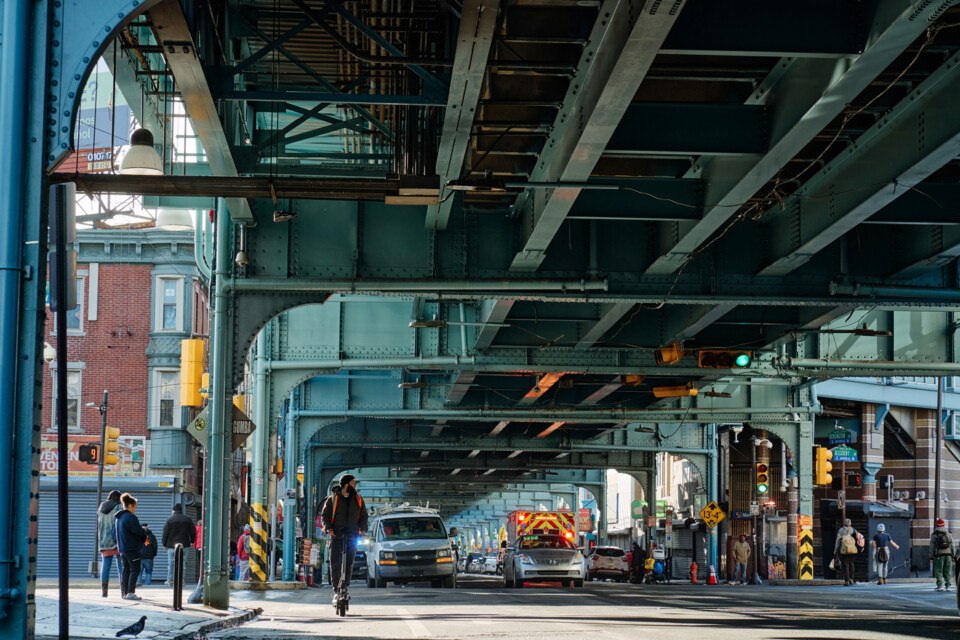
Kensington
From a real estate perspective, Kensington offers all the same fundamental opportunities as Fishtown: easy access to and from Center City, as well as New Jersey, New York City, and Washington, D.C., plus an abundance of post-industrial properties ready for a second life. But while investment in Kensington has been slowed by its status as an epicenter of the opioid crisis, Fishtown has been redeveloped and rebranded beyond recognition over the past decade. (In 2018, Forbes dubbed it “America’s hottest new neighborhood.”) Once fairly barren and struggling, it’s become a vibrant center of urban life unlike any other in Philadelphia. But the change has come at a cost: The median sale price for a home has soared past $400,000, quashing any hope for a family making the city’s median income — which is just under $61,000 — to own a home there and thrive. Meanwhile, commercial properties are focused on what Abizadeh-Barbour derisively refers to as the “highest, best use” — the business that will bring in the most money to pay the highest rent, no matter who or what it serves. “There are no capital gains in a garden,” she says.
Meanwhile, the shift she worries about (the Olneyville shift, essentially) has already begun in Kensington. More than half of single-family homes bought from 2020 to 2022 were purchased by corporate entities; out-of-town investors are buying up property and waiting for the turn.
“People who really made this their home, their community, don’t get to reap the benefits of positive change in any way,” Velez says. “How is that fair? How is that equitable?”
KCT aims to offer an alternative. Development and displacement don’t have to go hand in hand, it argues. Reinvestment can be accompanied by community equity, in the sense of both finances and fairness. At a moment when capitalism seems like an unstoppable force, perhaps a neighborhood can assert itself as an immovable object.
And just imagine: All of that high-minded socioeconomic experimentation happening here, in real time, in a tiny corner of Kensington.
With the initial $350,000 loans, KCT first bought two properties on the 3200 block of the avenue, where it planted the seeds for the community garden. In time, it added nine surrounding parcels, expanding the garden into a burgeoning social hub that occupies most of the block. The trust plans to create what it calls the (El)evated Stoop along the southern half of the garden — a series of broad steps leading to a raised basketball court that will offer ground-level shade in summer and become a gathering and event space. Burton, a member of both the board and the stewardship committee, plans to host skate days on the court.
Across 20 other properties, some of which are being actively redeveloped, KCT serves as landlord for commercial tenants including a hair-braiding studio, a candlemaker, a food pantry, a tax office, a church, a Mural Arts outpost, and an after-school cooking program. All pay rent that’s 75 percent or less of the market rate — a discount made possible because investor funding and low-interest loans mean the trust doesn’t rely on rent to stay afloat. And all were vetted by members of the stewardship committee, which rejects extractive businesses like pawn shops and cash-for-gold operations. Both board and committee members are paid twice the living wage, or $46.52 an hour for 2025.
The corridor will get its first grocery store this year when Kensington Food Company opens up shop near Tioga Street, offering fresh produce, meat, and fish as well as imported products. A shared commercial kitchen above the grocery will give local entrepreneurs a low-stakes way to launch food companies. In October, the building was in the process of a remodel at the expense of KCT, which works to keep its dollars in the neighborhood, hiring contractors and designers rooted in the 19134 zip code whenever possible (and within Philly when not).
The neighbors aren’t the problem. They’re the solution.” — Joseph Margulies, Cornell University
Thomas Sheridan, who owns the grocery, has been dreaming about the corridor’s revitalization since he was a teenager. A Kensington native who also sits on the stewardship committee, he reminisces about a youth spent walking the avenue with his grandfather. The neighborhood trust “is a point of pride for Kensington and a point of pride for Philadelphia,” he says.
That feeling of renewal is “a precious thing,” Margulies says. It’s also a reflection of the core belief that animated the creation of the neighborhood trust.
“The neighbors aren’t the problem. They’re the solution,” Margulies says. “What they need is a stable price structure and control of the space so they can make the changes they know need to be done.”
In addition to its commercial tenants, KCT owns 26 residential units and has dozens more in various stages of construction. The apartments are priced to be affordable for those making between 25 and 50 percent of area median income, or between $29,850 and $59,700 for a family of four. Studios rent for as little as $500 a month; three-bedrooms max out at $1,500. And the trust is working to move even deeper into affordability for residents with less money at their disposal. It recently supported its first tenants in becoming homeowners, contributing a portion of the family’s rent toward the down payment on an unaffiliated house, Abizadeh-Barbour says.
Between its commercial and residential properties, the trust is working toward realizing the neighborhood’s own vision: locally run businesses that meet residents’ needs and affordable housing that allows them to stay right here to appreciate it all.
To date, KCT has operated with negligible government funding — a good thing in a moment when government funding around the city is drying up. It used $10,000 from the USDA by way of Philabundance (because Kensington suffers from a “food apartheid,” as Abizadeh-Barbour says); state Representative Jose Giral’s office contributed $5,000 in recent weeks to support the mission. A pending application for $1.5 million in funding from the state Redevelopment Assistance Capital Program would help turn a former hardware store into 11 residential units and two ground-floor retail spaces and would represent a significant shift in funding. One big secret to the affordability of its properties, sources explain, is that the trust accepts only unsecured debt with interest rates between zero and two percent. It also relies on interest-only deferred payments while it redevelops properties, easing upfront costs.
As the trust grows, so does rental revenue, which accounts for roughly one-fifth (and rising) of its operating costs. Abizadeh- Barbour expects it can be self-sustainable once it has about 60 assets, although further acquisition and redevelopment will likely always require more patient, low-interest capital. (For a model of that, look no further than Shift Capital, based right up the block from KCT.)
The result is steady, measured progress toward the goal of building generational wealth and power in a community that, until recently, has had very little of either.
To that end, the trust is planning to give 19134 residents the opportunity to profit financially from the success of their own neighborhood, using a model first tested in Atlanta by the Guild, a cooperative focused on community self-determination. There, residents can invest as little as $10 a month in a trust that buys properties and returns surplus rental income to investors. In Kensington, the trust will add community investments to the capital it uses to purchase more properties and expand its presence on the avenue. Abizadeh-Barbour expects investors to receive dividends between four and seven percent.
Meanwhile, KCT is confident enough in its own progress to help foment change elsewhere. The trust is replicating its own model for the first time, helping Trenton-based architect and designer April De Simone in establishing a trust to promote long-term affordability in her community. Its first asset is a six-bedroom Victorian she and her husband are rehabbing with an eye on shared-equity housing. Revenue earned from assisting other developing trusts will strengthen KCT’s financial standing.
The growth of the neighborhood trust — in Kensington and beyond — gives Velez hope that it can be a tool for building generational security. “Seeing that replicated across communities?” she says. “That would be fire.”
But for all its effort to protect Kensington from reckless development, the trust can’t ignore the realities of the market. It’s taken nearly $20 million in capital for it to reach this point, Abizadeh-Barbour says. Truly preventing what’s happened in Olneyville (or Fishtown) might take hundreds of millions more, particularly given that KCT’s success might eventually imperil its own model, as Margulies suggests.
“At some point, it will operate like a siren that summons capital, and then there’s going to be a contest,” he says. “It will only work if there’s support from the city to say, ‘We’re not going to undo what KCT has done. In fact, we’re going to double down on it and encourage it.’”
Councilmember Quetcy Lozada, whose Seventh District includes KCT’s area of operation, agrees that the resident-driven approach to development sets it apart from other community-based organizations across the city. The model should expand beyond Kensington, she says: “Philadelphia is a city of neighborhoods, and who better to protect and preserve that neighborhood than those who are living in it, working in it, and playing in it?” Councilmember Mark Squilla, another member of the Kensington caucus, admires the trust’s progress: “How could you be against the concept?” he says.
But City Council has yet to make the type of policy changes that could promote KCT’s mission. Alongside the Philadelphia Coalition for Affordable Communities, the trust has advocated for legislation that would allow direct disposition of the city Land Bank’s estimated 40,000 properties — including many in Kensington — to perpetually holding entities, which would allow the city to convey some of its vacant and tax-delinquent land to the trust and speed its transformation of the corridor. But since passing for the Third and Fourth districts, the bill has yet to be reintroduced. Due to the city’s onerous councilmanic prerogative, the Seventh District, where KCT is located, is still waiting.
We can’t stop gentrification. What we can do is preserve areas and pockets of affordability so that people who are legacy residents still have a place.” — Jasmin Velez
Meanwhile, the trust’s staff and board understand that there are limits to its capacity, which is part of why it operates on such a small slice of the avenue.
“We can’t stop gentrification,” Velez says. “That’s a massive phenomenon that requires a ton of capital. We’re not there. What we can do is preserve areas and pockets of affordability so that people who are legacy residents still have a place.”
With this, already, the trust has changed how it feels to be a Kensington resident, suggests Brian Tejada, who occupies one of two youth spots on the KCT stewardship committee. “It’s hopeful,” he says.
Tejada applied for the role aiming to burnish his résumé as he headed off to college, but soon realized that he had stumbled into a way to care for the neighborhood — and the people — that raised him. He knows Kensington is infamous. When he tells people at college where he’s from, he gets a familiar response: Really? I see TikToks about what it’s like to live there.
He gets it. For a long time, Tejada dreamed of leaving Kensington. He wanted to get a degree, make some money, and move his family out of this place. He thought success was only possible somewhere far away from the avenue. The neighborhood still has a long way to go, but the trust has changed his mind.
“It’s scary to admit this out loud,” Tejada says, “but I can see a future where I’m still part of the community, where I don’t pack everything and go. It’s scary in that, what if it fails, what if I have to leave with a broken heart instead of fond memories? But it’s also encouraging. Now I don’t feel like I have to find another place to call home.”
Published as “Building Blocks” in the February 2026 issue of Philadelphia magazine.