How Philly Fell for Krampus — and a Darker Kind of Christmas
From a Northern Liberties parade to Krampus photo ops, Philly’s holiday season is trading forced cheer for folklore, horns, and a little rebellion.

The Parade of Spirits in Liberty Lands Park originated as a Krampus parade. / Photography by Laura Swartz
Listen to the audio edition here:
On a cold December night in Northern Liberties, Liberty Lands Park fills with bells, drums, horns, and fur. Lanterns glow. A bonfire crackles. A Slavic choir sings. This is the Parade of Spirits, an annual winter procession that winds through the neighborhood in celebration of the darker side of seasonal folklore.
The most popular costume? Krampus, an imposing figure from Alpine winter traditions. Think of him kind of like the anti-Santa: While St. Nicholas rewards good little children, Krampus punishes the naughty ones. He’s usually depicted as a horned, demon-like creature with fur, cloven hooves, a long tongue, and chains or birch sticks, which he uses to scare or “discipline” misbehaving kids. Some carry a basket on their backs to kidnap babies. (And while he’s now linked to Christmas, there’s evidence that Krampus dates back to pre-Germanic paganism.)

Krampus at Parade of Spirits
In Europe, Krampus shows up on Krampusnacht (December 5th), when people dress up in elaborate, terrifying costumes and roam the streets in a mix of folk tradition, winter ritual, and controlled chaos. NoLibs’ Parade of Spirits, in fact, was originally called Krampuslauf when it began in 2011, modeled after the European parades. But the event has now grown into one of the city’s most distinctive and inclusive holiday gatherings.
In a season often dominated by forced cheer and commercial gloss, Philly is embracing a little darkness, a little rebellion, and a reminder that the holidays don’t have to look the same for everyone.
Philly’s Dark Christmas
“There’ll be scary ghost stories” always seemed like a random line to throw into a caroling standard, but there’s always been a little darkness to Christmas here. Anyone who’s walked through Wanamaker’s Dickens Village as a kid likely has visceral memories of the chained ghosts overhead and eerie graveyard scenes lifted from A Christmas Carol. Is it any surprise that, in a city with little patience for forced cheer, we’ve embraced the alternative?
“I’m so tired of the holly jolly sometimes, I think it’s almost too much holly jolly,” Michael Dalpe told me as we spoke at the Parade of Spirits. (He described his furry, red costume as “Cruella de Vil, but for Elmos.”) “It’s dark, it’s cold, it’s gross — let’s get the friends together and be weird.”
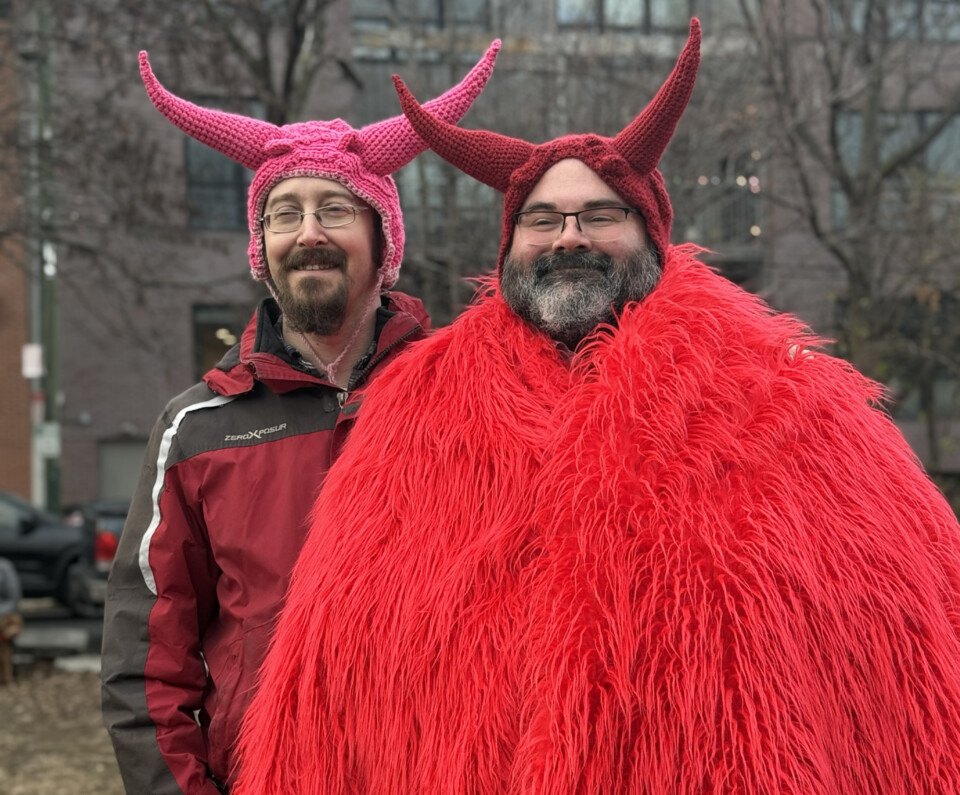
Michael Dalpe at the Parade of Spirits
Look around the city and you’ll see that the Parade of Spirits isn’t the only place to embrace the darkness. Last weekend, Manayunk’s Lincoln Mill Haunted House held “A Twisted Christmas” full of “sinister winter creatures” and scare actors at every corner. That same weekend, East Kensington Arts Committee held “Haunted Christmas” at Philadelphia Brewing Co., complete with spooky films, music, and vendors. There’s currently a pop-up Emo Christmas bar in the basement of the Divine Lorraine. And, for the first time, Fort Mifflin hosted its own Krampusnacht Festival on December 5th, the traditional night Europe celebrates the creature.
But that wasn’t the only Krampusnacht: Prism Arts held one that same night, with burlesque, art vendors, tattoos by the neighboring Houndstooth Tattoo, and of course, the man — er, beast — himself.
Cleary, Krampus held the key to this fascinating spiral into holiday darkness. So, I went out searching for them. And they had an Instagram account.
Enter Philly Krampus

Philly Krampus at the Parade of Spirits
Few people are more closely associated with Krampus’s rise in Philadelphia than Brandon Monahan, better known as Philly Krampus. Their @phillykrampus page shows a full schedule of appearances, which this year have ranged from metal bar Doom to bookstores to Conshy’s witchy shop Thirteen Circles to a dog bakery.
But Monahan didn’t set out to become a recognizable holiday figure. A few years ago, they were helping run punk shows and community events at Noble Earth, a tea lounge in Bristol, when the idea of a Krampus-themed fundraiser came up. When the original performer canceled shortly before the event, Monahan stepped in and built a costume with pieces from ScarePros in Levitttown.
“The original suit, I was wearing a sweater,” Monahan says. “It wasn’t even a gorilla suit yet.”
Over time, the costume became more elaborate, growing into the recognizable Philly Krampus we see today — complete with Austrian-made bells, basket, and horsehair whip. Monahan hopes to make it even more authentic going forward, commissioning a hand-carved wooden mask in the future.
When the pandemic shut everything down, the costume became a way to bring some levity into an otherwise bleak moment. Philly Krampus began making surprise appearances at friends’ tattoo shops, coffee shops, and small businesses. “It was kind of my way to cheer people up during COVID, because everything sucked,” Monahan says.
From there, the character spread quickly — first through word of mouth, then through Instagram. Businesses began requesting appearances, and Philly Krampus started doing low-cost photo ops, donating tips to charity.
View this post on Instagram
Over the past several years, they’ve raised thousands of dollars, including more than $2,000 this season alone for the Satanic Temple’s abortion fund and reproductive health clinics. While the name may shock people, Monahan describes the Satanic Temple as an organization focused on bodily autonomy, church-state separation, and civil liberties. “If you look more into them, they are more of a political movement than anything,” they explain. “So, it’s like a punk-rock ACLU?” I ask. Monahan approves.
That political edge, they argue, is part of what makes Krampus feel newly relevant. “One of the biggest things about Krampus is that Krampus is anti-fascist,” says Monahan. Historically, Krampus traditions in Alpine regions were suppressed around World War II, when the Nazis attempted to eliminate folk customs and reshape Christmas in their image. “So much of it was destroyed. The tradition was almost killed,” Monahan explains. Reclaiming the figure now feels pointed. “With the way the government is going right now, I absolutely love to be an anti-fascist Krampus,” they say. “It’s nice to be a little rebellious devil.”
The response from the public has been overwhelmingly positive. Philly Krampus appears at places they describe as being “run by weirdos of some sort,” in the best way: “For the most part, everyone has loved it or been very chill about it.” Concerns about frightening children, a common critique, haven’t borne out. In some cases, kids warm up over time — high-fives first, photos later. And if a kid is too scared? “I’ll call it and be like, we’re not taking a photo, sorry.” As for the December 5th Krampusnacht event they helped start this year, Monahan hopes to make it an annual thing.
Part of the appeal, Monahan believes, is that alternative culture has moved from the margins to the mainstream. “Growing up, I was bullied for dressing the way that I do, and people hated on the emo kids and the goth kids. And I think that somewhere along the lines, whether it’s through music or horror movies or whatever, it just became trendy.” (They also point to the 2015 horror movie Krampus as popularizing the character in America, but warn that it is not an accurate depiction of the lore.)
A Krampus for the Rest of Us

Seph Gorgar paired a Mummers outfit with Krampus for the Parade of Spirits.
At the Parade of Spirits, that symbolism feels less theoretical. Krampus isn’t an outlier there — he’s one figure among many finding community and joy. “It’s cool to see everyone putting in their own element to being Krampus,” says Monahan, who attends every year.
The event invites reinterpretation, and costumes range from historically inspired Alpine designs to playful Philly hybrids: one Krampus I met there, Seph Gorgar, paired the iconography with a Mummers outfit. He’s been coming to the event for more than a decade, he tells me, but has seen it grow and the costumes become more widespread and elaborate. What’s changed, Gorgar believes, is exposure — and curiosity. “In America, they just focus in on Santa Claus, and they stole St. Nick,” he says, but now people are discovering “all these other crazy characters.”
Michael O’Hara, a Krampus improvised with a red necktie for a tongue, agrees: “It’s like an extra Halloween. And I think that’s the appeal…these sort of older traditions, people were kind of like why not?”

Michael O’Hara’s improvised Krampus at the Parade of Spirits
And as for his darker overtones? Dalpe, my new furry Elmo-monster friend, explains, “We want something to root against … In a world where there are so many real-life horrors, there’s something, I think, almost comforting about a children’s story that can be overcome.”
The Parade of Spirits embodies that shift. It’s communal rather than consumer-driven, rooted in folklore rather than branding, and open to interpretation rather than strict tradition. In that context, Krampus isn’t just a devilish counterpoint to Santa — he’s part of a larger movement toward reclaiming the darker, stranger edges of winter celebrations.
As Philly Krampus put it, watching the crowd of costumed figures gather there each year, “I’m happy that people are down to be fucking weird.”
Want to catch Philly Krampus before the season ends? He’ll be at Laine’s Gluten-Free Bakery in Berwyn on Saturday, December 20th from 10 a.m. till 2 p.m., and at Doom Bar on Sunday, December 21st from 5 to 9 p.m.