Politics, AI, and Stress: Why Teaching in Philly Has Never Been Harder
Political tension, pandemic learning loss, cell phones everywhere, and the AI takeover of everything. All that before the morning bell even rings. Welcome to teaching in 2025.
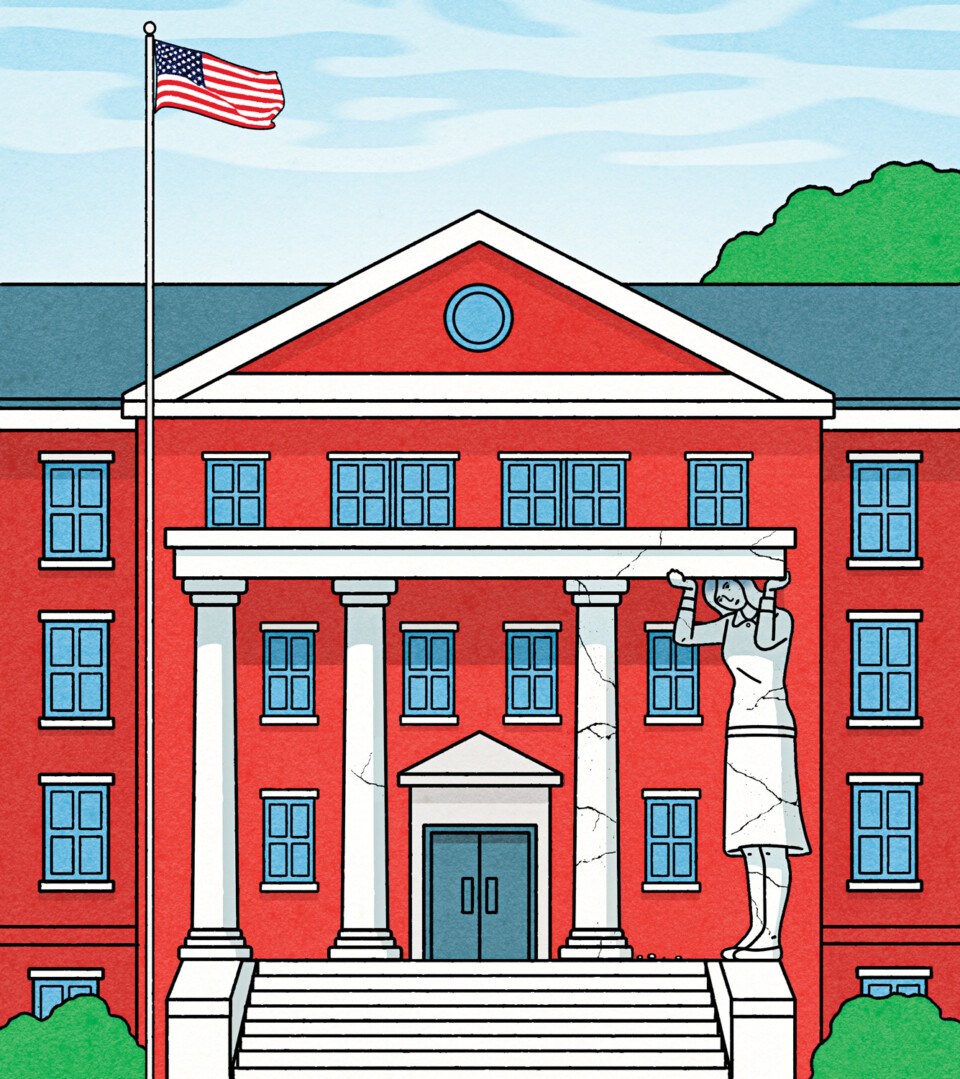
From student anxiety to cell phones and culture wars, Philly teachers say the job has never been more challenging. / Illustrations by Dan Page
There was a moment in 2020, in the midst of COVID — that dark year when so many schools were closed and so many parents were grappling with what remote education looked and felt like — that society’s appreciation for teachers seemed to reach new heights. This felt true anecdotally in Philly, where parents were chalking sidewalks and hanging posters to thank and support their teachers; it also played out in the data. One survey from the educational STEAM brand Osmo reported that some 80 percent of parents polled said they had a newfound respect for teachers.
And why not? Hadn’t we all just witnessed firsthand how much work beyond lesson planning and lecturing went into educating and nurturing our children? Hadn’t we seen professionals whose work, energy levels, talents, and psyches had been pushed to the limits by school closures and remote teaching, and who still just kept showing up? Wouldn’t we do anything to thank and support them for not letting our kids’ lives come to a complete standstill? In fact, if there was a silver lining to the educational and societal nightmare that was the COVID era, one economist from the Economic Policy Institute reasoned at the time, maybe it would be an “opportunity to bridge the gap between the strong appreciation, in theory, and the challenging working conditions for teachers, in practice.”
This wasn’t exactly what happened next.
When teachers returned to their classrooms full time, the desks and the whiteboards might have looked the same as they did before life and school were interrupted, but they were now teaching in a world with new and different challenging working conditions — a world that was more anxious, more political, more online. To hear them tell it, their students needed more from them now — not just as educators, but as counselors. Parents felt newly empowered to question what went on in the classroom and, sometimes, to raise hell if they didn’t approve. Administrators tasked with restoring normalcy in an era of abnormality also felt the pressure, which sometimes trickled down to (or was redirected at) the teachers they oversaw. Lots of educators left: Between 2018 and 2022, attrition rates in Philly reached alarming levels, nearly doubling in district and charter schools. (In 2022, 13 percent of district teachers quit their jobs and 23 percent of charter teachers did; the majority of those who quit left the profession entirely.)
Now, at the start of a fresh school year, the pandemic may be in the past, but its reverberations have lasted, and many of the cracks it exposed have gotten bigger. New challenges have shown up too — many of which are issues the whole country grapples with. But educators have to deal with these things — political polarization and culture wars, encroaching artificial intelligence and its unknowns, the threat of violence, and a sense of a destabilized society, to name just a few — every day in the course of doing their jobs. “In Philadelphia, in particular, teachers have been called upon to correct all of society’s ills,” says Matthew Mandel, an English teacher at Baldi Middle School in the Northeast, who was among this year’s recipients of the district’s Lindback Award for Distinguished Teaching.
By all measurable metrics, it would seem that the teachers are quite tired. That they are overwhelmed.
In 2008, nearly two-thirds of teachers across the country reported in a MetLife survey that they were very satisfied with their work; today, Pew shows that the number has fallen to one-third. More than half of current teachers polled say they wouldn’t advise a young person to enter the profession — and it seems like would-be future teachers are hearing that. In November of 2023, the Annenberg Institute for School Reform reported that interest in the teaching profession among high school seniors and college freshmen had dropped 50 percent since the 1990s and 38 percent since 2010, reaching the lowest level in the past 50 years. Here in Pennsylvania, between the 2010-’11 and 2023-’24 school years, the number of state-issued teaching certificates dropped 60 percent. It’s a distressing state of affairs — not just for parents, but for all of us — for anyone who believes that, to paraphrase FDR, education is the safeguard of democracy.
CLASSROOM CONFIDENTIAL
Teachers, in their own words
When I first started, they were really good about keeping class size to 20 or 21. Now, it’s 26 or 27. More students and not enough space. More kids, more desks, more problems, and less help.” — a charter middle school teacher in Philly
But the good news — and yes, there is still some good news — is that if you talk to teachers who are out there doing the work, you’ll find that many of them continue to like what they do, and still feel driven by the passion and mission that drew them in to begin with.
It is true, offers Justin Goulet, an English teacher and director of admissions at Bensalem’s Holy Ghost Preparatory School, that educating right now is as complicated as it’s ever been across his two-decade career. But, he says, he doesn’t want to do anything else. (Disclosure: Goulet is married to a contributing writer for this magazine.)
“There’s a real dichotomy between joy and stress,” says Clarice Brazas, an assistant principal and former teacher in a Philly district high school. Kids are still kids, eager to learn and rewarding to educate, she says. Teachers are trying their best to give them what they need, but they’re dealing with issues that go well beyond education — some of which they’re trained for, some of which they’re not. And that, she says, is emotionally taxing.
It’s challenging, too, offers Goulet, because the job is always changing. “It’s fluid,” he says. “As a teacher in any school, you have to be so adaptable.”
What does that adaptability look like? How is the work of teaching actually going in 2025? What do teachers think about some of the biggest challenges they face today? And how might we as a society — as parents, as administrators and district leaders, as citizens — think about helping teachers meet those challenges, to help ease the overwhelm and stem the tide of loss? To get a better sense of all of these things, we talked to public and private educators in the city and the burbs, educators from grade school through high school. We asked them about their work, their hopes, their stresses, and their challenges, and about how they’re managing to adapt in the face of so much change.
Here’s what they had to say.
On the Pressure Of Political Tension
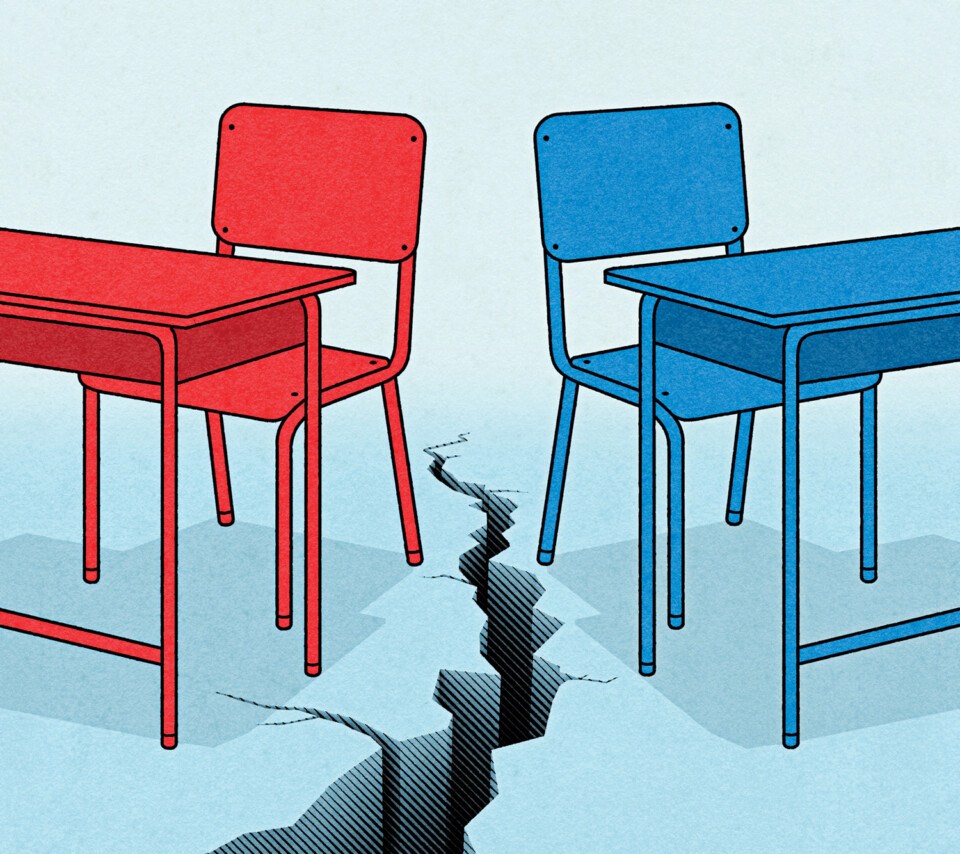
As he enters his 22nd year of teaching, one South Philly public elementary school teacher says, the steady creep of class sizes has historically been among the most significant obstacles to delivering high-quality education. (Some teachers in this story requested anonymity in order to speak freely about their experiences.) But at times this year, he’s found himself wishing his classroom could be filled to capacity. At his school, a significant portion of the student population is Latino. This spring, as the threat of raids by U.S. Immigration and Customs Enforcement loomed, this teacher found his classes strangely quiet as many parents kept their children safe at home.
“We’re living through difficult times, unprecedented times,” he says. “And the kids are collateral damage of the culture wars that are going on.”
The Trump administration’s immigration agenda has presented teachers in many communities with the task of trying to assuage and empathize with students’ fears about the risk of their families being broken up. Depressingly, the South Philly grade school teacher says, it’s also emboldened some children with a new bullying tactic. He’s witnessed elementary students threatening to call ICE on their classmates — a troubling reminder that our schools are a reflection of our society, and in 2025 that means they are hotbeds of political tension.
One second-grade teacher who’s approaching three decades at a Montgomery County public school says the incursion of politics into the classroom has gotten so bad that she’s had to stop conducting mock elections to introduce her young pupils to the democratic system. What was once a foundational lesson in American civics, she says, is now nearly unthinkable as national politics infiltrate every corner of daily life. Test-driving an election with her seven- and eight-year-olds? “You could never do that now. You don’t want to have a child start spewing what their parents say at home.”
CLASSROOM CONFIDENTIAL
Parents have changed tremendously. They seem to have a lot more control than they ever have. I don’t know if administrators are afraid of them, or just giving in.” — a public elementary school teacher in Upper Moreland Township
Amid so much political polarization, some teachers report feeling fearful that their own words will be weaponized against them by parents and outside agitators who increasingly view the classroom as the first front in the culture wars. “Moms for Liberty is among us,” says one recently retired Montco middle school social studies teacher, referring to the far-right parental-rights group whose opposition to education on issues of gender, sexuality, and race has upended libraries and discrimination enforcement in the state. She was shaken a year ago when she received a call from a father livid that LGBTQ rights had come up in a conversation around the 2024 election, she says. “It’s always lurking in the background that if I don’t play my cards right, I’ll end up on the front page of the Elmwood Gazette.”
In social studies and history classes especially, more than one teacher said to me, educators look over their shoulders during lessons on things like Black Lives Matter and Thomas Jefferson’s relationship with enslaved people, worried about accidentally stepping into hot water for teaching the facts. Their work is only complicated by a surge in legislative proposals across the country aimed at restricting what teachers can say about controversial topics including race, politics, sexual orientation, and gender identity. In Pennsylvania, a pair of Republican-backed bills put forward in 2022 aimed to prevent students’ “indoctrination” on these subjects and to prohibit classroom instruction on sexual orientation and gender identity in elementary schools. (Both failed.)
Faced with this new, highly charged reality, multiple teachers told me they weigh the risk of approaching sensitive subjects that might upset their students’ caregivers. For many, the result is a delicate balancing act: on one side, their own values and the education of their students; on the other, their livelihood and the stability of the classroom environment.
“What does it mean to have academic freedom in a classroom in 2025?” Brazas says. “What does it mean to be able to teach truth and history when it’s not what the government wants you to teach?”
Driven in large part by bitter divisions around current events (particularly the war in Gaza), some teachers say there is more attention than ever before — from administrators, parents, and politically oriented groups — on what is taught and discussed inside classrooms. In fact, the School District of Philadelphia is currently facing a federal civil rights complaint filed by three former teachers at Baldi Middle School who were suspended for allegedly disobeying the school’s neutrality policy in conversations about the war in Gaza; there’s also a federal lawsuit from a Northeast High School teacher alleging Islamophobia. (A spokesperson for the district said it does not comment on pending or active investigations.)
“It’s much harder to exercise your First Amendment right as a teacher in Philadelphia these days than it used to be,” says Kristin Luebbert, a humanities teacher who retired this year from the U School in North Philadelphia after 24 years in teaching. In a world where facts have become controversial, she says, teachers feel they are at risk of “blowback” within their schools or from central administration if they offend the wrong person. The result, she says, is a chilling effect, particularly for those early in their careers. “If I were a teacher in certain schools who did not have tenure yet, I would be very careful,” Luebbert says.
CLASSROOM CONFIDENTIAL
There’s no feeling of security that administration will have your back. And I have to train new, young colleagues every year because faculty leave to make more money elsewhere: No one can negotiate successfully for more pay.” — a private middle school teacher on the Main Line
The great shame, more than one teacher has alluded to me, is that students are far more comfortable tangling with the thorny realities of our current age than their elders are, but encouraging those critical conversations now feels dangerous.
“LGBTQ+ history and Palestine and racial justice and the state of economic inequality in our country — these are all things that I’ve found students are extremely eager to talk about,” offers one social studies teacher at a South Philadelphia public high school. “For me, it’s more so a district and administrative question: Will we be protected and encouraged to do this type of teaching?”
On Top-Down Teaching
Matthew Mandel, the Baldi Middle School English teacher, has been teaching for 32 years. In that time, he’s been asked to adapt to new curricula more times than he can remember. Every time he scraps lesson plans to adjust to his new assignment, he can sense his flow in the classroom being disrupted and his students losing something in the process. But even as the curricula have changed, test scores through the years have remained relatively stagnant, increasing in some years and decreasing in others. He and his peers often wonder, he says, whether administrators interrogate their own decisions as much as they question “the fidelity with which teachers implement them.”
His concern with the ever-shifting expectations being handed down from on high reflects a broader tension, notably in public schools, between teachers and the administrators and higher-ups who guide their work — tension that’s only risen along with questions about academic freedom.
In Philadelphia, for example, I spoke with teachers frustrated by a $25 million English curriculum rolled out last year that delivered scripts and slideshows to educators in an effort to improve reading proficiency in a district where just 34 percent of students are at grade level. To some, it seemed a desperate and costly bid to raise test scores — at the expense of teachers’ own intuition and educational aptitudes.
For the retired Montco middle school teacher, the slow drift away from classroom creativity and toward more prescriptive curricula sapped something significant from the teacher–student relationship. She taught for some 30 years, and where once she could take classes on field trips and develop her own teaching units, building interdisciplinary lesson plans to unite the various strands of a child’s education, by the time she left, she felt a loss of freedom amid the strictures of administration-supplied guidelines. “We all have to be in lockstep, and everybody has to be teaching from the same page in the textbook,” she says.
It’s a model that works for some, she admits — but it leaves others questioning the efficacy of teaching to the test, as they’re increasingly asked to do.
“The idea that if you gave all teachers the same books and the same script you’d get the same outcomes, that’s like saying if Julia Child gave me her ingredients and utensils, we’d create the same food,” Mandel says. “It’s never going to happen.”
When Philadelphia revamped its math curriculum as part of a broader $100 million overhaul that began with the 2023-’24 school year, the South Philly elementary school teacher says he quickly became familiar with pulling up a ready-made slideshow to conduct a lesson. But when he was knocked during an administrative observation for skipping some of the slides, despite the fact that they were duplicates, he couldn’t help but feel like the administration had lost its trust in teachers.
“A classroom does not work in a prescribed way,” he says. “Those sweeping changes in curriculum are one of the toughest things to deal with. The first time, it’s fine. The fourth or fifth time you’re like, ‘Again?’ You start to lose your enthusiasm.”
For its part, though, the district feels compelled to ensure that in a transient city, all students have the same rigorous curriculum should they change schools, wrote district spokesperson Monique Braxton in an email. She adds that the district aims to help teachers adjust to changes, including at more than 80 professional development sessions it hosted last spring, and encourages teachers to join Superintendent Tony Watlington Sr.’s monthly teacher advisory meetings to voice their concerns.
“We honor the hard work of our teachers and value their feedback and want them to feel seen and heard,” Braxton says.
Nearly every teacher I spoke with did note at one point or another that the right administrators within an individual school can help with this, and can ease much of the tension that exists between educators in the classrooms and decision-makers at the district. What else might ease some of this strain? Among the teachers I spoke with, several said they’d love to see administrators spend more time in the hallways and classrooms of the schools they oversee, and more time speaking with the students and educators their decisions affect most. And when they do that, offers Luebbert, it should be “with a curious bent and not with an evaluative bent.” Administrators who haven’t taught since before the pandemic might not realize just how seriously it has altered the work of education, she says.
CLASSROOM CONFIDENTIAL
There’s too much administration. You used to have your principal, but now there are so many layers. And the rules change with whatever administration or whatever new administrator comes in.” — a public (magnet) high school teacher in Philly
The South Philly elementary school teacher would like administrators to “stop seeing themselves as the experts and teachers as solely deliverers of content.” In the process, they could return to teachers some of the autonomy that helps them engage students, what he calls “the human element that actually makes the magic work.”
Teachers want to feel respected, valued, more in control of their own classrooms, Mandel says. They want to be trusted to adapt their lesson plans to the students in front of them, rather than told to scrap them altogether in pursuit of measurable results. They want to be creative and inventive in helping children learn, rather than made to memorize lines like an actor.
“In an attempt to get serious about test scores,” Mandel says, “the district decided that more oversight and more documentation and more accountability is a substitute for more support — and it’s not.”
On Overwhelmed Students, Overextended Teachers
Between 2016 and 2020, there was a nearly 30 percent spike in the diagnosis of anxiety and depression among teens, according to a study in JAMA Pediatrics. Nearly 70 percent of teens surveyed by the Pew Research Center said they feel pressure to do well in school; multiple teachers told me that even middle school students are already nervous about how their grades will affect their college future.
There’s more to it than just grades, though. Some students (particularly in the suburbs) have parents striving to position them for athletic scholarships, hiring tutors and private coaches who sap youth sports of their joy. Others (particularly in the city) find themselves shouldering the burden of supporting their families financially while trying to manage life as a student. In the background of all of this, kids everywhere are still recovering from the pandemic (which set the average student back half a grade level in math and reading — even more in poorer districts), being bombarded by social media (which, according to a study in JAMA Psychiatry, may double the risk of negative mental health outcomes), and navigating the same fraught cultural and sociopolitical moment as the rest of us.
In short, Holy Ghost’s Goulet says, “It’s an overwhelming time right now to be a kid.”
Donna Kutzer, a school counselor at William Dick, a K–8 public school in Strawberry Mansion, says in 24 years she’s never seen more students experiencing self-labeled panic attacks and anxiety than she has since COVID. The level of free-floating anxiety coursing through schools these days has teachers gravely concerned about the welfare of their students. Kutzer describes children hyperventilating in class and breaking down in the hallway. “They don’t know how to manage the different pressures in their lives,” she says.
The stats bear this out: Between 2007 and 2021, the portion of high school students reporting depressive symptoms increased from 28 percent to 42 percent. The Centers for Disease Control and Prevention reported in 2023 that some 40 percent of high school students had experienced persistent feelings of sadness and hopelessness, 29 percent had experienced poor mental health, 20 percent had seriously considered attempting suicide, and nearly 10 percent had attempted suicide — a crisis exacerbated by the pandemic. In all cases, a sense of connectedness at school reduced students’ risk.
But in many schools, the need for counselors — professionals trained to help foster that connectedness — goes unmet. The American School Counselor Association recommends a ratio of 250 students per counselor, but Pennsylvania’s median ratio was 353 to 1 as of a couple of years ago; in Philadelphia, the ratio was 650 to 1 in 2023, according to the education-focused news website Chalkbeat. Too often, Kutzer says, that means the responsibility to help children through their struggles falls on their teachers, who have developed trust with their students but aren’t certified mental health professionals — and also aren’t bound by the same confidentialities a counselor is, she notes.
“Every school needs more counselors,” she says. “And master’s-level school counselors — not anybody from an outside provider, not a social worker with a bachelor’s. We need more certified school counselors to manage all of the student need.”
CLASSROOM CONFIDENTIAL
The biggest challenge is making sure we have supplies we need because of funding. I just went to Harrisburg to advocate for funds.” — a gifted education teacher in a public K–8 school in Philly
Studies have shown a range of benefits to lower student-to-counselor ratios, including higher attendance, SAT scores, graduation rates, and college entrance rates, as well as decreases in disciplinary incidents. They also relieve some of the pressure on educators, who are struggling to balance their roles as both empathetic ears and educators responsible for students’ success. “You get caught between a rock and a hard place,” Mandel says — as when his middle school students worry that a B in writing will cost them on high school applications years down the line.
These emotional support issues are only compounded by the threat of violence, both in school and, for some, outside of it, which takes its toll, says Dan Stepenosky. Stepenosky, a Bucks County native and Villanova grad, is superintendent of California’s Las Virgenes United School District; he studied school shootings for his doctoral dissertation. Regardless of a school’s safety, he says, the threat of a shooting weighs on kids and educators. (Rightly so. As I write this piece, yet another school — this one a Catholic grade school in Minneapolis — has fallen victim to a deadly shooter. That makes at least 58 shootings at K–12 schools this year, according to Everytown for Gun Safety.)
“Students tell me they’ll pull up to school and sit in the parking lot shaking before they get out,” Stepenosky says. And for teachers who would do anything to protect their students, the ambient stress adds “an extra weight on them that you can see and feel, especially after something’s happened,” he says.
In Philly, too many teachers and administrators are also familiar with the experience of sitting with a child the day after they’ve lost someone to violence outside of school, says Brazas, the assistant principal. “That’s something most of us have had to do, and it’s not something we’re trained for,” she says. And beyond the heavy emotional burden, this aspect of the job also complicates the work teachers are trained for. “If you’re spending 20 minutes of your period consoling a child, that’s 20 minutes you weren’t doing instruction,” she says.
CLASSROOM CONFIDENTIAL
Teachers are increasingly excluded from any input on how schools are run. Most private schools have done away with staff representation on boards; administrators seek to suppress any attempts at unionizing. Many teachers feel that any input on policy based on their experience with students gets ignored.” — a private upper school teacher in Philly
On the “Ugly, Ugly” Impact of Phones
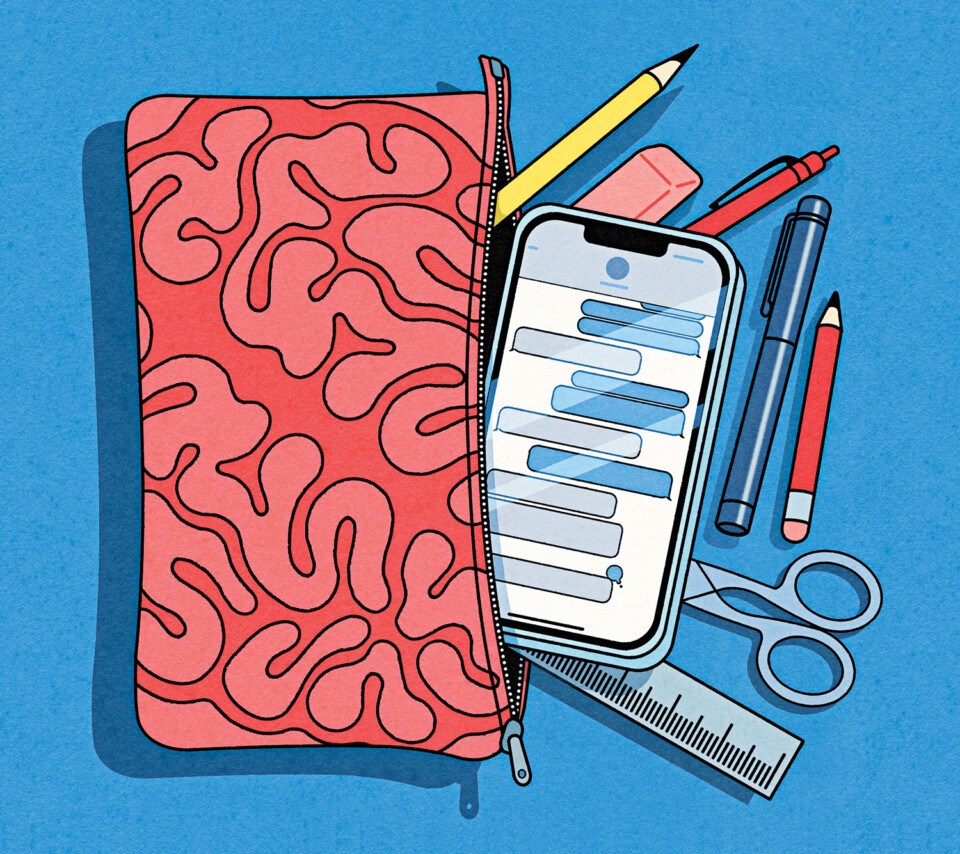
“We have kids for whom a phone is literally an appendage,” says Christopher Frank, a Lindback awardee who teaches history and economics at Northeast High School. “They really cannot stop themselves. And what it’s doing to their decision-making, their perspective of the world, their ability to balance short- and long-term gratification, their overall life choices — it’s horrible.”
Almost every teacher I spoke with said something similar. In classrooms, notifications buzz incessantly, camera snaps interrupt lessons, and music regularly plays through earbuds — enough that some teachers accede to letting students listen while they work as long as they don’t distract others. Just as concerning as the presence of the phones — more, maybe — is the social media platforms that keep kids connected to them. The average teen spends 4.8 hours a day on social media; 41 percent of the heaviest users rate their overall mental health as poor or very poor. Social media is the top reason that more than two-thirds of parents polled told Pew it’s harder to be a teen today.
In the past, students went home at the end of the school day and separated from any drama that had been stirred up, Frank says. Now, they’re plunged into an endless cycle of angst by the phones that never leave their sides.
“They’re posting things all the time — ugly, ugly stuff,” the recently retired Montco middle school teacher says. She would happily support an outright ban on phones in schools. “They’re too young to realize what is inappropriate and why it’s inappropriate. It’s like they’re living in this world that none of the adults are seeing.”
In an effort to rein in students who seem inseparable from their phones, at least 26 states have passed bans or restrictions on phones in schools. In July of 2024, the Pennsylvania Senate passed legislation that would establish a pilot program to study the impacts of a phone ban; at press time, the bill had just been introduced in the House and was awaiting a vote. But there’s still little agreement on whether this is the correct way to proceed, or what a good answer might be. Some teachers I spoke with said bans are necessary; others were opposed, including Brazas, the assistant principal, whose school is among those that use “phone hotels” — glass containers at the front of the room where students deposit their phones upon entering.
“Our job as educators is to teach kids to be part of our society,” she says, “and phones are going to be part of our society for a long time to come.” Parents, too, are divided. Many don’t want the phones taken away, fearing an emergency — school shootings included — that might necessitate a call home.
Either way, everyone is tangling with reality. At Holy Ghost, Goulet says, the problem is worst among his younger high-schoolers (as opposed to the upperclassman), who treat their phones as “a security blanket, or a crutch to lean on.” Even the second-grade teacher in Montco is troubled by how children behave in a world increasingly defined by screens. When she started teaching, she says, only one or two kids in her classroom had issues with attention. Now, only a select few don’t. “You can’t compete with a screen, no matter what you do,” she says. “I can’t even describe to you what it’s like keeping their attention. It’s a constant dog-and-pony show.”
As the South Philly public elementary school teacher says, attention spans for adults are broken too. But the problem — from a teacher’s perspective — is even more prevalent in children. “They get their entertainment in even smaller chunks than I do,” he says. “I’ll watch a 15-minute YouTube video. They’re watching 15-second TikToks.” He suggests that schools “slow the world down” for students, prioritizing longer-form projects like reading novels rather than excerpts, in order to train children to sustain their attention.
His school uses phone hotels; he feels that enforcing some separation is a worthwhile pursuit, that it can ultimately be a relief for students to break the tether to their phones, however briefly.
“They may initially push back against it, but once they don’t have their phones and they’re interfacing directly with their peers, it’s a different experience,” he says. “It’s one people have enjoyed for hundreds of years, and they still enjoy it. They don’t know that it’s missing until they have it.”
CLASSROOM CONFIDENTIAL
I’m concerned about the future as it pertains to a federal administration that’s waging an assault on education by withholding funds, censoring books, and restricting access to federal loans. I always speak to my students in a nonpartisan way, asking them, ‘Are you paying attention?’” — a public high school teacher in Abington
On “Living in An AI World”
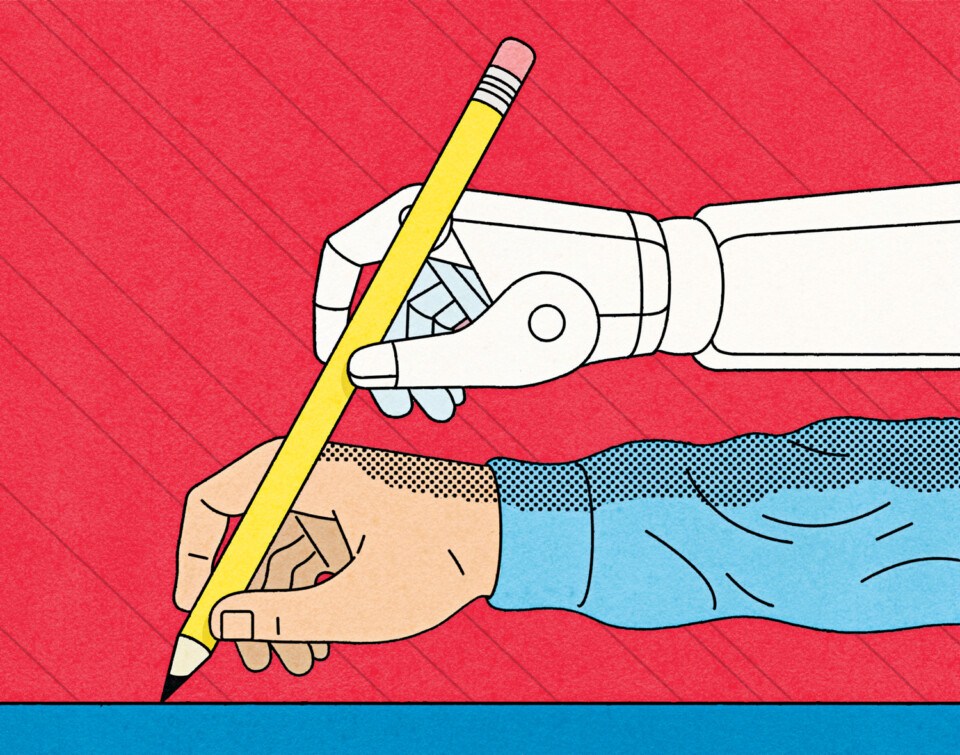
As soon as ChatGPT arrived, Goulet decided to restructure his high school English classes at Holy Ghost. Asking students to read a book and turn in an essay two weeks later was a fool’s errand now that they could ask an AI to draw one up in 30 seconds. Instead, he’d dial back his lessons and devote more class time to completing work without any artificial aid.
As time wore on, he says, he was encouraged through professional development sessions to explore AI and take risks in using it with students. After some trial and error, his lessons now include teaching students how to blend their own strengths with the power of AI. For end-of-semester research papers, he asks them to present an AI-generated draft, then identify its weaknesses and improve it with the skills they’ve gained in the classroom.
“We’re living in an AI world,” Goulet says, “and if you can navigate that you’re going to be so much ahead of everybody else.”
But for teachers vexed by the incursion of AI into the educational experience, it can feel like a constant cat-and-mouse game to keep students honorable and thoughtful in pursuit of personal improvement. In a world where an app can scan a photo of a math problem and deliver the answer, teachers have to work to make the case that the kids should resist — and it’s tricky, Mandel says: “They have a survival instinct.” The allure of AI to a student is like the steroids that beckon some athletes, he says. Except there’s something “diabolically wonderful” in the ways students wield AI — they apply initiative he wishes they would put into honest academic work.
In some classrooms, teachers tell me, their tried-and-true student assignments are giving way to creative solutions, much like Goulet describes. In others, teachers say, they’re going back to basics, ditching computers altogether and asking students for handwritten work. The social studies teacher in South Philadelphia is leaning more heavily on having the kids write letters to elected officials and draft their own policy proposals as ways to engage — and assess — his classes.
Administrators, too, are trying to navigate the arrival of AI — with mixed results. At Northeast, Frank says, he took part in a series of professional development workshops led by central administration in the past year, though he felt the guidance didn’t match the way students are deploying the technology. “They’re replacing the skills we want to focus on and build and develop,” he says, such as writing a thesis or framing out an essay. He remains skeptical.
“Is this going to be reading all over again, where for a decade you tell us, ‘This is going to be the best, this is what you need to do,’ and then when somebody looks under the surface the results show the opposite?” Frank asks.
For the South Philly grade school teacher, there are plenty of reasons to be wary of AI, but none of them is going to make it obsolete. “As teachers, we’d be better served teaching kids how to use it responsibly,” he says.
The trick, he adds, is figuring out how. And well … you can just add that to the list of challenges teachers — and the whole world — are facing right now. In most cases, we know, there are no easy answers in sight. But despite the pressure, teachers I spoke with said they want to keep showing up, looking to make a difference, because maybe more than anyone, they understand the stakes.
“At the end of the day,” Goulet says, “you can impact young people and try to empower these students to go out and change their own little worlds going forward.”
And, Frank says, the work is all about the students. This hasn’t changed over the years. The students are all the reminder he needs for why he loves what he does. A much-needed reminder, sometimes.
“Our young people really are wonderful. They’re tremendous,” Frank says. “Yes, they’re problematic. Yes, they’re difficult. Yes, they can make you want to tear your hair out. But they really are amazing to work with.”
Published as “Pressure Points” in the October 2025 issue of Philadelphia magazine.