Chad Williams and the Neverending Quest for Excellence
The chef of Friday Saturday Sunday finds his purpose in the pursuit of perfection.
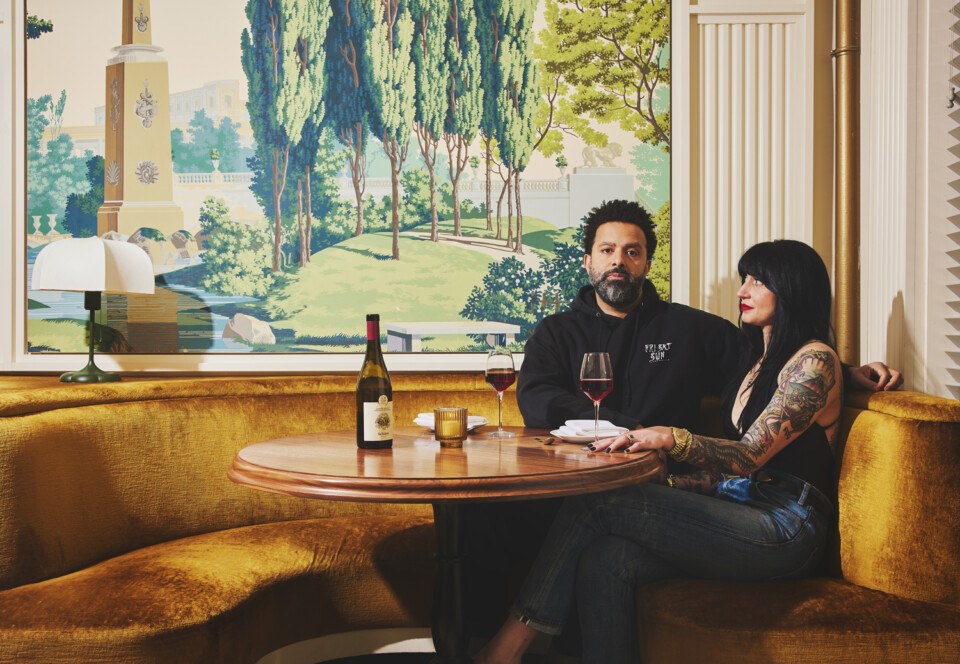
Chef Chad Williams and his wife and business partner, Hanna, at Friday Saturday Sunday / Photograph by Justin Tsucalas
“You’ll need to use your imagination,” says chef Chad Williams.
I follow him into two empty buildings that sit right next to Friday Saturday Sunday, the restaurant he and his wife, Hanna, have owned and operated for just over a decade. As he steps over a pile of mail left in the doorway, he explains how the buildings will play a starring role in expanding the couple’s dreams for the restaurant, which was packed long before they earned a star in November from the revered Michelin Guide. Within just 3,000 cramped square feet, they do about 200 covers a night.
“We want our shot at a grand Philadelphia restaurant,” Williams says, invoking names like Le Bec-Fin and Vetri while gliding over a scuffed-up floor. “It’s what we’ve always wanted.” The first building, a former artist’s studio, bears a quirky resemblance to the hull of a ship: wooden floors, nautical metalwork, and swells of sunlight cascading from tall windows. The second, adjacent building, which previously belonged to an anthropologist who died last year, came with a heap of artifacts — filing cabinets, a mattress, an urn full of pennies. If zoning permits come through, the couple will blow out the walls before installing a show kitchen, an herb garden on the roof, and a series of opulent dining rooms.
The concept for this long-awaited follow-up act to Friday Saturday Sunday is something that doesn’t currently exist in Philly, a movable feast of sorts: Williams wants diners to transition from room to room in the newly expanded restaurant, progressing through a meal as if in a loved one’s home. “You know, at my grandma’s house, you would have a drink outside, go eat in the kitchen, then go to the living room where somebody’s playing music. There were natural stages to an evening,” he explains. In contrast, “a restaurant is kind of artificial. You just sit down, eat your food, get a dessert, and leave.”
This project isn’t the Williamses’ first fixer-upper. About 12 years ago they were in a similar position, only less well-known and way more skeptical that doing a massive rehab would work out. After years of toiling in Philly kitchens (and before that, at Eleven Madison Park in New York, Guy Savoy in Paris, and Manresa in Northern California), Williams was eager for an opportunity to go out on his own. That’s when Hanna, his girlfriend at the time, raised the possibility of taking over an existing brand rather than starting a new one from scratch. Friday Saturday Sunday, near Rittenhouse Square, she had learned, was up for sale.
While the restaurant had been in continuous operation since its founding in 1973, it had seen better days. “I thought it looked like a dumpster,” Williams recalls of his first tour of the place. “It was this important restaurant, but nobody had put money into it for years.”
He thought they should pass, but Hanna convinced him otherwise. Out went the second-floor fish tank and in came an elegant marble bar downstairs. No more mushroom soup; instead, lobster bucatini. After they gutted the place and overhauled its menu, Friday Saturday Sunday was truly theirs. In October 2016, a few days before opening, they put a ring on the deal by getting married on-site, in the kitchen, in a small ceremony officiated by their general contractor.
Their success since then speaks for itself: the Michelin star, the James Beard Award for Outstanding Restaurant in 2023, a steadfast place in this magazine’s rankings of the region’s 50 best restaurants. Not only have the Williamses pushed the city’s culinary scene to new heights, they’ve done it in a quintessentially Philly way — by paying homage to history and nostalgia while breathing new life into a place.
In fact, if there’s anyone with nothing left to prove, it’s Williams, who at 45 is a bona fide national culinary star — a status he has attained as a Black man in a fine-dining world that’s typically as white as the chefs’ coats. Instead, he acts as if he’s just getting started. In addition to the expansion — part of his new pursuit of a second Michelin star — Williams is spearheading a hospitality collective that will support Black professionals in Philly for years to come.
Basically, Williams is adding another level to his (already lofty) game.
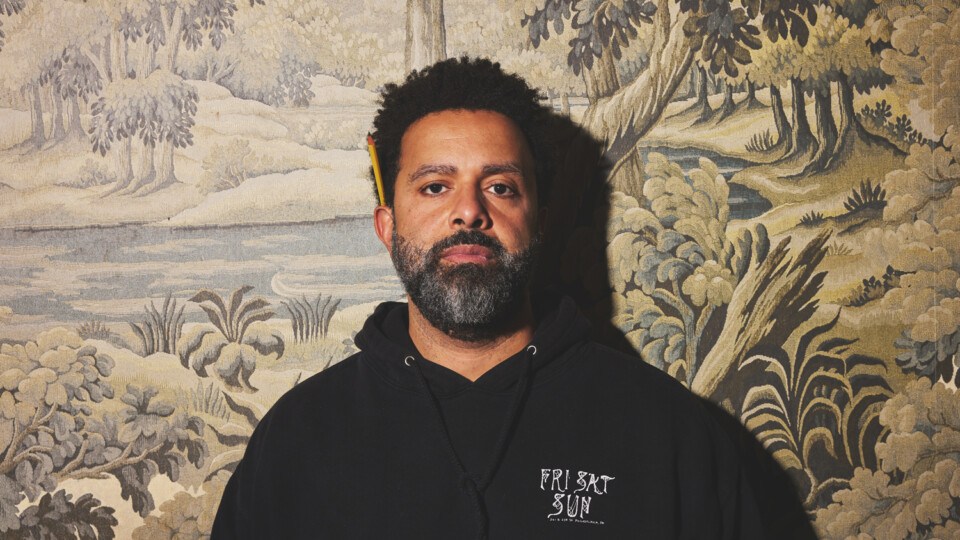
Chad Williams / Photograph by Justin Tsucalas
When we meet for lunch at Oyster House in Center City, he’s wearing a black Eagles jacket and fluorescent orange sneakers. Despite the salt-and-pepper in his beard and his ordering of “the old-man clams,” Williams brings a youthful intensity to each of our conversations — this one being no exception. He quickly rattles off a diverse list of talking points, tapping the wellspring of a busy mind — everything from defunct apps (RIP Evernote) to the writing of Ta-Nehisi Coates (they both attended Howard University in the 1990s) to the hidden lessons of failure. But the theme that consistently emerges from multiple conversations is his yearning for a permanent legacy with his food, which he considers art. “When I think about different art forms, I see cooking as one of the toughest, because you’ve got to do it every day,” Williams says. “If little things go wrong, now it’s a bad day, and now you’re a bad restaurant.”
While his art is increasingly drawing praise from critics and international judges, Williams has long been admired by his peers. “There are so many little Easter eggs and little details, tiny gestures that Friday Saturday Sunday does that I’ve really tried to emulate,” says Omar Tate, co-owner of the Afrocentric Honeysuckle on North Broad Street, whose menu reclaims Black food traditions. “There’s just so much convergence of craft and invention and art and practicality in it.”
Marc Vetri, the dean of Philly fine dining, has known Williams for about 20 years. Each mouthful of his food, Vetri says, tells a story that transcends any one culture or tradition. “All of his life experiences, everything that led up to Friday Saturday Sunday makes it what it is,” says Vetri. “That’s why his food is so, so original.”
Had Williams branched out more quickly, he’d never have had the chance to buy the adjacent properties — which hit the market within a few months of each other — and create something “even more special than what he has,” says Vetri. “I always say that your first restaurant is like your business card, a marketing tool. It’s what you do after that which is most important.”
While a Michelin star is pretty good, Vetri adds: “Chad’s just getting started.”
But how do you build something lasting in an art form designed to vanish — course by course, plate by plate, night after night? This is the tension that animates Williams now, the theme of the next chapter of his career: the search for artistic and creative meaning on the other side of massive recognition.
In 2023, in an interview on CBS Saturday Morning after the James Beard Foundation had named his restaurant the best in the country, Williams was asked about the role his family had played in inspiring his love of cooking. His answer? None at all — because his mom never cooked.
“I want to set the record straight in this article,” Barbara Williams tells me with a smile. (Pro tip, Chad: Always credit your mom with your success.) “We ate together every night. Maybe it was regular food, but you got lots of interesting conversations.”
Chad Williams grew up in the Wynnefield section of West Philly in the same house his mother lives in today. (His dad died in 2020.) Both of his parents were politically active. They met in 1971 while knocking on doors for mayoral candidate Hardy Williams (father of current state senator Anthony Williams, but no relation to Chad’s family), who would narrowly lose to infamous former police commissioner Frank Rizzo in the primary. When Hardy Williams got elected to the Pennsylvania Senate in the early ’80s, Chad’s father, Bill, served as his chief of staff — before abandoning politics altogether.
“He thought a politician could change the world,” says Barbara of her late husband. “I think he got disinterested, because he thought more could be done.”
While their political idealism ebbed, their sense of shared purpose did not. Chad’s mother worked as a public school teacher, and then later as a consultant for school districts around the region; his father became a school principal. To balance those demands while raising Chad and his brother, his parents leaned on extended family for pinch-hit parenting help.
Nobody had a greater impact on Williams than his maternal grandmother, though. “Chad is as much my mother’s doing as mine or my husband’s,” Barbara says.
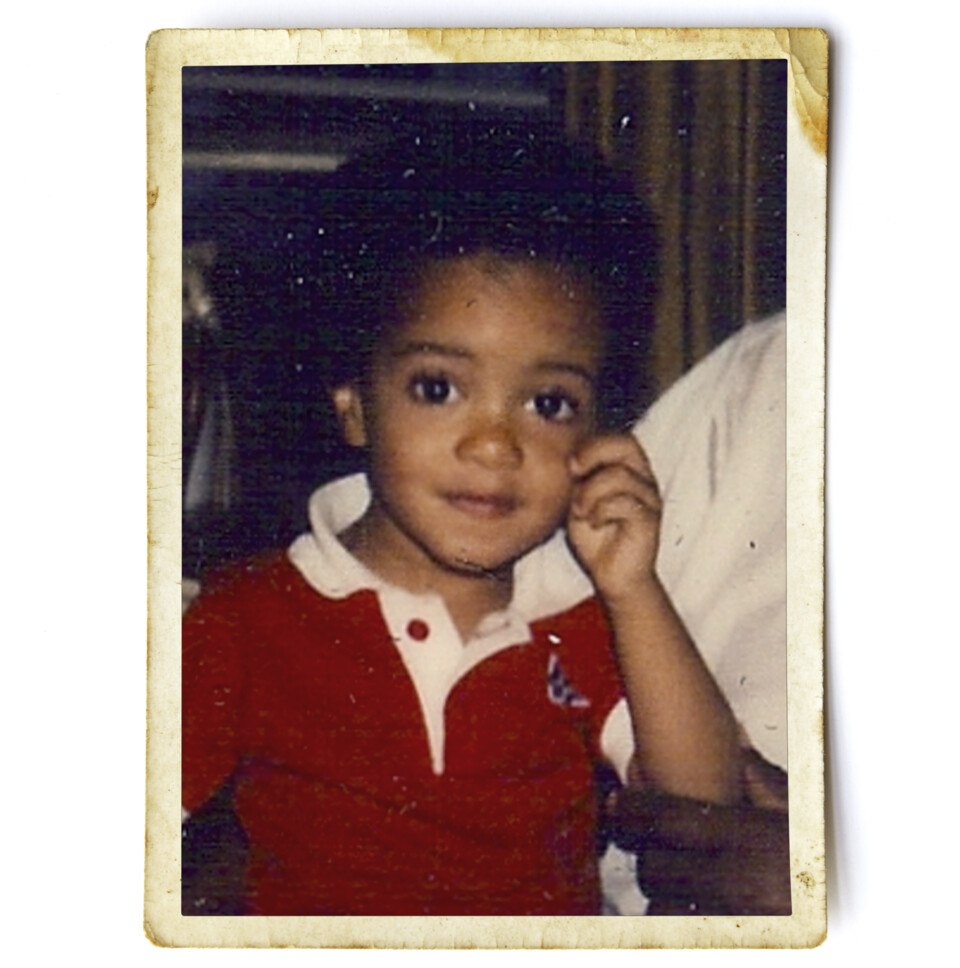
Chad Williams as a toddler / Photograph courtesy of Barbara Williams
Every Sunday, his grandmother opened the doors of her home at 57th and Girard to family, friends, and neighbors. No matter how busy she was or how unsafe the neighborhood became — she was robbed several times — there was a seat at the table for whoever needed it. “The cost of locking that door was unacceptable,” says Chad. “It didn’t matter if you were a family member or somebody she’d known for only two weeks; everybody received that same level of attention. At the restaurant now, we try to achieve that, even though we fall short. That’s the standard. She was the standard.”
It would take years for Williams to catch the fine-dining bug, however. In fact, the more you get to know him, the less he seems like an obvious fit for the profession he wound up choosing. His extended family had artisans and intellectuals — including a grandfather who founded the city’s first Black photography club — who showed all sorts of paths for a dreamer. But a job waiting tables intervened.
After graduating from Central High School, where he excelled, Williams entered Howard University and promptly embraced the intellectual freedom of that community — perhaps a little too much for his mother’s liking. He switched majors from engineering to anthropology, which led him to reject certain orthodoxies, especially about cuisines. In the classroom, he interrogated misconceptions about where food comes from — how, for example, we think about tomatoes as a bedrock of Italian cooking, even though they came from the New World, or how there’s no indigenous rice in Mexico. On a whim between his junior and senior years, he began waiting tables at Rocky’s, an Afro-Caribbean restaurant in D.C. whose menu featured an eclectic medley of cuisines, including dishes like confit duck risotto, coq au vin, and gumbo. (Williams can still taste the lamb loin cooked medium rare with mango puree, he says — a meal that inspired him to shift from waiting tables to exploring the kitchen in the back of the house.)
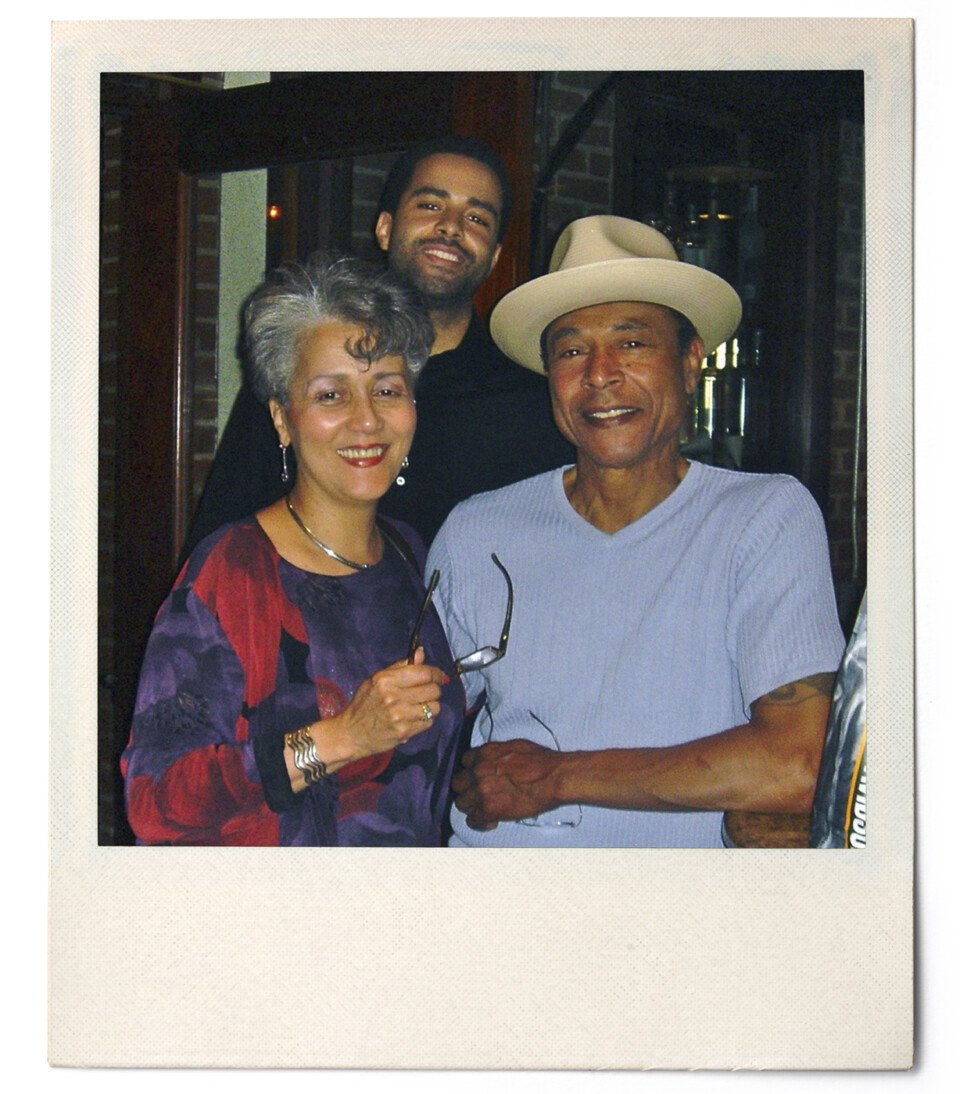
Chad Williams with his parents, Barbara and Bill, in 2005. / Photograph courtesy of Barbara Williams
If his grandma taught him lessons in hospitality, then Paul Pelt, the chef and co-owner of Rocky’s, was a role model for culinary ingenuity. Although Rocky’s would close after a few years, Pelt inspired Williams to believe that there was agency, expression, and storytelling in what you cook. “Without him I wouldn’t be a chef,” says Williams. “He was a pioneer and has received virtually no recognition.”
At that exact same time, iconoclasts were in vogue within the culinary world. The era was defined by Spanish chef Ferran Adrià, who’d turned El Bulli, a restaurant off the beaten path, into an avant-garde beacon of modernist cuisine. A pioneer in molecular gastronomy and other new methods, Adrià broke loose of the confines of classical European cuisine. For a generation of chefs around the world, that’s what makes Adrià “the GOAT,” as Williams puts it.
Another paradigm-shifting spot that rose to prominence during Williams’s foray into the industry was Noma, the Copenhagen-based restaurant that is still considered among the very best in the world. Noma chef René Redzepi, the shining star of Nordic cuisine, has a Muslim father from Albania.
Williams took inspiration from the fact that both chefs had to venture beyond their immediate cultures to create truly original art. Cultural ownership over any ingredient or dish, he began to feel, was a little too far-fetched.
“I felt like I could do whatever I wanted,” he says. “There was no idea that I just had to do French or I just had to do Spanish. I saw cooking as an art form — a creative license to do whatever you want.”
He dropped out of Howard a few months later to work full time at Rocky’s, horrifying his educator mother, who began calling his boss on a regular basis to try to persuade him to fire her son. When that didn’t work, she told Williams directly: “You’ll be flipping pancakes for the rest of your life.”
She laughs about it now, clearly happy with how things turned out at Friday Saturday Sunday. “I go down there a couple times a month, and I sit in my ‘mother’s seat’ at the bar, and everybody treats me like a queen,” she says.
In those early post-Howard years, though, very little about high-end cooking came naturally to Williams. To train his palate, he set up blind tastings for himself centered around a single ingredient — studying all the varieties of, say, green tea — before moving on to the next. And to prove his industry mettle, he staged in Michelin-starred restaurants in Spatin and France, then later worked in California and New York, experiences that were equal parts lonely and exhilarating. “The racism was pretty intense,” says Williams. “No mentorship to speak of. There were maybe two other Black cooks I saw in the entirety of that time.”
If there was ever going to be a place that felt familiar, a place where he could work toward a more inclusive fine-dining culture, it was always going to be Philly. When he returned to the city in his mid-20s, he linked up with Jose Garces and became instrumental in expanding the chef’s reach, working alongside Garces at Stephen Starr’s El Vez and Alma de Cuba before helping Garces launch the award-winning Amada in 2006. One year later, as Amada’s chef de cuisine, he met a server named Hanna who made the best cappuccinos. And life changed again.
A mix of pride and terror came over Williams recently when he looked at a piece of artwork his daughter, Ruby, 5, had made. In her kindergarten class, she drew a kitchen with a Japanese grill, including true-to-life like oversized burners. “She’s a full-on restaurant baby,” says Williams.
Ruby’s mom can relate. “I was born into restaurants,” says Hanna Williams, whose father was a chef and whose mother was a bartender and waitress. “History repeats itself.”
In the mid-1970s, a dining revolution took place in Philly. More than anything, the famed restaurants of that moment were defined by upscale meals in informal atmospheres — names like Astral Plane, La Panetière, and Frog, where her parents worked together for years. Before Hanna was born, in fact, they’d often meet for after-work drinks at Friday Saturday Sunday.
Years later, when Hanna heard that the original owner of Friday Saturday Sunday wanted out of the business, she sprang into action. Williams had reached a point in his career where he felt unfulfilled working for other people. But when she floated the idea of buying the place, his initial reaction was a hard no. Today, he has no trouble admitting he was wrong.
“Without her we’d never have done this. For her to be able to walk into this space” — a dumpster to him, remember? — “and, without question, know that we must do it? She has a real gift,” Williams says. The experience was humbling for him, he says — he realized that he didn’t have all the answers — and also exciting as it ushered in a new era of their partnership. “Being able to bounce ideas off someone who you really trust is just incredible,” he says.
Hanna’s personal connection to the Philly restaurant renaissance was valuable in multiple ways. She had a deep appreciation for its heyday but also understood that if they were going to keep Friday Saturday Sunday going, the place could not run on nostalgia alone. So they split the baby, so to speak. With the redesign, they preserved the original name, sign, and elements of the decor. At the same time, they modernized the dining room with handsome wood paneling and got rid of classic menu items like chicken Dijon, which angered plenty of the old regulars.
However, it eventually became clear to skeptics that the new owners were old souls at heart. “Every building made now is crap,” Hanna says. “People now want the tallest ceilings and these giant glass boxes, but they’re soulless. And while these old places” — like Friday Saturday Sunday — “are challenging in so many ways, you get a space that isn’t trying to manufacture authenticity. And I think at the end of the day that’s inherently just cooler.”
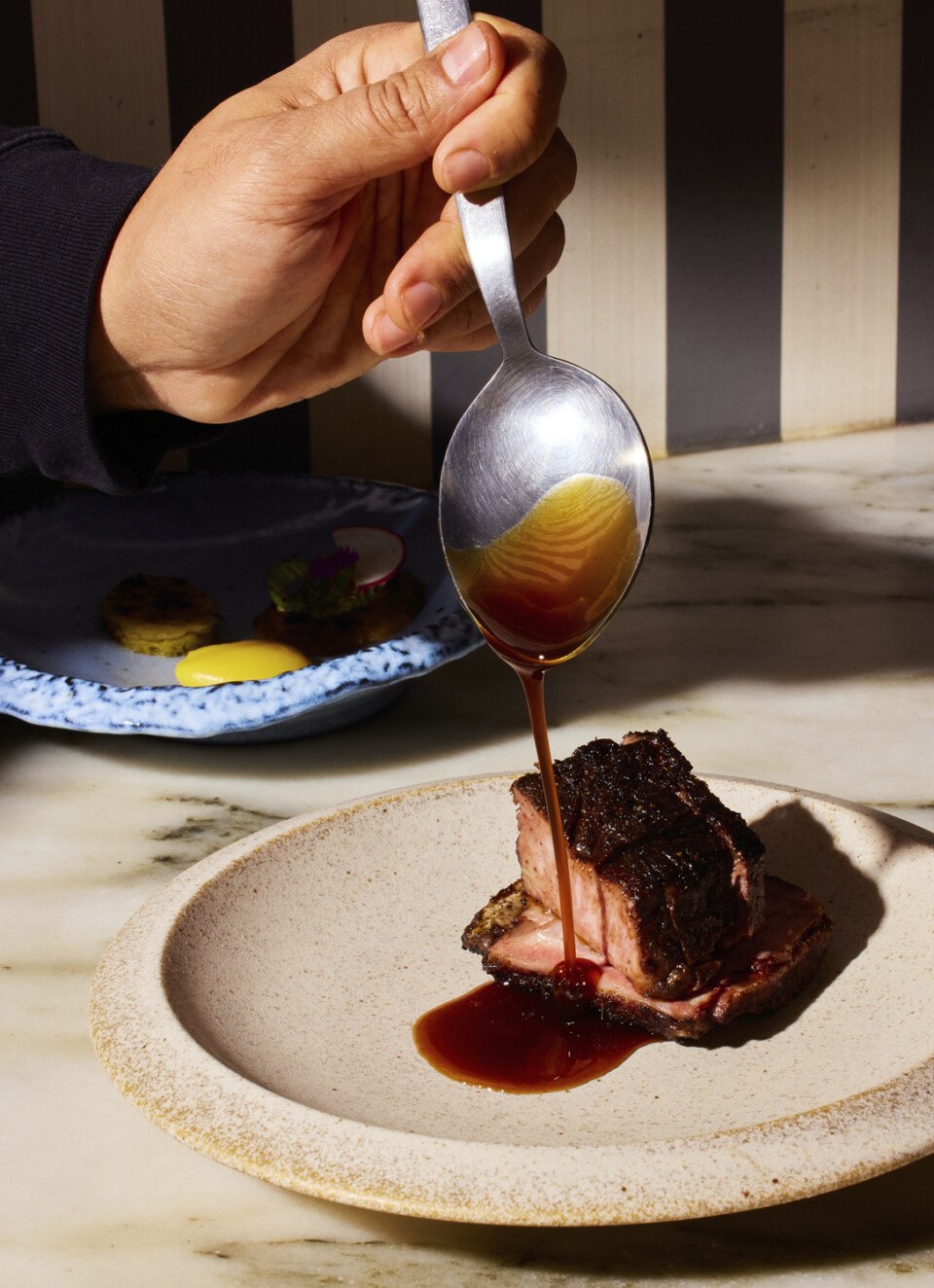
Grilled short rib drizzled with oxtail jus, from the tasting menu at Friday Saturday Sunday / Photograph by Justin Tsucalas
When Ruby was born in 2020, Williams and Hanna were living directly above the restaurant (today, they live a few blocks away) and navigating the chaos of that moment. Especially for a tiny restaurant, the pandemic and social distancing rules posed an existential threat. Once the initial stay-at-home orders were lifted, they had to rethink how to keep going. That’s when Williams had the idea to switch up their tasting menu, elevating the level of luxury (and price tag) as a means to compensate for the restaurant’s operating at partial capacity.
That tasting menu often featured odes to classic dishes with marks of reinvention and whimsy: a menudo-inspired octopus served in pork broth, a creamy potato soup paired with a caviar-topped tuile, a plantain-glazed roast chicken with Peruvian mojo. On any given night, diners might circumnavigate the world with the ingredients but still feel right at home.
“Our vision was a little different, our culinary style was a little different,” he says. “At the time, everyone was doing tasting menus, but the recognition started coming in.”
Still, neither Williams nor Hanna expected the ultimate recognition of winning the 2023 James Beard Award for the best restaurant in the country — only the second Philly restaurant ever to receive it. (Zahav was the first.) When he accepted the award onstage in Chicago, Williams turned to Hanna and said, “I get to wake up next to this woman every day, and it’s the best gift that life has given me.”
The feeling is mutual. Says Hanna, simply, “I’ll follow him anywhere.”
For decades, an acclaimed sushi chef named Keiji Nakazawa ran what many people considered to be the best restaurant in all of Japan. But in 2016, Nakazawa, then in his 70s, abruptly moved to Hawaii — launching a small sushi bar called Sushi Sho that was supposed to be his swan song. Only it turned out that Nakazawa had plenty left in the tank: In 2024, at 85, he opened a Sushi Sho location in New York City, and it promptly won a Michelin three-star rating.
When Williams recently dined at Sushi Sho, he was drawn not just by the food but by a desire to study Nakazawa in his element — and to glean any insights into the chef’s personal fountain of youth. How can you do this for that long and still be the best?
“There are only a few chefs who are a singular force, just them, and they will give you the best food in the world,” says Williams. “I’m not that guy.” On a different level, however, he found himself relating to the elder chef: “We all envision retirement and being done. But [Nakazawa] looked a lot happier than retired guys I know who are sitting on the beach.”
It’s a few days after Christmas and Williams is eating lunch at Cafe Nhan in South Philly, where he’s taken the conversation down another existential road — from an octogenarian sushi chef to a Zen monastery he used to attend in Brooklyn to 20th-century French-Algerian philosopher Albert Camus, whose book The Myth of Sisyphus has provided him a rare source of contentment. Sisyphus, of course, is the character in Greek mythology who is made to push a boulder up a hill over and over again for eternity, stuck in a loop as a punishment from the gods. Williams, though, is convinced that Sisyphus doesn’t have it so bad.
“Camus basically said that this is not punishment. This is reality. This is the joy of life. What would happen if you stopped pushing?” For Williams, the answer is simple: “I’d be upset that there’s no more boulder.”
These days, Williams is excited that some of those boulders — and not only his own — will have an extra set of hands. That’s the purpose of the Black-led hospitality collective that’s in the works. It’s the sort of support that he could’ve used himself as a young chef. “When I was about 26, I had a whole idea for a restaurant fleshed out and ready to go,” says Williams. “In reality, I was not ready at all, and it would have been a failure, point-blank.”
There are, of course, already stories of how Williams has served as a mentor and change agent in his restaurant. One former mâitre d’ recalled the three-plus years of working for the Williamses as “the first truly positive work experience” in a decade’s worth of fine-dining jobs.
“Chad and Hanna are not leaders who whip you from the chariot’s seat,” says the former employee, who prefers not to be identified to avoid upsetting current or former employers. “If we needed to push a rock up a hill” — there’s that metaphor again — “they were always putting their shoulders into it too.” And yet, despite the high standards, she says, the Williamses displayed a “rare” level of care toward their employees. “Nobody was ever yelling in the kitchen or airing their trauma at someone else,” she says. “They led from a place of safety.”
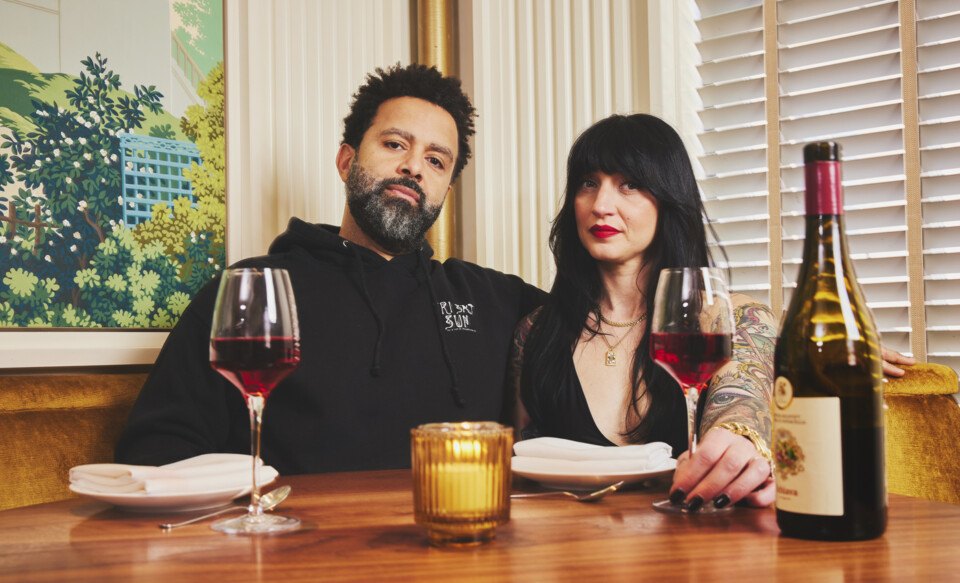
Chad and Hanna Williams at Friday Saturday Sunday / Photograph by Justin Tsucalas
Honeysuckle’s Tate isn’t surprised to hear the praise. “There is a concentrated effort amongst chefs in our generation to shift from food to the politics and culture of kitchens,” he says.
So, yes, Chad Williams is a Black chef. But he’s also just Chad Williams, an artist and culinary leader whose success transcends cultural pigeonholing. While there are chefs like Tate trying to explicitly redefine what is considered Black cooking, and succeeding at doing so, Williams is furthering that same goal by virtue of his sheer excellence. As Tate says, “Sometimes the story is just on the tongue.”
Williams has heard the negative noise around the Michelin Guide’s new presence in Philly’s food scene: It’s elitist. It’ll make things more expensive. Who’s to say we even need it? (“We’re a bunch of haters,” he says of Philadelphia’s reliable pessimism, adding “I’m one of the biggest haters.”) But all he can see is the extraordinary gift of it, which he plans to parlay into opportunities for others with the same drive and enthusiasm that earned him that shiny star in the first place. What a legacy that would be.
“There’s a bunch of guys in the city doing great work in their own silos, but now” — with this seed of his idea for the Black chef collective — “we have the chance to do something great as a group,” says Williams. “There’s money and infrastructure behind us. There’s people who believe in us. That’s part of being a dreamer — you have to push for the vision. So let’s do this together.”
At least for the next year — or however long it takes to finish the next phase of Friday Saturday Sunday — he’ll also be hunkered down in a project that’s deeply personal. He and Hanna searched for nearly seven years for a new space before finally taking their grand vision to buildings right next door. As with his pursuit of a second star, Williams says, with the new idea, there’s a responsibility as an artist to keep pushing.
“When,” he says, “would we have this opportunity ever again?”
Published as “Portrait of the Artist” in the March 2026 issue of Philadelphia magazine.
Editor’s note: This story went to press prior to a recent New York Times investigation that revealed accusations of physical and psychological abuse by Redzepi. On March 11th, Redzepi resigned from Noma.