Why Philly’s Biggest Whiskey Collector Is Finally Pouring His Private Stash
Hop Sing Laundromat’s Lê is sharing rare spirits from his personal collection, opening thousand-dollar bottles (at unheard of prices) for anyone with a bar seat.

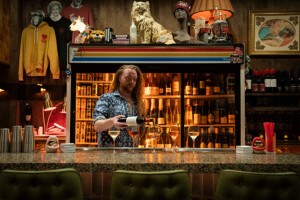
Hop Sing Laundromat’s bar / Photograph courtesy Hop Sing Laundromat
Listen to the audio edition here:
Lê calls me late on a Monday. Sometime around dinner. He just woke up. “So you know I’ve been collecting all these whiskies, right?”
I do, in fact, know that. Lê (the bar’s mysterious and eccentric owner) is, among many other things, a collector. Watches, sunglasses, antique furniture, enemies. He finds a certain definition of himself among the acquisition of things, and bottles of wine and liquor are just one of his obsessions — strange for a man who doesn’t really drink, but maybe not at all for someone who owns one of the most talked-about bars in the modern era of Philly’s drinkable history. Who stocks his well with bottles that would be call (or better) at most other bars.
And now, according to Lê — on the phone, chattering like a squirrel — he’s going to be dipping into his private collection and cracking open some of the rarest, most sought-after, most expensive bottles around and, in the process, fundamentally altering the model of how his bar operates.
Also, he’s going to be selling his liquor cheap. Not dime-beers-and-dollar-shots cheap. We’re still talking $30, $40, $100 a pour. But cheap considering what he’s pouring. Cheap when you’re talking about thousand-dollar bottles. And we’ll get to all those details shortly. But first, a story …
This one time, back in maybe 2022, Lê pulled off a kind of (legal) whiskey heist that explains exactly the kind of collector he is. On a whim, he picked up 841 bottles of a rare, limited-edition rye from Old Overholt (a historically Pennsylvanian distillery that now operates out of Kentucky). The overproof rye was part of a release meant to celebrate the distillery’s 210th anniversary in 2020, and cases were distributed exclusively in Pennsylvania and Ohio. Ohio’s stock sold out completely, but after two years, the PLCB still had a bunch of cases sitting around in warehouses all over the state, so Lê bought them.
All of them.
Every single bottle in the entire state — meaning every single bottle available anywhere in the world. And he demanded that the PLCB gather them all up and ship them to a single warehouse so he could pick them up personally (which they did).
The end result? Lê ended up with 75 cases of very good, 11-year rye tucked away, and Hop Sing Laundromat became the only place serving it — which made Lê happy because it meant that a rye whiskey with Pennsylvania roots (and meant for Pennsylvanian drinkers) would stay in the state where it belonged. Plus, since he had all the bottles, he wouldn’t have to worry about other collectors coming in, buying them up, moving them out of state and jacking up the price. He would be in complete control.
That rye? Hop Sing is now pouring it for $18. There’s also an 18-year Knob Creek for $35, a 10-year-old Basil Hayden for $20, a single-barrel Elijah Craig for $42. They’ve got an Orphan Barrel Barterhouse bourbon, left sleeping for 20 years, and Hop Sing will be selling it for $50 a pour.
“A two-ounce pour!” Lê reminds me. “A real two-ounce pour. None of this one-and-a-half-ounce bullshit like some places. You can sip it. Two ounces? You can sip! One ounce? It’s just gone. You can’t taste anything. A hundred dollars and you’re like, where did it go?”
Right now, Lê has a list of about 50 bottles — rare ryes, scotches, and bourbons, American and Japanese whiskies, about a dozen tequilas (including a scotch-casked 2014 Herradura Reposado for $35 which, if you can find it, would normally run you a few hundred dollars a bottle), and two different chartreuses.
He started serving them, at the bar only, this past Saturday. And the change to the way Hop Sing operates that I mentioned? As of now, the bar at Hop Sing is shots-only. If you want cocktails, you have wait for a table on the floor. If you want to try a sip of 18-year-old Yamazaki Japanese whiskey, you’re welcome at one of the 10 bar seats. Plus — and this is important — if there’s space available, you won’t have to wait in line.
(It’s also worth mentioning that Lê is pouring two ounces of said Yamazaki for $100. If you want it pretty much anywhere else, you’ll be lucky to find a single ounce at that price. Lloyd, for example, is currently letting it go at $110 per ounce.)
In addition to this new bar policy, Hop Sing will be changing its operating hours. Starting tomorrow, February 19th, Lê will be reopening for Thursday night service. And he’ll finally be re-launching his $10 throwback cocktails menu — available only on the floor, and only on Thursday nights. The whole shots-at-the-bar thing? That’ll be standard practice going forward, available on Thursday, Friday, and Saturday nights.
“I didn’t want to do it in January,” he tells me. “Dry January? Fuck that. But now? February? After Valentine’s? Now we do it.”
So all you whiskey (and tequila, and chartreuse) fanatics out there, this is your moment. Lê has spent decades collecting. He has bottles hidden away that you wouldn’t believe. And the list he’s launching with?
“This is just the beginning,” he says. And then he tells me that if anyone asks why he’s doing this, I should tell them he has a cocaine habit he needs to support. “Tell them I need the cash!” he yells into the phone, then laughs.
Because like the Old Overholt … acquisition from a couple years ago, the real reason is that he likes collecting things. But he also likes sharing them. He likes letting other people experience those things that they might not otherwise be able to. Because, really, what good is a bottle of whiskey just sitting on a shelf? It’s an inert object. Useless. Collecting value, maybe, but not doing anything.
Open it, though, and it becomes an event. Something to try, to taste, to remember. It becomes special only in its consumption, and then is gone.
There’s probably some kind of moral in that. Maybe you should head down to Chinatown yourself and find out.