The Cure For Loneliness? Dining Out Alone
What if a table for one isn’t a sign of isolation, but its antidote?
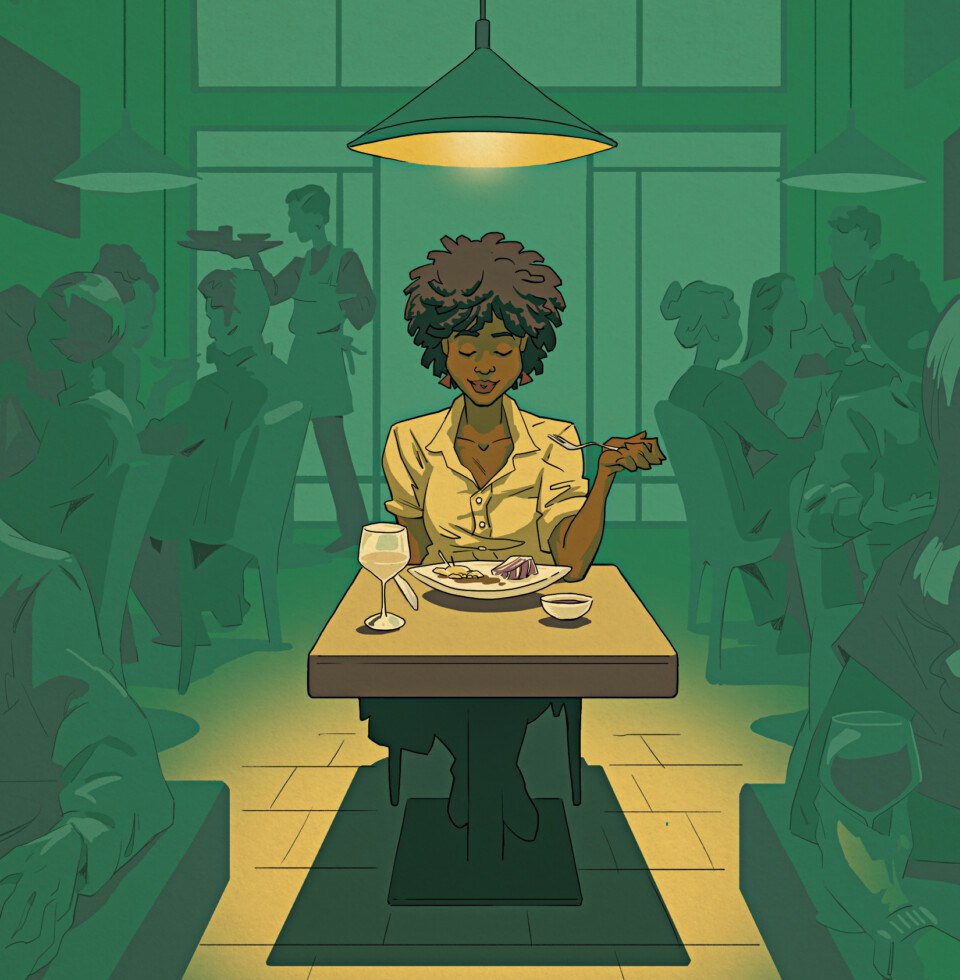
The joys of solo dining / Illustration by James Boyle
Listen to the audio version here:
Few daily rituals are as meaningful to me — and yet as mundane — as breaking bread. In the secular way, to be specific. I’m not religious, and I didn’t grow up with religion, but I did grow up sprinting downstairs when my mom called us for dinner, desperately trying to get myself a decent serving of whatever she’d made before my ravenous older brothers had a chance to corral most of it, then sitting at the table, with all six of us talking over the local news in the background. To this day, I look at nearly all major holidays as, first, days off from work, and, second, opportunities for a sizable, shareable meal. When eating out, I don’t even like to take my first bite before everyone’s plate has arrived. Of course, this is all backed up by decades upon decades of anthropological research. The literature on commensality, as it’s called in the field, has shown that since the times of hunting and gathering, human beings have seen eating as a social act — at first for security against threats, and eventually, after about a dozen or so millennia, for a sense of belonging.
But on the other end of the spectrum, there are few acts I can offer myself as self-indulgent as an hour or two spent at a restaurant, enjoying a meal, totally alone. No phone, no television, and, most crucially, no companion.
Whether it’s a people-watching session with steak frites at Parc, a one-woman book club meeting with a malbec on the lush patio at Southwark, or a dozen (and then some) buck-a-shuck oysters and no task but to take down the icy tray of mollusks in front of me, my parties of one are among my most treasured private joys.
Naturally, my solo dining experiences weren’t always so gratifying. When I was an overwhelmed undergrad, my free time didn’t always overlap with that of my friends, which regularly left me inhaling stale tater tots alone at dining hall tables while chipping away at assignments or staring at my phone. Solo dining was pure utility. Then the pandemic hit, and I graduated and moved to a nice neighborhood teeming with nice restaurants and nice people I wanted to get to know.
But while I (blessedly) had a remote job, my roommate at the time worked an hour away in New Jersey. I knew I couldn’t depend on her or my other friends, most of whom were spread out across the city at their in-person jobs, to help me explore all the new sushi spots and wine bars in my neighborhood on any random weekday.
Still, the time I was spending alone at home, tapping away at a laptop, was beginning to drive me insane. I started working from a rotation of coffee shops just to get out of the house, then popping into boutiques and bookstores to window-shop on slow days, eventually working my way up to rewarding long days with a cocktail and a seat at the bar, or, if I was feeling really luxe, an entire table and a selection of small plates at happy hour. Yes, for one, thank you.
I often joke that if I don’t get at least eight hours of alone time every day I start to get cranky, but at some point, my solo ventures stopped being just a reason to step away from the desk and started being a delightful little treat I lavished on myself — one that fulfilled a lot of cravings I’d developed post-pandemic: my mandatory daily alone-time quota, my desire for new experiences, my need to engage with the world outside my inbox.
Solo dining certainly isn’t new — OpenTable reports a whopping 64 percent rise in the practice since 2019, not accounting for walk-ins — but negative perceptions remain. When we see pairs and packs of diners in the wild, we typically associate their eating out with a special occasion — celebrations, catching up, happy couples — whereas we associate eating alone with microwavable desk lunches, ditched dates, and midnight snacks consumed standing over the kitchen sink. What would happen if we swallowed the way we judge dining choices and used eating out as an opportunity to spend quality time with ourselves and with the world around us?
The Japanese have been at this game for years now and have refined their solo dining culture, offering one-person grills at barbecue joints called hitori-yakiniku and popularizing the ramen chain Ichiran, often called the “introvert’s dream” for its individual-booth seating design. So why are we still so weird about solo dining? And could hanging up our hang-ups about it actually be good for us?
It might seem a little counterintuitive to suggest an activity that hinges on aloneness in the midst of our modern crisis of loneliness, but stay with me here.
It’s true that researchers and writers (including myself, for this magazine) have run themselves ragged over the past near-decade trying to get to the bottom of how so many disconnected, mistrustful people have become that way and what can be done about it. Americans are spending more time on their own than ever before, a fact that becomes even clearer once we look at our dining tendencies. According to a 2023 survey from the Bureau of Labor Statistics, about a quarter of Americans reported eating all their meals alone the previous day. This tracks with many recent stats about the increasingly solitary way we lead our daily lives, like the Pew Center finding that 38 percent of adults between 25 and 54 live alone — a figure expected to continue its rise in the future. This year’s World Happiness Report, published by the University of Oxford’s Wellbeing Research Centre, ranked the United States 24th worldwide — our lowest bliss ranking yet — citing a “sharp rise” in many solo activities, including meals, as a possible source of Americans’ misery.
For any number of reasons relatively beyond our control — our living arrangements, our work schedules, our dependence on online spaces because of the lack of actual, physical third spaces — many of us spend a significant portion of our days alone. And the World Happiness Report’s assessment isn’t totally off the mark. Psychological research has long established a connection between eating alone and such debilities as depression, stress, and even political polarization.
If you ask me, though, these findings fail to account for one factor: choice. Recent studies that have examined the role of conscious decision in alone time have found that the negative effects typically associated with being alone were reduced or entirely eliminated when participants purposefully set aside the time for a solo activity. Some even reported decreased stress and moodiness and improved sleeping habits.
“Being alone is one thing, but dining solo doesn’t mean you’re lonely,” says Jill Weber, an anthropologist and the owner of Philly restaurants including Rex at the Royal and Jet Wine Bar, and a solo diner for over 35 years. “It’s more lonely to sit in your house and eat alone than it is to go to a restaurant where there are other people.”
Indeed, intentionally spending an evening at, say, Fitler Square’s Sally with a pizza and a glass of natural wine will likely be more fulfilling than passively tossing a DiGiorno in the oven and rewatching Law and Order: SVU. With increasingly limited and dystopian avenues for connection (must I bring up the AI chatbot-girlfriend epidemic?), chances are that many of us will be spending considerable portions of our days alone whether we like it or not. But in my optimistic moments, I believe that by taking control of the framing, we don’t have to be at the total mercy of our solitude.
This is just one part of the equation, though. Even if, overnight, we all decided to take control of the narrative about our dining tendencies, the social scripts we regularly run through and how they play out in the real world might not so quickly follow suit.
One hot late afternoon this past summer while walking along South Street, I passed by a lovely little Italian bistro that I’d eaten at with my brother the week before. We’d both raved about the place, and having just run a list of errands, I was starving, sweating, and thinking longingly about ice-cold water and linguine alle vongole. So I stopped and asked for a table, yes, for one, please. The host looked at me like I’d come out of a spaceship, then at a handful of sidewalk tables — some taken, some unoccupied — then back at me, and blandly told me to come back and ask in an hour.
Any habitual solo diner has lived it — being seated at the worst table (or outright turned away!), getting rushed through a meal, then receiving the check unprompted as a not-so-subtle hint to get the hell out of there. Some restaurants (looking at you, Zahav) don’t even give you the option to reserve a table for one through Resy.
It’s understandable, considering restaurants’ thin margins, that they don’t want to sacrifice double the earnings for the sake of one presumably less monetarily valuable customer. But it still stings.
“It is kind of a bummer,” says Georgette Sipala, a nurse who, in her free time, runs the Instagram account @thelonebruncher, documenting her solo dining jaunts around town. “It makes it harder to normalize it.”
American culture does cast a pitying, disapproving eye on any solo activity, and who wants to invite that?”
Sipala, too, has occasionally received a, well, lukewarm welcome upon requesting a table for one, but in six years running the page she hasn’t let that discourage her. She finds, in fact, that the biggest barrier to solo dining is one’s own anxieties about being seen in public alone.
“I don’t ever want not having someone to go with to be a hindrance for me to do things that bring me joy. But the quote-unquote ‘norm’ is that you’re seeing people together,” she explains. “People don’t necessarily know how to behave alone with themselves at something that we so often see people doing together, like dining out. It’s like the safety blanket is gone.”
American culture does cast a pitying, disapproving eye on any solo activity, and who wants to invite that? Consider for a second the connotations of words like hermit and spinster and loner and recluse. Not too appealing, right? Interviewees — particularly younger ones — in studies on the perceptions of solo dining often blame their reluctance to partake on the cultural framing of solo diners as sad or lonely, and the fear that someone might apply that unflattering framing to them.
I don’t want to make it seem like my contemporaries are petrified by the very idea of stepping outside the home alone, much less sitting at a bar without company. But Gen Zers, having grown up recording and being recorded at almost all times, are much more vigilant than older generations about the way they may be perceived. Since childhood, we’ve been highly aware of how easily one innocuous action can become the next viral social media moment. And these days, we have even more reason to be aware of how our behavior both offline and online might be perceived not just by peers, but by the government.
Still, though there’s undeniably some hostility toward solo dining coming from both ends — from restaurants, out of aversion to monetary loss, and from customers, out of aversion to awkwardness, to judgment, and sometimes just to boredom — the benefits could far outweigh the risks, if only we sought them out.
If there’s a completely normal twentysomething who isn’t endlessly wrestling with the feeling that life is passing them by, I have yet to meet them. To go through the motions and the daily routines that are at some points comforting and at others stifling is tragically human. But recent neurological research suggests that in order to break up the monotony and consequently slow down our sense of time, we need more novel, memorable experiences. Realistically, not all those experiences can be jumping out of planes or scuba diving. Sometimes they simply consist of paying more attention and engaging with the sights and smells and sounds around you — or, in this case, engaging with the staff and diners and eatery around you.
This is what the vast majority of the solo diners I spoke to get out of it. It’s something more than decadent self-satisfaction. Sure, solo dining can be very pleasing for what it is on the surface: time spent outside the home, enjoying a nice meal made by someone else at a beautiful restaurant. But look a little deeper and you can see an opportunity to brush up on skills that we don’t often get to employ in our increasingly isolated lives — things as seemingly inconsequential as small talk and eye contact. For diners like Sipala and Weber, one of those skills is self-sufficiency.
“I can go out to eat totally on my terms. I don’t have to ask anybody to compromise on the where, the when, the why, the how, anything,” Weber says. “You don’t have to worry about somebody else’s timeline, how long someone can stay at the restaurant, what does that person want to eat. You don’t have to worry about any of those things.”
For diners like me, it’s a chance to reach out to the world and see what reaches back.
On a different sweltering afternoon this past summer, I was on the patio (well, sidewalk) at P.J. Clarke’s in Washington Square West, drinking a spritz, picking at an order of fries and staring at passersby from behind my sunglasses, when a trio of girls about middle-school age stopped beside me. “Are you here alone?” one of them asked. I immediately wondered whether they had come to me as an adult, for help, or to me as another girl, to bully me. But I wanted to find out, so I told them yes, I was alone. They looked at each other to confer for a moment before turning back to me. “Can we have some of your fries?” another one asked. I was stunned by their audaciousness — and a little proud of them, as a former painfully shy young girl who never would have been able to muster up the bravery at that age. So I handed them a cluster of fries while the host monitored the situation from a distance. They thanked me and walked away, then suddenly whirled around, already reaching for my table, to ask for my ketchup, at which point I’d had enough of the back-and-forth and told them as much.
Odd and fascinating encounters regularly interrupt my daily goings-on, but rarely do I wish they hadn’t happened. I delight in these kinds of interactions — feeling curiosity and shock in the moment, being presented with an opportunity to do something nice, having a new story to tell friends. And all of it is stuff I wouldn’t have a chance to see or feel while eating fries and doomscrolling on the couch at home.
And sure, everyone may not be champing at the bit to be accosted by a gaggle of preteens in the middle of a summer happy hour — but couldn’t we all use a little more fascination in our lives? The fact that we’re here on the same planet, at the same time, let alone sitting at the same restaurant, is a marvel. Why wouldn’t you take a moment to look at the beautiful interior design surrounding you? Or start a conversation? Or listen to someone else’s?
Despite our societal assumptions about the great misfortune it must be to appear in public alone, we should give intentional, introspective solo dining a shot.”
Solo everything has taken off in the years since the pandemic, from dining to living to travel, with millions giving it a try for the first time. On TikTok, videos tagged with “#SoloDate” have garnered millions of views. And while the Instagrammified, empowerment-focused “hot girls drink red wine and have Caesar salad on Fridays”-style capitalizing on the increasing popularity of solo dining grates on me, my fear that our cultural narratives around solitude will keep the fearful stragglers too apprehensive to come out into the world with the rest of us only grows. Whatever it takes to get the loneliest of us outside, breathing fresh air, taking seats at the bar, is fine by me.
Seasoned Philly solo diners have tips and tricks to make their outings smoother: sticking to the bar rather than tables, going at low-traffic times like lunch or early dinner, even just making chitchat with the bartender or server. Some stick to more casual spots; some take advantage of their solo status, swinging big for single counter seats at restaurants known for impossible-to-get reservations, like Friday Saturday Sunday. Some bring books, tablets, newspapers. Some, like me, obsess over being present in the moment and keep the phone out of sight. But many agree that the real golden rule is to put an end to the self-surveillance.
“What does it matter?” Weber says. “No one cares that you’re there alone. They just think you’re another person. You’re there at the same restaurant that they are. You’re sharing this thing, whether you’re with a person or not. Look around; enjoy. Realize it’s not the end of the universe.”
At Weber’s restaurants, particularly Rex at the Royal — coincidentally, one of her favorite places to dine solo — parties of one are always welcome. “I love solo diners,” she insists. “Most of the time they’re regulars, they’re loyal, they’re friendly, and they tell other people about us. They’re some of our best customers.”
As for the future of solo dining, Weber and I agree that it seems bright. With the number of customers intentionally dining alone rising and the perception of the practice moving away from shame and embarrassment, American restaurants seem to be capitulating, offering more communal tables and single-friendly menus.
In the post-pandemic years, I’ve fluctuated between introversion and extroversion, from borderline stir-crazy and needing to get out there and see something, anything, to desperate to just get back home to my couch and my pastimes. Interestingly, I’ve found solo dining to be one of the few reliably rewarding acts across all these phases. Even as in the current social climate we seem to be becoming less trusting and more infuriated by each other, eating alone has made me feel hopeful and even warm toward my fellow Philadelphians. At the end of every episode of RuPaul’s Drag Race, the eponymous host asks: “If you can’t love yourself, how in the hell are you gonna love somebody else?” Well, I’m asking: If you can’t be by yourself, how in the hell are you gonna be around other people?
So despite our societal assumptions about the great misfortune it must be to appear in public alone, we should give intentional, introspective solo dining a shot. You might encounter the odd waiter or fellow diner who looks at you like you’re an alien or a dog with cancer enjoying its last meal, but change has always come from pushing through the growing pains. Maybe one day, someone will look at you and think about how thrilling it must be to live so unencumbered, so free.
Published as “Dining on My Own” in the December 2025/January 2026 issue of Philadelphia magazine.