Why I Didn’t Wait in Line for a Last Bowl of Ramen at ESO
After standing in line for over two hours, our restaurant critic reflects on what it means to say goodbye to a restaurant and questions what we're really hungry for.
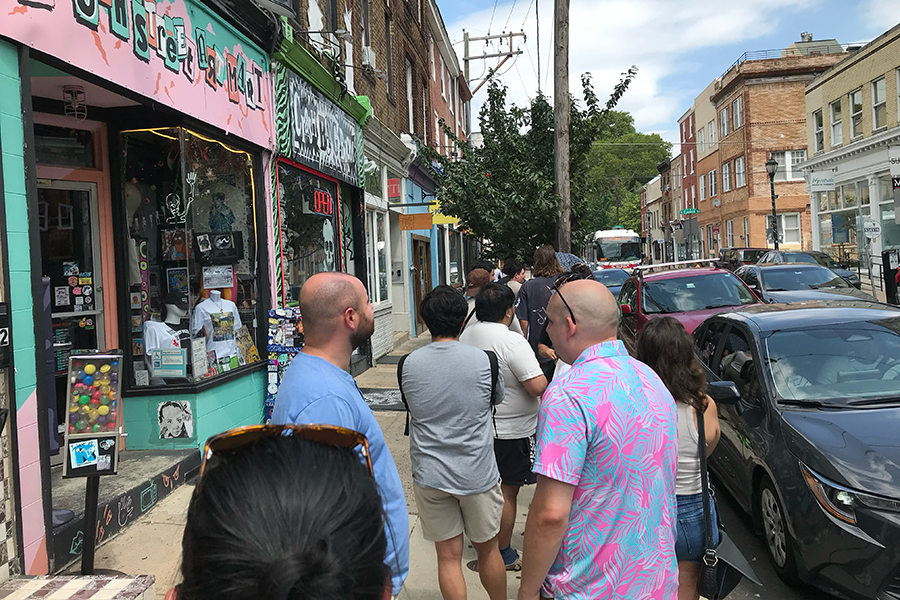
The line in front of ESO / Photograph by Jason Sheehan
When I showed up at ESO late in July for a final bowl from one of the best ramen shops in the city, there was already a line.
It wasn’t surprising. There’d been lines all month, and the month before, too. There’d been lines since owners Jesse Pryor and Lindsay Steigerwald announced back in April that they were going to be shutting down the tiny, six-seat shop (and production space) on South Street and moving to Japan to try their hands at making ramen in the place where it was born.
The announcement (like all closing announcements, no matter the circumstance) triggered a bit of mortality salience among the noodle-obsessed and ramen-curious in Philly: an understanding that all good things must eventually end. A reminder that nothing — not noodles, not summers, not restaurants — lasts forever. So, lots of people wanted a final taste. Some wanted a first taste before it was too late. And the closer it got to the final weekend, the longer the lines got.
“Please remember,” ESO posted on their Instagram feed. “We are a six-seat shop and can only serve so many people in the two and a half hours that we’re open per service. There will be a line outside so check the weather and prepare accordingly! It’s been a pleasure meeting and serving all of you. Can’t wait to see you this weekend!”
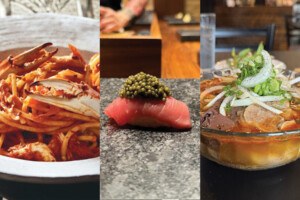
On the day I dropped by for my last taste, doors opened at noon for the no-reservation, walk-ins only lunch service. The menu was gyokai tonkotsu with pork belly and noodles from their Yamato noodle machine imported from Japan. Nothing more. Back in the day, I used to hit Neighborhood Ramen for the hybrid iekei ramen (pork broth and shoyu, mixed), and this is similar — that same smooth, almost creamy tonkotsu pork broth thinned here by a kick of seafood stock, the same kinked, slightly chewy noodles. Chasing sharp memories of those first amazing bowls, I showed up a little after 11 a.m. and the line was already 30 people long. Within minutes, there were another dozen behind me. Early on, the rumor in line was that the first people had showed up at 9 a.m., but actually it was more like 10.
Still, two hours early? For soup? During summer?
A part of me absolutely understood. I’d been a fan of Neighborhood Ramen when Pryor and Steigerwald first started slinging their noodles in a Queen Village brick-and-mortar just over six years ago. I liked them when they were doing pop-ups and strange, come-as-you-are noodle socials, loved the Godzilla cut-outs, graffiti art, and punk rock anti-establishment ethos on South 3rd, respected the fact that both of them had come from serious Philly houses (Morimoto, Zahav, CoZara, Cheu Noodle Bar) and chose to jettison any sense of generalism for a ruthless focus on doing one thing as well as they possibly could every day. Ramen was their thing. They were going to push it as far as they could.
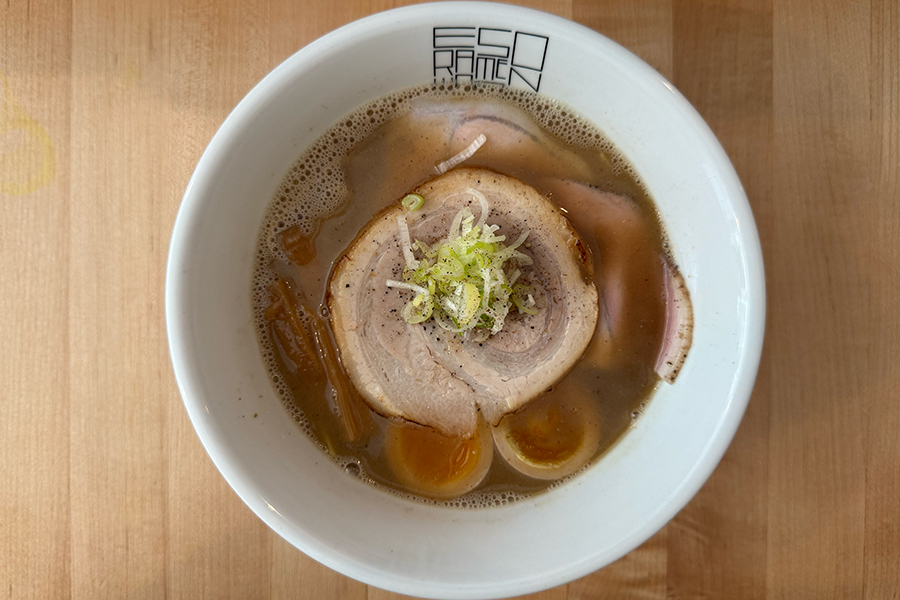
Gyokai tonkotsu from ESO Ramen Workshop / Photograph by Kae Lani Palmisano
And when they finally decided to close up shop at Neighborhood Ramen in anticipation of their move to Japan, ESO became a kind of fall-back location. More accurately, it was their test model. With its short counter and limited seating, this small space on South Street (which had previously been used mostly for noodle production, ramen experiments, special dinners) could be run by just two people. It mimicked (in size, in scope) the kind of places they knew would be available to them in Japan — tiny storefront operations made to serve just a handful of people at a time. Plus, it forced every bowl coming from the kitchen to be an individual expression. A singular culinary work.
“When we started looking for a brick-and-mortar, we wanted it to be just Jesse cooking and me serving,” Lindsay said in an interview last year, right around the time that Neighborhood was shutting down. “But all the spaces we saw were too big, so we adapted. In Tokyo, the infrastructure allows for shops where there’s just one, maybe two people running the whole place — that’s what we’ve always wanted to do.”
For an hour, the line in front of ESO inched forward. Two or three people would go in, then there’d be a pause, then a couple more would get their shot. Outside, I stood on the sidewalk and listened to the people around me. Some were fans from way back. Some were regulars looking for one last taste. The two guys I stood closest to had planned their whole day around their pilgrimage. They’d gotten takeaway beers in paper bags and spent the hours talking about jobs and baseball and travel and old friends — just catching up after too long apart.
But behind me, small groups talked about the place like they were checking off a box on a bucket list. And there was a group ahead of me — young guys in retro Vans and sunglasses — who’d never been. But they’d heard about the place. Seen it on Instagram. They’d come all the way from New York just to try it and couldn’t wait to post the photos.
And I get it. Taken at face value, none of these reasons are any better or worse than any other. Each one of them ends with people together at a table (or, in this case, at a counter), eating noodles. I could make an argument that whatever reason gets people through the door is the right one.
But as a collective dining economy, though, I worry sometimes about our motivations. I worry that this FOMO craving for experiences and the desperate (and futile) completist need to hundred-percent life like it was a video game can demean the ultimate point of all this — which is, at its most basic, to enjoy a thing on its own terms and in the moment that it is in front of us.
But we are curation engines, all of us. Meant to make museums of ourselves, filled with moments worth remembering, collected during the brief, shining window of our existence.
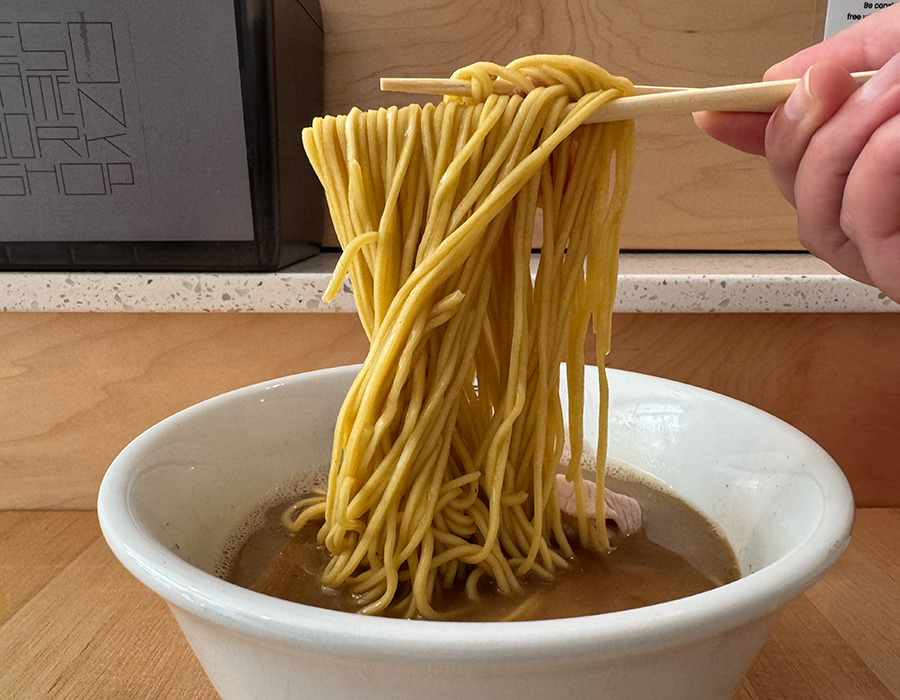
Gyokai tonkotsu ramen noodles / Photograph by Kae Lani Palmisano
And one of the reasons restaurants are so important to us is because they are very good at creating those moments. They formalize the act of gathering together for a meal and, in doing so, create spaces for memories to be made. It doesn’t always work. Hell, most of the time it doesn’t work. But when it does? Then we carry those moments with us forever. And whether they knew it or not, that — that moment of wonder or connection or brilliance — was what everyone lined up at ESO that day was looking for. In the sun and during one of summer’s many heatwaves on South Street, just a chance at collecting one more memory was what they were willing to stand in line for hours for.
But not me.
I am one of the most privileged people I know. Not in every way, certainly, but in this one way. For most of my life, my job has been chasing after exactly those kinds of moments. I have likely had far more than my fair share of them already. And lately, I’ve been thinking a lot about their value and their cost.
I really like the work Pryor and Steigerwald have done at Neighborhood and ESO. I think they are committed professionals who are attempting something remarkable with this move to Japan — testing themselves against a place where a bowl of ramen is not a box to be checked but a deep piece of culture to be explored. But I have eaten this soup before. And standing there, two hours and change into my wait, I realized that not only was it unlikely I would make it to the door before the gods of Philadelphia parking decreed that my time in this place was up, but I also didn’t really need another bowl to make myself feel complete. I was okay with NOT getting a last bowl from ESO. More than that, it felt kind of wrong, considering the number of people still lined up behind me, that I might be taking a final bowl (and the memory of a final bowl) from someone who needed it more.
So, I left. Smiled at the people behind me. Said, “Looks like y’all are moving one step closer. Good luck.” And then went on my way.
I wish Pryor and Steigerwald nothing but the best on their next adventure. I hope that someday they’ll bring all that they learn back home to Philly. If they do, I’ll be there. Ready to experience something truly new.
No matter how long it takes.