This Penn-Made Device Helps Block NICU Noise and Keep Babies Calm
Developed by Penn Engineering grads, Sonura is a high-tech beanie that protects preemies’ ears by blocking out too-loud sounds of an intensive care nursery, and supports the parent-baby connection with recorded messages from home.
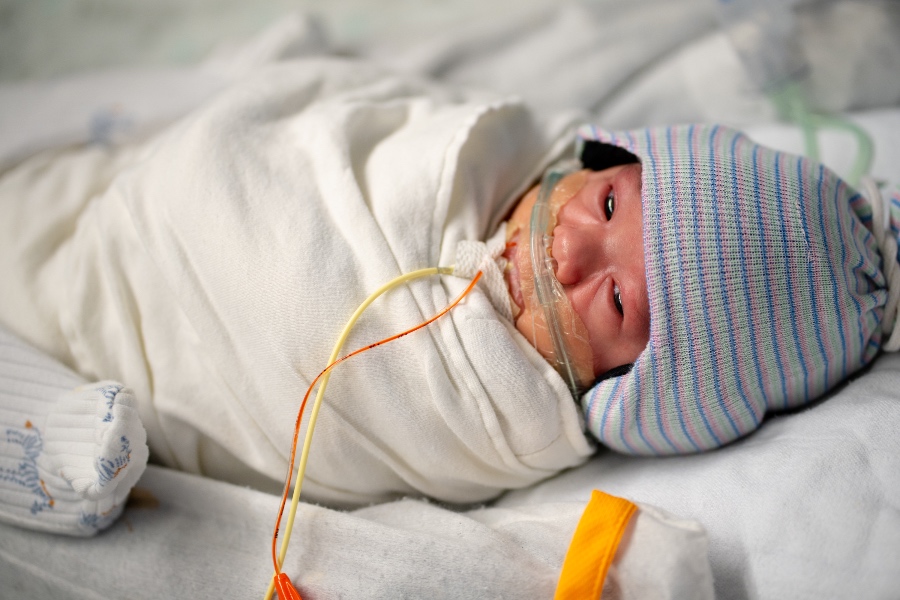
Sonura, a high-tech beanie created by two Penn Engineering grads, blocks hospital noise levels that are dangerous to babies, especially those born prematurely, while delivering soothing messages from parents. / Photography courtesy of Penn Medicine
Listen to the audio edition here:
Hospitals are notoriously loud — from machines beeping and whirring to doors opening and closing to calls coming over the loudspeaker. Noise levels in emergency rooms and intensive care units, especially, consistently exceed 35 to 40 decibels — a range set by the World Health Organization — and sometimes reach close to 100 dB. (That’s as loud as a construction site!)
For adult ears, continuous, loud noise can cause temporary or even permanent damage. But when it comes to babies, especially those born prematurely and spending time in the NICU, such levels are even more dangerous. That’s because adult ears can generally tolerate sound levels of 70 to 80 dB — think the noise level of a coffee grinder or a vacuum — for extended periods (though sounds at or below 70 dB are safest), while newborns can withstand 60 dB at most.
This becomes a problem when a baby needs to spend time in an intensive care unit. Though the American Academy of Pediatrics recommends the maximum noise level of any NICU be 45 dB — that’s akin to soft background noise or a quiet suburb during the day — some have been reported as operating between 60 to nearly 90.
These levels can not only damage preemies’ hearing, but can also spike heart rates, induce stress, and hinder feedings and sleep — all of which directly impacts their ability to grow and thrive.
To solve this problem, two local entrepreneurs created a device that aims to protect preemies’ ears, help newborns develop without noise-induced stress, and better bond with their parents.
Designed by Gabby Daltoso and Sophie Ishiwari, both graduates of Penn Engineering, Sonura is a high-tech beanie that works in several ways. Instead of masking environmental noise like, say, a white-noise machine would, Sonura’s electronics — which are sewn directly into the newborn caps traditionally used by hospitals — recalibrate the baby’s environment by blocking out harmful hospital noises and high frequencies.
While dangerous sounds and frequencies are obstructed by the filtration system, lower frequencies, like that of the human voice (which typically exists around 200 Hertz), can pass through. Research has shown that babies who have been exposed to hearing their mothers’ voices are more primed for language development, but parents and families of NICU babies aren’t always able to be together 24/7, which means that preemies in an intensive care unit “often hear less maternal speech than if they had continued to develop in utero,” notes Stanford Medicine senior science writer Erin Digitale.
That’s why Sonura allows parents and families to record messages — like songs, stories, and general sentiments of care — and their heartbeats that are played in the beanie (at those safe auditory levels) during times when parents can’t be physically present. Parents can record unlimited messages, all of which will be relayed to their child. “We want parents to have access to their baby whenever they want,” Daltoso says.
In this way, Sonura essentially mimics the infant’s experience in utero. The womb isn’t a quiet place — it’s full of sounds like the pregnant person’s heartbeat, blood flow, and digestive system’s gurglings. But those sounds are low in pitch, operating like background noise that the fetus’s ears can withstand. The womb’s natural filtration system also transmits the voice — the sound and the vibrations — of the mother or gestational carrier through amniotic fluid to the fetus, allowing the baby to not only recognize this voice, but be soothed by it.
Daltoso and Ishiwari were inspired to create the device during their senior year at Penn, which began in 2022. As the bioengineering students were brainstorming options for their capstone project, they had the opportunity to tour a NICU, where they noticed how loud the environment was. “Even after we left, we swore we could still hear some of the alarms,” Ishiwari says.
In addition, both have personal experiences with parents who needed prolonged hospital stays. “We understand what it’s like to not be able to speak to your mother or parent for days, and know that parent-child connection is extremely important. So, we went to work to figure out how to solve this problem for NICU families,” Ishiwari adds.
In 2023, the duo won Penn’s President’s Innovation Prize — an award that recognizes ventures that make “a positive difference in the world” — which they say opened many doors for their invention. They were awarded $100,000 in funding, plus a $50,000 living stipend for each team member, which they used to secure two utility patents granted — the first is for the architecture of the system, including connecting the app with the device and the Sonura cloud infrastructure, while the second is for the filter and the playback schedule of the recordings — as well as product development.
In addition to funding, the prize helped them gain entry into the intensive care nursery (ICN) at the Hospital of the University of Pennsylvania (HUP), where Sonura is currently being tested for usability and feasibility.
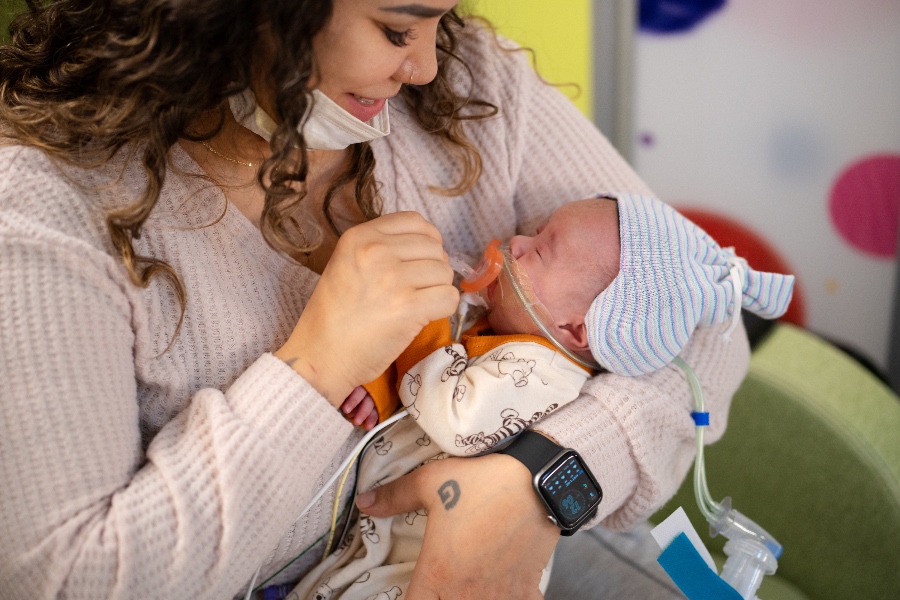
Poconos resident Pamela Collins holds her son John, who was born at 29 weeks and required a NICU stay. John was one of the first babies to trial the beanie.
The clinical study, which began this past November, is measuring early signs of reduced stress in 30 preemies. Basically, the team is looking to see how wearing the beanie during feedings (when the filtration system is on, and when parent’s messages are played) impacts vitals including heart rate, respiratory rate, and oxygen saturation. (The study also involves surveys regarding ease of use by nurses — to ensure it seamlessly integrates into the ICN — and parental experience.)
Testing the beanie during feeding times is key, says Michelle Ferrant, a neonatal clinical nurse specialist at HUP and one of the co-investigators of the Sonura study. “Having a baby who is calm and who is resting during feeding can decrease their energy use and also help with digestion, and we want preemies to grow!” she says. “But constant loud sounds won’t help anyone stay calm or rested. Hopefully this [study] will show some results of babies who are able to get to full feeds or have improved long-term nutrition and growth from being able to be calmer and more soothed during feeds.”
Eligible babies are those born at or between 28 weeks to 34 weeks gestation. Babies who are younger than that at birth can become eligible once they are old enough, though some preemies are ineligible based on factors like certain medications and need for surgery.
Ferrant explains how this age bracket is a sweet spot for the beanie: “That premature range of babies are starting to grow, gain weight, and feed by mouth, and they are coming from the isolette, which is more of a contained environment, to an open crib, exposing them to louder sounds,” she says. “Also, babies who are born later” than 34 weeks “are more likely to not spend as much time in the hospital. For those born at 28 weeks, the anticipated hospitalization is through your due date, and that’s an extended period of time that your family is separated from their baby, so this also provides that connectivity from patient to family.”
While there’s no hard data to share yet, Ferrant says the observations and feedback from nurses and parents have been promising: “Our nursing staff was really involved in editing what the beanie looks like, and they’ve said it’s not invasive and not interruptive to their workflow to utilize the beanie during feeding times. I’ve heard parents say how meaningful it is for them to be able to provide their voice and provide that connection. Anecdotally, the nurses have said they see babies calm down and smiling, and, the things that we already know based on evidence of parental presence, parental voice, and those things that help calm and soothe babies, you can see that also translate over into this product.”
After the study concludes, Daltoso and Ishiwari hope to use their data to pilot Sonura at other hospitals, so that the beanie can be shared with “far more than 30 infants,” they say. They have already received expedited clearance from the FDA, as they look to designate Sonura as a medical device that can be used in any NICU in the United States.
“NICU nurses have been looking for ways to decrease the sounds and turn off alarms as fast as possible, to read to the babies, and to teach parents how to be involved in the developmental care of their baby,” Daltoso says. “Our beanie tries to not only offload much of that burden of the time nurses spend doing that, but make parents feel truly integrated into their child’s care team. Our goal is to make a real impact for these infants and their families.”