
Market East’s Big Summer Experiment: Inside the Bid to Revive Philly’s Most Beleaguered Corridor
Meantime on Market is transforming six empty storefronts into laboratories for a different kind of downtown comeback.
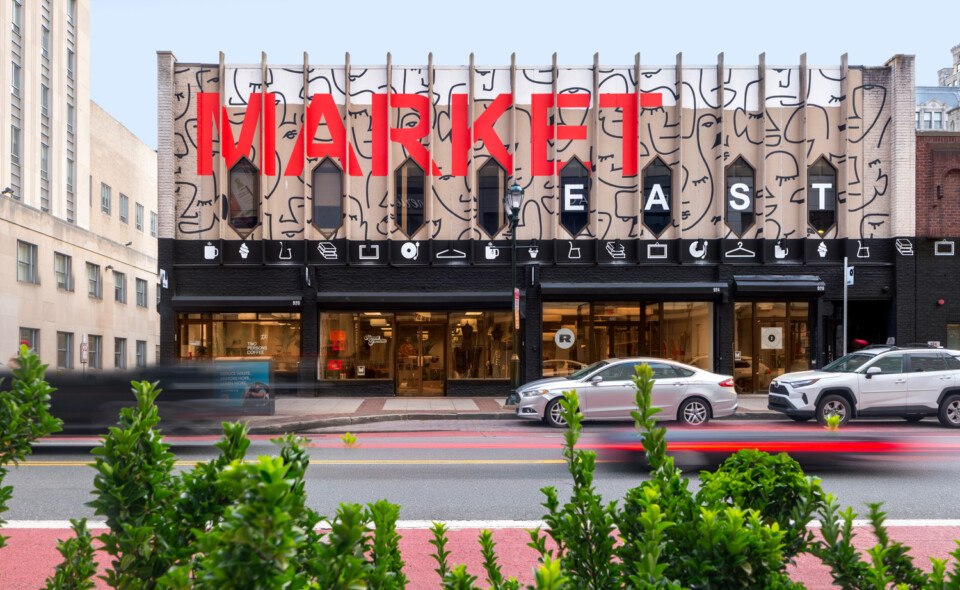
Meantime on Market / Photography by Charlie Schuck
“I’ve always had a bit of a love for this area,” Brian Phillips says as we duck into a vintage furniture store on the 900 block of Market Street.
Phillips has been in Philadelphia for more than 30 years. One of his first projects he gave his architecture students was designing housing for the Gallery mall in the ‘90s. He remembers the fish markets on the concourse level of the Gallery, and the Funk-o-mart, peddling everything from musical instruments to DJ equipment.
“There were a lot of people crossing paths here — commuters, Chinatown, West Philly, North Philly, adjacent neighborhoods to the south. It was a place that was a crossroads. I feel like that’s sort of its destiny,” he says. “It was just a very Philly thing that is gone.”
There aren’t many Philadelphians who share Phillips’s enthusiasm for Market East. The neighborhood, stretching from the east apron of City Hall to Old City, has been the site of a number of big dreams deferred: scuttled plans for a new Sixers arena; a sparkling new mall … whose operator declared bankruptcy after less than a year; a 30,000-square-foot surface parking lot dubbed the “Disneyhole” after the entertainment company jettisoned plans to turn it into an indoor arcade/theme park.
Today, the beleaguered corridor feels a bit like a ghost town, a wasteland of vacant storefronts that lack a coherent identity.
But Phillips is good at taking a rough-and-tumble space that lacks purpose and turning it into a vibe. An architect by trade (he’s behind Cherry Street Pier and Frankie’s Summer Club), Phillips has hosted everything from pop-up markets in a parking lot to modular synthesizer workshops in empty storefronts with his nonprofit, Meantime. The goal: Take vacant spaces and turn them into homes for local, thriving small businesses.
Market East is Meantime’s latest (and largest) project. From May to August, Meantime has invited artists, entrepreneurs, and others to turn six empty storefronts on the block into pop-up shops — hosting events, selling snacks, furniture and clothes, and, hopefully, changing Philadelphian’s minds about the potential of one of the city’s most beleaguered corridors.
Phillips fell in love with Philadelphia when he moved here as a graduate student to study architecture at Penn in the 1990s.
He’d been drawn to the field for its potential to improve people’s lives through building design; and he quickly developed a reputation, with his research and design firm ISA, for quirky housing projects that cater to the need for diverse, affordable housing choices in dense, walkable cities. Like XS House in Chinatown, a 63-foot-tall, seven-apartment building built on an 11-foot-wide site that served as an informal, two-car parking lot for years. Or the 100K House in Kensington, a prototype for what was to be a series of 1,000-square-foot sustainable homes for $100 per square foot, as an answer to the 2008 housing crisis. They ended up building eight.
In COVID’s wake, Phillips noticed a number of unoccupied storefronts — especially on ground floors of shiny, new apartment buildings. Average commercial rent in Philly varies neighborhood by neighborhood, but tends to be in the ballpark of $38 per square foot, which pencils out to about $4,000 per month for a 100-square-foot space.
“They were asking for like, $4,000 a month for four years, and if you do the math, that’s $200,000 somebody’s going to sign on the dotted line,” Phillips says. “Think about the kinds of businesses and enterprises that can do that. That’s why we get a lot of bank-ATM lobbies and vacancies.”
Phillips thought architects were uniquely positioned to act as a bridge between creative entrepreneurs looking for space and developers and landlords with space to fill. So, he started approaching building owners about hosting pop-ups in their spaces, with the pitch that a vibrant space would be easier to lease than one that’s sitting empty. He incorporated Meantime as a nonprofit 18 months ago and has since hosted three activations, including in Fishtown and West Philly. They have nine scheduled for this summer — the six on Market Street, and three in University City.
“The magic of this program, and why I found Brian’s model to be so compelling is in Philadelphia we have great neighborhood businesses — diverse, homegrown, cool retailers — and connecting those retailers as they’re ready to scale up with the highest pedestrian counts in the city, the economic and civic engine of the region, I think, is really incredible,” says Prema Gupta, president and CEO of Center City District (CCD), who is working with Phillips on the Meantime on Market project.
Phillips and Gupta share the belief that temporary activations can defibrillate neighborhoods struggling to find footing in a post-pandemic world of skyrocketing vacancies and existential business crises over whether a physical presence holds value in the age of online … everything.
Gupta started seriously considering the role of pop-ups in activating retail corridors a few years ago. She was on a trip visiting family in San Francisco when she and her daughter went out to an Indian ice cream shop that served scoops in dosas. While they were there, she noticed a decal in the window that said “Vacant to Vibrant.”
She googled the phrase and found it was a program run by the city with the nonprofit SF New Deal that both helped small businesses and breathed new life into a struggling downtown. Half of the San Francisco businesses who signed on to do pop-ups ended up converting to long-term leases.
“My daughter was like, Can we just eat our ice cream?” Gupta laughs. But already, her mind was turning: Could this work in Philly? She’d been following Meantime’s work and thought “his model seemed to fit the needs beautifully,” she says. There was also a great candidate: a string of empty storefronts between 9th and 10th streets on Market, owned by the Harris Blitzer Sports and Entertainment-Comcast real estate partnership.
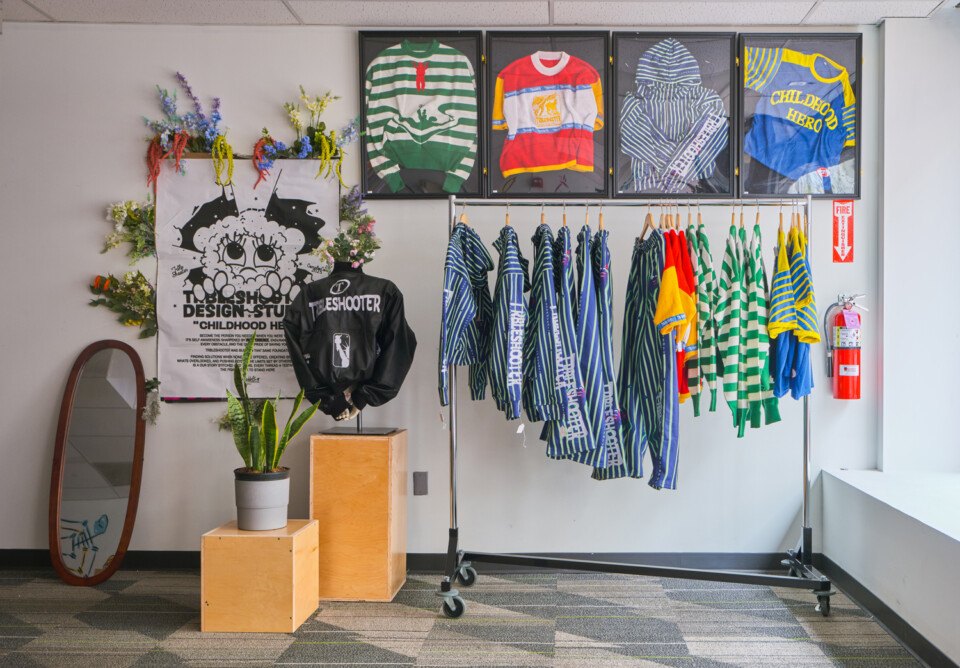
Almost Famous at Meantime on Market
Like Phillips, Gupta sees Market East as a corridor, a neighborhood people pass through on their way to somewhere else. Tourists walk by as they leave Independence Hall and head to City Hall and the museums on the Parkway. People attending conferences at the Convention Center exit their events into the neighborhood on their way to their hotels or dining and shopping in Washington Square West. Commuters emerge in Market East from Jefferson Station and shuffle off to their jobs. People needed a reason to stay.
“We need reasons for everyday Philadelphians or our regional visitors to stop and linger and enjoy themselves,” Gupta says. “I want Philadelphians to know that they belong on Market East. That there are cool things to do there.”
They started work on the project at the tail end of 2025, using a $1.85 million grant from the city. Gupta remembers feeling nervous when they first walked through the spaces — many felt dark and a little dingy; a former jewelry store still had abandoned displays. Comcast and HBSE went to work cleaning the spaces, painting and preparing them for use. On April 20th, Phillips got access and businesses started moving in.
Visiting the Meantime shops between May 1st and the project’s ribbon cutting on May 7th was like watching a timelapse. Graffiti disappeared from windows. Chairs and tables strewn about a coffee shop become an orderly, welcoming scene for guests. A soft-serve decal appeared on the window of a water ice shop. On a wall of Almost Famous, a clothing and art retailer and event space that has participated in Meantime activations before, a Gianni Lee mural bloomed with a skeleton and robot.
“It’s been really fun to watch Market Street as we’ve moved in,” Phillips says. “People are looking into the shops to see what’s happening. There’s a big difference between seeing this block boarded-up and empty and all the gates down all day, to seeing it these days. You can just feel that it has a real impact.”
In addition to Almost Famous, there’s West Philly’s beloved Siddiq’s Water Ice, the vintage furniture shop Rarify, a creative exchange space for artists by ArtPhilly and Jos Duncan-Asé’s Love Now Media initiative Love Lab, a second location for the beloved, Bok-based Two Persons Coffee, and the record shop and listening room Clubfriends Radio & Records.
Phillips approached around 14 businesses and curators — a mix of former collaborators, folks in his network, and other creative entrepreneurs he’d been following — to fill the six slots he had available for this summer’s activation. (Creatives and entrepreneurs interested in doing future pop-ups can reach out via Meantime’s website).
“It was clear to me that this was a huge passion project, and something done out of love,” says David Rosenwasser, Rarify’s co-founder and co-CEO. “I was touched to be thought of and gave the thumbs-up right away.”
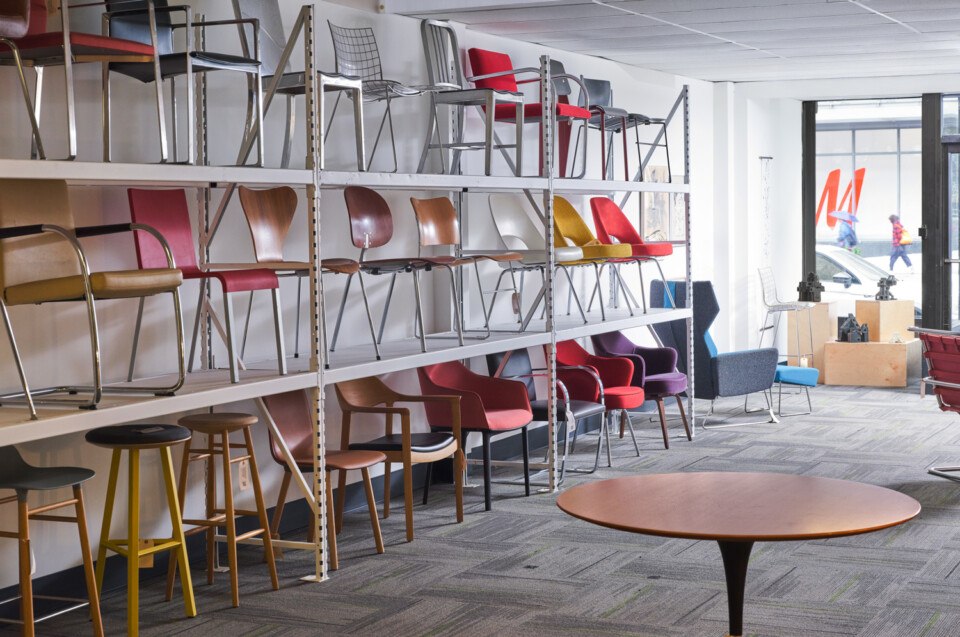
Rarify vintage furniture store at Meantime on Market
For businesses, the case to participate in these temporary activations is clear: free rent. Creatives and small business owners can freely test out new ideas, experiment with an IRL location if they’ve only ever sold online, and host events alongside their sales.
“I recognize the need for artists and creative entrepreneurs to have physical space to showcase and sell their products and services,” says Melasia Pinder of Almost Famous, who curates clothing from designers and work from artists to sell in her shop.
“We were deep on the internet, but I understood from my experience growing up that physical space was just so much better. Although social media is a good tool, I knew that making those connections in-person was invaluable.”
For landlords, Phillips and Gupta argue that hosting any business — even a provisional one — can help attract long-term tenants. As seen in San Francisco, some pop-up businesses may choose to make their makeshift locations a permanent home.
But lively storefronts can also attract tenants who want to sign long-term leases from the start. That’s what happened with a Meantime pop-up at The Magnet apartments in Fishtown.
“As we think about Market East and the ambitious transformation that I think is ahead of us,” says Gupta, “we see this as a down payment — to change the tone, change the conversation, and again tell people that big things are possible.”
Market East is packed on the afternoon of May 7th. Philadelphians are (finally!) enjoying a bit of sunshine. The Meantime shops have their doors propped open, and patrons wander in and out.
Tom Scannapieco, president and CEO of the luxury development firm Scannapieco Development Corporation, (and father of Lindsey Scannapieco, the visionary behind the Bok Building and the former UArts properties) swings into Rarify, where a crowd browses mid-century modern chairs and sips wine from plastic cups. Clubfriends Radio & Records pumps music and people dance around the shop’s sofa and sound system, taken from founder Alexa Colas’s actual living room. She says having nearly 100 people there felt like “a house party on Market Street.” Mayor Cherelle Parker calls the whole project “a vibe” during her ribbon cutting and walkthrough that afternoon.
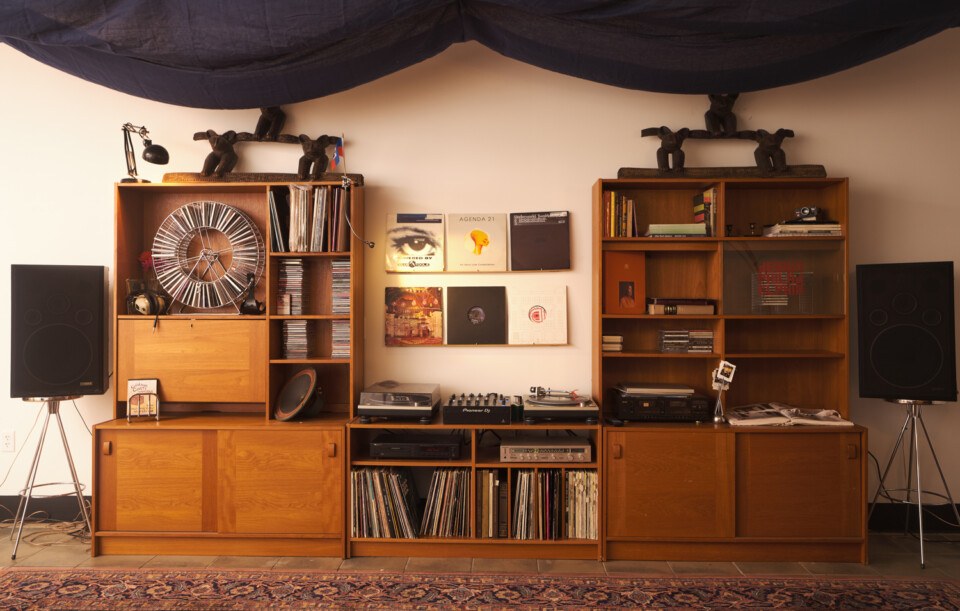
Clubfriends at Meantime on Market
People are here today for the ribbon cutting, elbow-rubbing, and free drinks; the hope is, when those visitors flock to Philadelphia for all things 250th, they’ll stop by, too. But what happens, come August, when the tourists go home, the Meantime entrepreneurs pack up their clothing and vintage decor, and these shops once again become inactive?
Parker has launched a task force, the Market East Revival Advisory Group, to consider the future of the corridor. Some of Philly’s best urbanist thinkers have debated what we need to do to re-energize the neighborhood. Gupta says CCD will be carefully tracking the foot traffic and business receipts of Meantime on Market to see how this data can inform the future of the corridor. They’ll also look at whether the activation helped its resident businesses to grow or change how they operate.
Phillips, for his part, hopes Meantime on Market will create opportunities for visitors to experience only-in-Philly moments and for Philadelphians to share their stories and feel like Market East is theirs again.
That’s already happening. About a week ago, an older woman in an Eagles sweatshirt wandered into Colas’s shop. She’d just seen the Michael Jackson movie at the Fashion District’s AMC and was excited to browse records. She started telling Colas about the shows she used to go to in Philly and how she knew Reenie Kane, a DJ that helped establish Philly’s queer nightlife scene. She went home with a McFadden and Whitehead 45 recorded by Philadelphia International Records, and a Patti LaBelle LP.
“This experience allows for a place where you can build a relationship with a city through its people,” Colas says. “I think that music history oftentimes doesn’t get told, but I get to hear it firsthand from people who’ve actually lived there and experienced it. Those are the stories that I’m really, really interested in sharing and making visible.”