

Rocker/TV Star/Vampire Honus Honus and Man Man Come Home
The Man Man frontman discusses his unlikely second act on AMC's The Vampire Lestat, a long-awaited tour, and why Philadelphia's 2000s music scene was unlike anywhere else.

Honus Honus and Man Man play Underground Arts on July 23rd. / Photograph by Ebru Yildiz
Honus Honus is a very busy man, man.
When we spoke on the phone last week, he and his indie band Man Man — an integral and eclectic pillar in the Philly music scene of the 2000s — were on a drive day somewhere in the Central time zone, touring behind a record that actually dropped two years ago. Carrot On Strings (SubPop) is classic Man Man: experimental, cooly raucous, oddly groovy and grand. (Along with some bold krautrock overtones, like in the bold and zesty “Iguana.”)
Why wait two years? It’s a whole thing we don’t get into, but suffice it to say he’s got a lot going on, including the family he started with a genuine famous person, and a recent move to Brooklyn after years in L.A.
Surely the craziest addition to the Honus Honus story is his involvement with the AMC’s Anne Rice show The Vampire Lestat, formerly known as Interview With the Vampire. Also known as Ryan Kattner, he started out doing music supervision for the bloodthirsty AMC hit, but more recently was added to both the writers room and the cast — he’s Salamander, bassist in the titular vampire’s goth rock band — which has led to him making music for the show.
We talked about that, the leaner and meaner modern Man Man, his suddenly useful degree in screenwriting from UArts, and the good (and gross) old days in the Philly music scene.
So, you’re a vampire now?
Yeah, I started in music supervision for the first few years, and then this season … I got brought into the writers room — Daniel Hart, the composer on the show, was also added to the writers room — so we could talk about our experiences [in music]. It was great to be able to use my writing degree. But also be able to share stories that I never thought would have any relevance in the real world, or with anyone who was not in a band.
Is Lestat’s band anything like Man Man?
No. But, one of the prerequisites was we all had to be able to be play our instruments. I was able to write some songs [for the show], and then after everything wrapped, they asked if I wanted to audition. So I submitted like four auditions.
Wow.
It’s been a blast.
I know you studied screenwriting at UArts back in the day.
R.I.P. It was some weird closed-loop system. My album from 2024 [Carrot on Strings] came out the day that UArts shuttered. To the day.
Was it an emotional thing to hear that your alma mater went down like that?
No, but it definitely set off my spidey senses of “Oh, someone got rich. This seems like complete financial mismanagement.” It’s a bummer, but no, not really. I mean, the facilities were great. The program that I went to school there for — I was there for the first year of the program. And then it went away, years ago.
Yeah, I wasn’t even aware that there had been a screenwriting program at UArts.
I had planned to transfer after two years but then my credits, none of them transferred. I got kind of scammed by the school. And then and I stuck it out and got a degree that took 25 years to put into practice. Which I thank them for. Playing music was only supposed to be a little detour.
I know you’ve done some acting before, but how do you like working on The Vampire Lestat?
Oh, it was a dream. I mean, it was such a unique experience to be involved in every aspect. You know, you’re sitting in a writers room, and you’re just taking in the audience of all these other great writers. And then you’re there for the shooting of it. So you kind of know the secrets that you can’t tell everyone about the story — what it was, what it’s gonna be — and you’re seeing how the sausage is made. Then as a music supervisor, and also writing some songs in post. You really see how it’s all put together.
That’s cool.
I’m really proud of the show because living in these dystopian times to have a show about gay vampires on TV is few and far between.
Why the delay in touring behind Carrot on a String?
Ah, you know. My personal life kind of fell apart. It’s finally in a place where I can go ahead and play shows. But you know, the record before that [Dream Hunting in the Valley of the In-Between] came out in May of 2020, so my timing on this stuff isn’t great. And now when we launch this tour, our schmuck of a president decided to go to war, the economy’s in a tailspin … But it’s in times like these when I think distractions are great for people, being able to share these different songs.
What was it like sitting on Carrot On Strings for a couple years?
Agonizing. Agonizing to be not be able tour an album I put years into writing. I mean, that’s the thing. It’s like with Dream Hunting; it took four years to make that record. And then this one — the idea was like, Oh, we’ll come out right afterwards and do another record. And this one took a couple of years. Going into it, I wanted to write kind of a krautrock record — I don’t know if that’s a term that could be used — that was the vibe we were going for.
Man Man goes krautrock.
Yeah. It was inspired by — we got to do a cover song on a Neu! box set and I was like, it’d be fun to just kind of jam on that vibe a little bit.
Sonically, Man Man is always been its own little planet.
I guess an aspect of it is constant curiosity, but also, I’m not actually [thinking] Let’s do this different sound. It just kind of happens because I’m limited as a musician.
You picked a fine corner to paint yourself into.
You know, I feel like the closest thing I could say — even though it’s maybe not a stylistic thing — would be a band like Ween, who are not genre-specific. We share that [curiosity]. Maybe. We obviously differ in the humor side of things.
Interesting.
I appreciate that they never really adhered to a genre. And for me, when I first started playing, Can was kind of my north star. Though I know their sound is rooted in rock, they’re all classically trained. I’m just a caveman.
I know for Ween, I didn’t really get it until I saw them live.
I wish I got into Ween back in the day. It’s been a relatively recent thing. I think I was distracted by maybe the jokey stuff. But … what is the Philly song? I love that song.
Oh, “Freedom of 76.”
Yeah, baby. What an incredible song.
The Man Man lineup has changed over the years.
The one skill I have is finding incredible musicians. I mean — even when it was Mister Heavenly [the supergroup also featuring members of The Unicorns, Modest Mouse, and The Shins], and the Honus Honus [solo] record. They’re all good.
You’ve lived a couple places at this point.
I’ve lived a couple places. I’ve lived a dozen lives. We’re out right now as a power trio. It’s been interesting. I mean, a lot of that has to do with the economy, but it’s also just a challenge. On the vampire TV show I was a bass player, so it forced me to like play a lot more bass. I’m playing a lot more guitar on this tour.
I was wondering if your character was gonna die, since he’s the bass player.
Well, they did make me the dumbest mortal that the main characters ever met.
You finally got to tour behind Dream Hunting in the Valley of the In-Between, once the pandemic subsided.
And that’s when I learned the stark reality of how the economics of touring really fucked up everything. I went out with a normal-size van, and it was five to six players. And it was the first time I lost money since like ’07. I was like, okay, this is not sustainable.
Well that sucks.
I mean, it forces you to evolve as a creator.
How’s it going so far, the three-man Man Man?
It’s fun on this tour. We had like a standalone [appearance at] a hippie festival called the Family Hoedown [in June], and we were required to play a two-hour set. We were like, oh my God. So we learned 40 songs for that. So, it’s kind of fun. Maybe no one should have to watch two hours of music, but it’s a fun festival and it kind of forced us to cram.
You got your start in Philly in the 2000s. What are your memories from back then?
Now that the early aughts and that time are being re-celebrated, it’s very funny to look back. It was really exciting because at the time it felt like there was a lot of hard rock bands — I kind of wince when I say that term — but it felt like there was an embrace of experimental. I know there’ve always been aspects of that on the fringes. You know, there were bands like Need New Body, and Make A Rising. … And it just felt like there was an avenue for that. Then the window kind of closed, and classic rock just became the choice again. Philly was cheap and functional, and it was awesome to be a band from Philly.
That’s nice to hear.
I have one story that I always tell about my peak experience of being in a Philly band. Did you work for the City Paper or the Weekly?
City Paper.
I remember we were on the cover of the one of them, for “band of the year.” For me at the time, it was awesome. Like, band of the year in the city you lived in, in your 20s. And I’m riding my bike in Center City, I’m at like 13th and Chestnut, or Market. And in the span of like five to 10 seconds of crossing that intersection, I see the honor box. I see my face on the cover of the paper. And then I see an unhoused person pull down their pants and defecate on my face in the honor box. It was an incredibly silly moment. It was the middle of the afternoon, with pedestrian traffic.
Wow.
It was incredible. I got to experience all the Philadelphia emotions in that 10 seconds of riding my bike through an intersection.
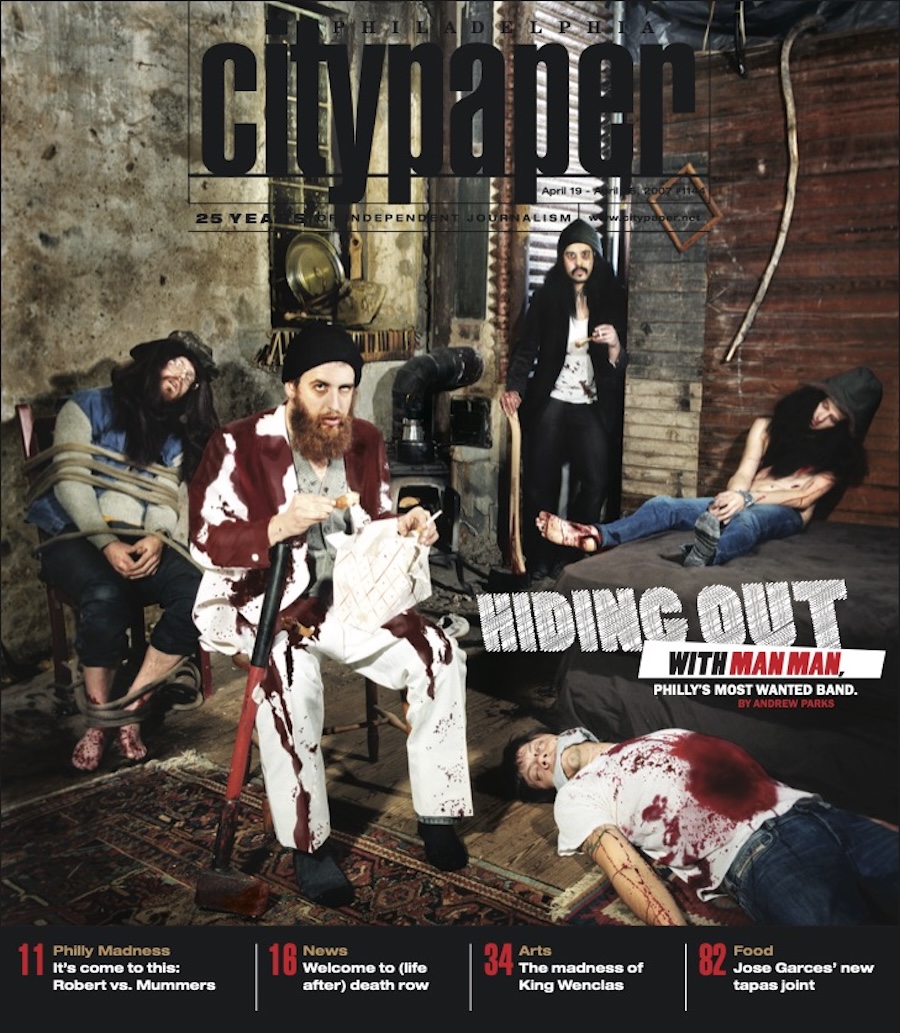
Man Man on the cover of City Paper in 2007, possibly the issue mentioned in Honus Honus’s anecdote.
Man Man plays Underground Arts with Death Valley Girls on Thursday, July 23rd.