How Bobby Clarke and the Broad Street Bullies Became Immortal
The only Flyers teams to win a Stanley Cup defined what Philly grit looked like for a generation.
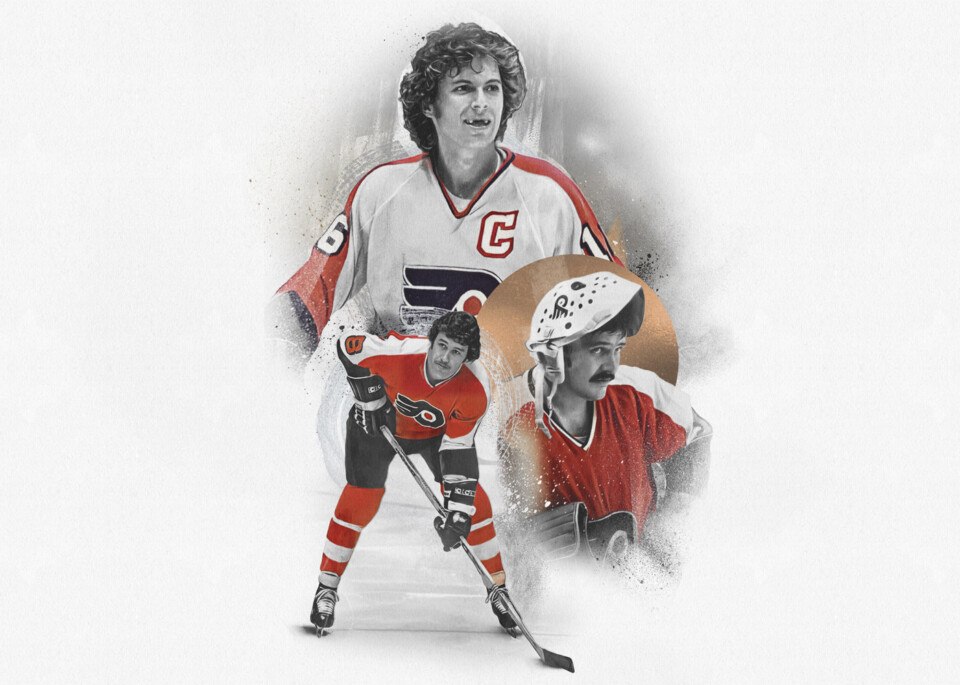
Bobby Clarke / Photo-illustration by Neil Jamieson; photograph via Getty Images
Our “25 Most Philly Athletes of All Time” list would be worthless without Bobby Clarke, the toothless, grinning captain who played 1,144 games in the orange and black and defined for a generation what Philly grit looks like. But …. do you want to be the one to tell Dave “The Hammer” Schultz, Bob “Hound” Kelly, or Andre “Moose” Dupont we left them off? Or #1 in goal (and in our hearts), Bernie Parent?
While, yes, Clarke is the face of the franchise, there’s just no singling out any one player from the Philadelphia Flyers teams that gave this city two straight Stanley Cups. The whole was truly greater than the sum of its parts. Win today, and we walk together forever, head coach Fred Shero famously scrawled on a whiteboard in the locker room before Game 6 of the 1974 final. And so they did, and have.
Even if you aren’t old enough to remember Rick MacLeish’s winner in that game against the Boston Bruins, or a single one of Schultz’s 472 penalty minutes during the repeat campaign, you’ve heard the stories, watched the highlights, seen the banners hanging, know the names. And what a bunch of names, even just phonetically (Orest Kindrachuk! Ed Van Impe! Gary Dornhoefer!).
We’ve had better teams and more beloved champions, but none has ever been more Philly, nor meant more to the city in its era. The Broad Street Bullies made Philadelphia a hockey town. They were Rocky before Rocky. And they won. That first run to the Stanley Cup came at a time when the Phillies, the Eagles, and the Sixers were all last-place teams (and the 9–73 Sixers the worst team in NBA history). The Flyers set the standard for championship parades, both in exuberance and in crowd size. Schultz even beat A Philly Special Christmas by four decades, cutting a seven-inch single, “The Penalty Box,” with lyricist Kal Penn (Chubby Checker’s “Let’s Twist Again”) and MFSB/Sigma Sound great Vince Montana.
Rodney Dangerfield may not have been in Philadelphia when he “went to the fights and a hockey game broke out,” but that joke does not exist without the Broad Street Bullies. The team was its own larger-than-life orange and black mascot: ornery, hulking, porn-stached, and, above all, loathed by hockey purists. “These bullies would bloody the face of the National Hockey League,” narrator Liev Schreiber says in HBO’s 2010 doc about the team, while New York Times sports columnist Dave Anderson once called the Spectrum a “cradle of licensed muggings.”
To put it another way: No one liked them, and they definitely didn’t care. Certainly not founder/owner Ed “Mr.” Snider, who could be as pugnacious as the players (well, not literally).
“Only the Lord saves more than Bernie Parent,” the bumper sticker said, which was especially true given how often the Flyers had to kill off penalties. In ’73–74 the four biggest Bullies — Schultz, Kelly, Dupont, and Don “Big Bird” Saleski — combined for more penalty minutes than six of the NHL’s other 11 teams; the next year, Clarke, who was more a slasher than a brawler, was third on the team behind the Hammer and Dupont.
Along with that intimidation came the time and space to score a lot of goals, by future Hockey Hall of Famers Clarke and Bill Barber (then just 24 and 21 years old, respectively), by MacLeish, and then, in ’74–75, Reggie “The Rifle” Leach. The Flyers outworked teams as much as they outplayed them; the cerebral Shero could out-system any coach.
During that second season, Parent, who’s also in the Hockey Hall of Fame, made the cover of Time magazine, his Jason Voorhees–style mask sporting the headline “Hockey: War on Ice.” The toughness was also the greatness, and it wasn’t just the fighting. The core things the Bullies did — make the other team afraid to go into the corner, not be afraid of getting hit themselves, go hard to the net — are still everything this city wants out of the Flyers in 2026.
While today’s fan-to-athlete bond is parasocial, these were guys you could actually have a beer with — so long as you were drinking at Rexy’s in Mount Ephraim. The Bullies were the last all-Canadian team to win the Stanley Cup, but more than a dozen of them never left the area. And of course, Clarke, Barber, and Paul Holmgren all went on to run either the Flyers front office or the bench (or both), and remain “senior advisers.” Alas, what was the city’s only championship franchise in the 1970s has now surpassed the Sixers for longest championship drought. Which is also pretty Philly.
>> Click here to return to The 25 Most Philly Athletes of All Time
Published as “The 25 Most Philly Athletes of All Time: Bobby Clarke” in the March 2026 issue of Philadelphia magazine.