Why Mo’ne Davis Is One of the Most Philly Athletes of All Time
Atop the mound of a sport men, largely white men, have dominated for going on 180 years, she, a Black girl from South Philly, represented a change, something bigger than herself.
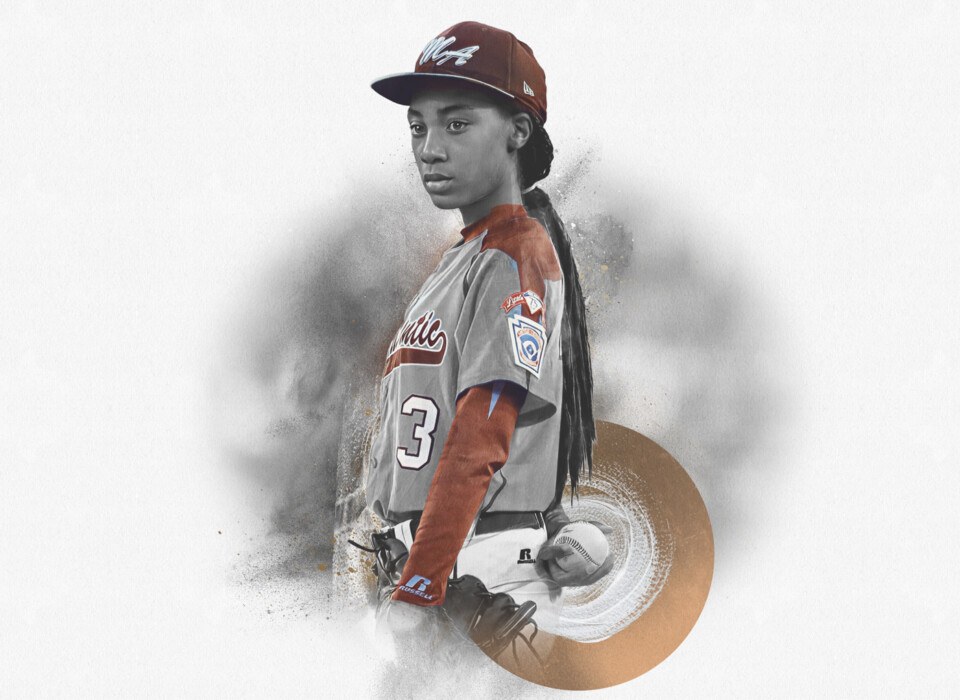
Mo’ne Davis / Photograph by Rob Carr/Getty Images
Mo’ne Davis celebrated her 13th birthday six weeks before the 2014 Little League World Series, in which she became the first girl in series history to earn a win as a pitcher. She did it with a shutout.
Back then, it was clear that there was something special about Davis. On the cover of the August 25, 2014, issue of Sports Illustrated (she was also the first Little Leaguer to earn that honor), she’s a skinny kid with a thick, low ponytail of braids, wearing her team’s retro blue and burgundy Mid-Atlantic uniform. Her cheeks puff as she exhales and delivers a fastball.
“Remember her name” the cover says, and readers — and anyone who saw that ball come in at 70 mph — complied. Clearly, this kid was confident. Strong. A standout. Atop the mound of a sport men, largely white men, have dominated for going on 180 years, she, a Black girl from South Philly, represented a change, something bigger than herself. Something revolutionary, you might say.
She belonged to Philly, for sure, but she also belonged to something bigger: a movement to make the sport more inclusive, the unfulfilled promise of women’s sports, and something else, too.
Davis’s team performed well in Williamsport, exiting after falling to and then throwing their support behind the eventual winners of the whole thing, Jackie Robinson West, representing Washington Heights, Chicago. All the while, kids, baseball fans, Mike Trout, Kevin Durant, and Michelle Obama cheered on Mo’ne — by then a one-name star. She belonged to Philly, for sure, but she also belonged to something bigger: a movement to make the sport more inclusive, the unfulfilled promise of women’s sports, and something else, too.
Davis had her own story, and we gobbled it up. How, at age seven, she caught the eye of coach Steve Bandura. He was dragging the infield at the Marian Anderson Rec Center at 17th and Fitzwater; she was throwing a football in the outfield.
How she wasn’t just a natural athlete but also whip-smart — “brilliant,” Bandura says now. Bandura believed in her so much that he helped her enroll in Springside Chestnut Hill Academy and then welcomed her into his family’s home, so she didn’t have to spend four hours riding the bus to and from school every day.
But it was also the story of the Anderson Monarchs themselves, named for the neighborhood’s Black opera diva and civil rights crusader and the Negro League team Satchel Paige and Jackie Robinson played on. Bandura, a Parks and Rec employee, founded the team in 1993 to give kids nearby (this was pre-gentrification Graduate Hospital) the opportunity to play not just baseball, but also soccer and basketball, like he did growing up at Frankford and Cottman.
He knew (and knows) about the financial and logistical inaccessibility of travel sports, and wanted to give kids chances to play — and to absorb the lessons that preparing for and playing team sports impart. The team bought a 1947 bus, and Bandura took them on a “barnstorming” tour of Negro League sites, and, one year, the Civil Rights Trail. (He’s now trying to raise $100,000 to fix the bus in order to resume these trips.) Most of all, he said, the team provided opportunities — especially for Davis, an outlier among boys.
These were “opportunities to explore and develop her talents in sports and academically,” he said. “It hurts me to know that there are thousands of other girls out there that will never get the opportunity to find their talent. Like they always say: How many Beethovens were out there that never got a chance to sit down at a piano? Every kid should have those opportunities. What they do with them is on them. Mo’ne just took hers to the next level.”
So did her teammates, who went to college and graduate school. Three play pro ball, including Bandura’s son, Scott, Davis’s catcher. And, as of this fall, Davis herself.
After the Sports Illustrated cover, late-night talk shows, Christmas with the Obamas, an ESPY, and a memoir, Davis went to Hampton University, where she played middle infield for the HBCU’s softball team. She later interned for the Dodgers (while in L.A., she stayed with the deeply Philadelphia-rooted Robinson-Peete family) and earned her master’s in sports management from Columbia. She has also worked as a broadcaster for Little League games on ESPN and thrown out baseballs at major-league stadiums. Davis could, says Bandura, do almost anything she wants in sports: work in the MLB, the WNBA, even the MLS. He admires her for keeping her options open.
Last summer, Davis announced her next big move.
With a gentle push from her old coach, she began to lift weights, take batting practice, field balls. Davis was jogging her muscle memory to try out for a spot in the Women’s Professional Baseball League, which launches this August in Springfield, Illinois. Doesn’t matter that she’s been out of the game for five years. Ever the striver, Davis figured she’d give it a try. She returned to Anderson’s Ryan Howard Training Center, where, in her spare time, she coaches youth softball and basketball.
Davis entered the draft on November 20th. Out of 600 players, she went 10th overall, to the team repping Los Angeles. This time, Mo’ne Davis would like to play center field.
>> Click here to return to The 25 Most Philly Athletes of All Time
Published as “The 25 Most Philly Athletes of All Time: Mo’ne Davis” in the March 2026 issue of Philadelphia magazine.