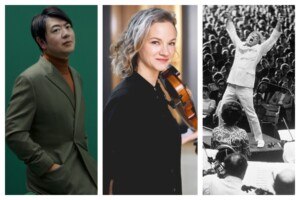
Ormandy’s Orchestra
He arrived in the U.S. for a concert tour at the age of 21. It turned out his manager didn’t make any bookings and Ormandy was forced to take a job as violinist with a Manhattan movie house which served up classical music to its customers between films. He soon became concert master, then filled in for an ailing conductor, eventually took over the post. "Conducting the same piece four times a day, 20 times a week, gave me an opportunity to imagine new ways to bring out its beauty," he is quoted as
observing. He was shortly able to memorize the scores, still has every note he conducts in his head. From the Capitol movie palace he moved on to CBS Radio, conducting its symphony on the air.
Twice in his life, he has had the unnerving experience of being asked to replace topflight and well beloved conductors — and twice he has not only survived, but gone on to win plaudits for himself as a man formidably gifted, if almost completely without the need to project his own person while playing topnotch music. When he took the podium in Philadelphia for Arturo Toscanini, ill with a sore arm, in 1931, a friend told him it was suicide. Then he took over for Stokowski here, the warning was repeated in spades. He handled the assignments brilliantly and was subsequently engaged to conduct the Minneapolis. He was called to Philadelphia in 1936. The range and variety of the Orchestra today is its own unquestionable tribute to his discipline, his devotion to producing fine music with unmatched tone, and his personal qualities of perseverance plus a firm faith in his own ability to overcome all obstacles. The famed ‘Philadelphia Sound’ is, he will say with total honesty, "in reality the Ormandy sound."
"An orchestra takes its tone from its conductor," he insists. "It is, after all, the conductor’s instrument. Therefore it seems only natural that an orchestra should reflect the training of a violinist." And it does, indeed, have the sound of a lush and beautifully-tuned stringed instrument.
While he was turning it into the country’s first symphonic group, he was quietly making himself a place in the hearts of Philadelphians. He never has called forth the same frenzy as Stokowski — nor, seeing him, would you feel he’d be anything but embarrassed by such displays. Charm, however, is the most variable of qualities, and especially in the performing arts, it wears many faces. The tears, when Ormandy leaves, will be as many and as heartfelt as they were over his predecessor.