

She Transformed Bok Into a Creative Force. Now Lindsey Scannapieco Is Taking on Broad Street
The city’s most soulful developer takes on her most important project yet: breathing new life into the former UArts campus.
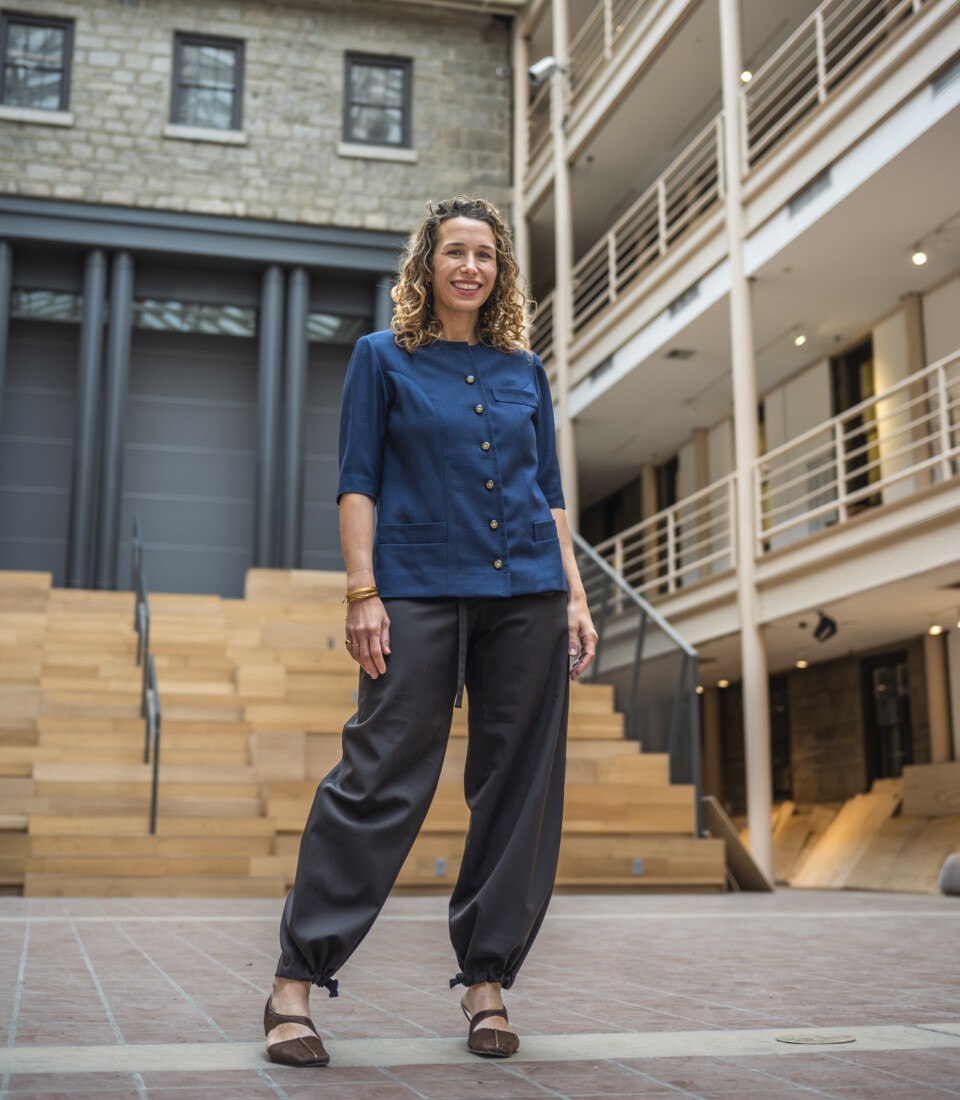
Lindsey Scannapieco in Haviland Hall / Photograph by Linette Messina
It wasn’t particularly quiet at the rooftop bar, and anyway, plenty of words sound like “Bok,” so Lindsey Scannapieco was certain she’d misheard. Plus, she was all the way out in Los Angeles, sipping cocktails with friends atop a trendy Koreatown hotel, more than 2,700 miles away from South Philly. But then she heard it again, more clearly this time, the word floating up over the bar’s buzzy din.
Bok.
She leaned in to her friend, nodded to the knot of people standing next to them. “I think they’re talking about … my building.”
It was a stifling hot Saturday in October of 2017, just two years after Scannapieco, then 29, had bought the historic Edward W. Bok Technical School in South Philly, which had shuttered in 2013 after 75 years in operation. She’d spent those two years doggedly transforming the building — a 340,000-square-foot Art Deco behemoth that imposes itself upon an entire city block — into an affordable workspace for the city’s creative class. It was inching toward success at that point, half-leased to a motley collection of artists, makers, small businesses, and nonprofits that worked out of the school’s former classrooms, closets, and workshops. There was a rooftop bar on the eighth floor of the newly reimagined Bok, which, as it turns out, was precisely what the people next to Scannapieco were talking — raving — about.
“It was so shocking to me,” she says. “It was this real moment of, oh my gosh. This is going to be a place.” And so Scannapieco did, frankly, what any real estate developer should do when her long-shot project earns cross-country acclaim. She walked out of the bar, rounded a corner, and jumped up and down, shrieking.
That sunny rooftop bar in California is a world away from where Scannapieco stands on this cold, gray afternoon in January, in front of Center City’s landmark Hamilton Hall. Broad Street is a mess, lined with dirty mountains of ice-encrusted snow that won’t melt for weeks. As Scannapieco climbs the iconic steps, she spins through the building’s history as easily as someone reciting the alphabet — “It was built in 1824, oldest building on all of Broad Street, older than City Hall, the Academy of Music, the Divine Lorraine.” She punches a few numbers into a keypad — “When it was built, it was surrounded by pastoral landscapes. People would take their carriages here just to see it.” She opens the hulking doors — “In 1875, they added the Furness dormitories, built by the famous architect Frank Furness.”
And just like that, we’re in.
Scannapieco unwraps a gray scarf from around her head, her curls tumbling out, and strides purposefully through the lobby, walking around like she owns the place. Which, in fact, she does. When the University of the Arts closed suddenly in June of 2024, her boutique development and design practice, Scout, acquired this building and the adjoining Furness Hall in a fraught, frenzied auction process. As with Bok, it was another long-shot project, with Scout barely edging out a New York real estate firm with plans to turn the historic arts buildings into a shiny “live, work, play” mix of retail, offices, makerspaces, and, naturally, “affordable luxury” apartments. Buoyed by social media campaigns, public outcry, editorial petitions, (eventual) city support, and, most important, an undisclosed eleventh-hour supporter with an emergency bridge loan, Scout won the bid.
“I still cannot believe we got this project,” Scannapieco says, as shocked today as she was on that L.A. rooftop. “I cannot believe this is a reality.”
Now, Scout’s plans for the buildings are displayed on an easel in the lobby, which, Scannapieco explains, used to be far more beautiful than it is now. “At one point, a very famous furniture designer, Paul McCobb, designed it,” she says. She points to a stark wall. “There used to be a fireplace there. In my dream world, we’d bring it back.”
The fireplace may or may not find its way into the new design, but her dream world nonetheless seems to be taking shape: She calls it Village of Industry & Art — VIA for short. A mission statement is printed on the plans: “Breathing new life into a historic space where art, culture, and creativity can continue to grow.” VIA’s development will follow the Bok blueprint, an iterative, intentional, light-touch renovation. Things like fresh paint, working heat and air conditioning, new LED lights, restored windows, repaired floors — just enough to make the buildings habitable, useful, and affordable for tenants, a Bok-esque crew of makers, artists, nonprofits, and small businesses, plus Frankie’s Summer Club, the pop-up beer garden that debuted last summer in the courtyard between the two buildings.
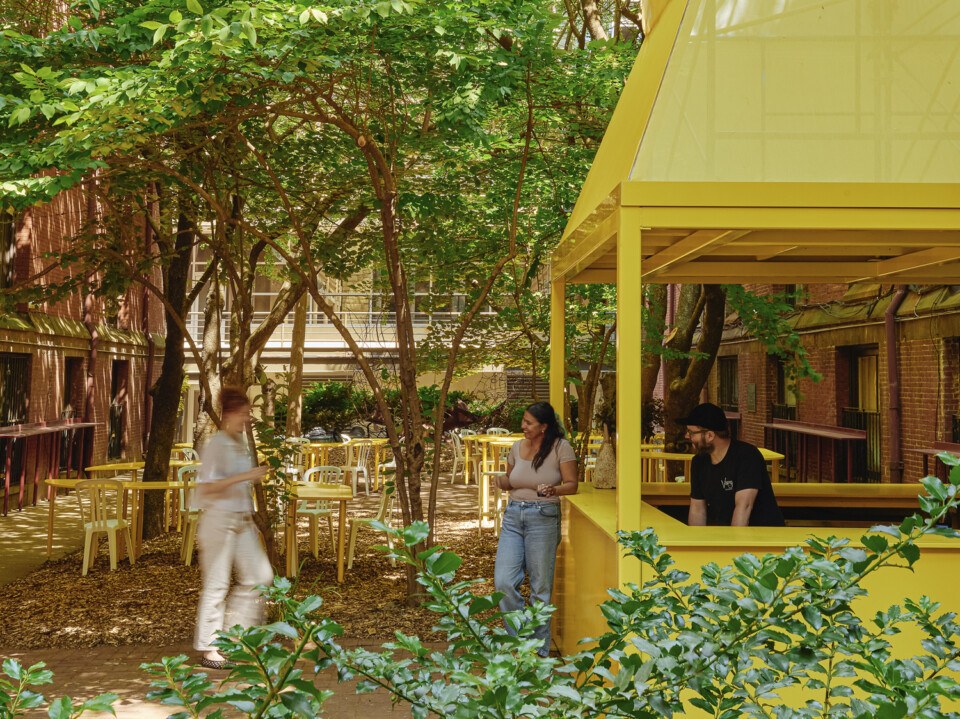
Frankie’s Summer Club / Photograph by Breanne Furlong
It’s a dream world, yes, but it’s also a vision rooted in reality. And the reality looks something like this: A century and a half after Philadelphia established itself as a leader in art and craft and industry, our major cultural institutions are in tumult, and our vibrant creative class is becoming increasingly fragile thanks to a lack of funding and city recognition, a scarcity of affordable workspace, and inequitable access to resources. But a world-class city can’t thrive without creative and cultural workers, and these workers can’t survive without support. Without a place.
Scannapieco understands this reality, deeply. She recognizes the irony here — that her dream world is being realized in the empty shell of one of the country’s oldest art schools. And that other institutions and studios are suffering the same fate: In 2024, PAFA cut its degree programs. Arts-centered workspaces like NextFab in South Philly and REC Philly in Center City have closed. Places are shutting down, locking their doors.
But the reality is also this, even if she still can’t believe it: Lindsey Scannapieco, a 40-year-old woman carving a path through a field long dominated by bold-named, often bombastic men with louder voices, deeper pockets, and much stronger influence for a much longer time (the sort who would never jump up and down with glee), has the keys to this place now, and the vision. And she’s ready to start building.
If you rewound even further, back to the summer of 2015, you’d find Lindsey Scannapieco on a different, quieter rooftop, this time overlooking South Philly’s crowded grid of streets. She’d just gotten the keys to Bok, and had assembled a team of seasoned experts for a first tour of the building — structural engineers, architects, an environmentalist. Among them was, surprisingly, Conrad Benner, a twentysomething photographer whose fledgling blog, Streets Dept, documented public art in Philly. Scannapieco had invited him to tag along and photograph the space as a way of documenting history.
Benner was used to being in neglected buildings, abandoned warehouses, empty factories, but seeing the state of Bok was still jarring. Water from leaky pipes pooled on dirty floors; wires draped from drop ceilings pockmarked with missing tiles; paint peeled from graffitied walls. The School District of Philadelphia, confronted with a $300 million deficit, had also closed 23 other public schools in 2013, and Bok had become a dumping ground for much of the contents. Classrooms were packed with hundreds of chairs stacked in teetering towers; closets were stuffed with broken electronics; hallways were littered with trash; the rooftop was speckled with shards of broken glass.
“Are you really going to do this?” Benner asked Scannapieco as they stood together on the roof.
She looked at him. “I think so?”
Benner had a sense of her vision — he was thrilled by it — but it seemed daunting at best, impossible at worst. Or, in his words: “It felt insane.”
Scannapieco’s dad agreed. And he would know: Tom Scannapieco is the president and CEO of Scannapieco Development Corporation, an ultra-luxury real estate development firm that’s responsible for more than $1 billion in development across Pennsylvania, New Jersey, and Maryland. And so when his daughter called to say she’d found an old school for sale online, in a great location in Philly, he had … concerns.
“I said, ‘Honey, what do you know about a great location in Philly? You’ve been living in London for the past seven years!’”
He had a point. Even though Lindsey grew up in New Hope, Bucks County’s artsiest enclave, she hadn’t been back in the tristate area for more than a decade. She’d gone to college at the University of Southern California, and then gotten her master’s in city design and social science at the London School of Economics and Political Science.
Scannapieco stayed in London after graduation, working for the Olympic Park Legacy Company, which oversaw the planning, development, and management of the site of the 2012 London Olympics. When the organization couldn’t continue sponsoring her visa, she founded her own company, Scout UK, so that she could keep working in the country as a contractor. Scout’s first project, Films on Fridges — which involved transforming a vacant lot across from the Olympic Stadium into a pop-up cinema — was a splashy success.
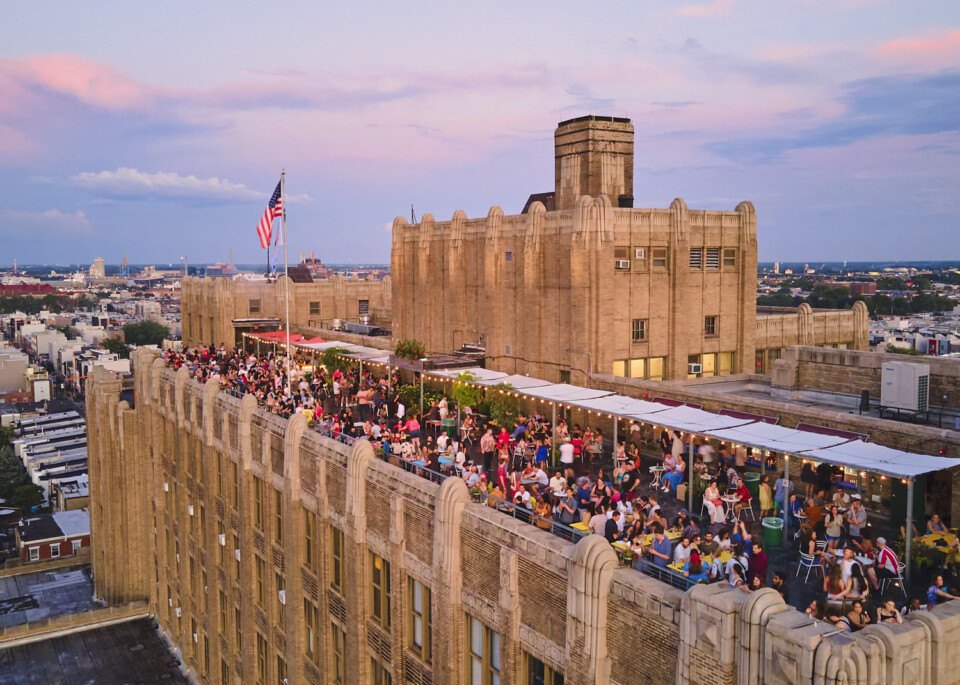
The rooftop at the Bok Bar / Photograph by Stephen Recchia
“She had to explain to me what the concept of a pop-up even was,” Tom Scannapieco admits. “But she did it. She found the site, came up with a concept, negotiated for the rights to use the land temporarily, got people to donate services, and raised money, and she and her team built this amazing set out of refrigerator doors. It was the most incredible thing.”
It was incredible — an outdoor movie theater inspired by East London’s infamous “fridge mountain,” an enormous repository of discarded refrigerators, washing machines, and other appliances that had plagued the area for years before being cleaned up to make room for the Olympics aquatics center. The outdoor theater was constructed mostly from two tons of refrigerator doors, as a way of recognizing the area’s industrial past. Over the course of three weeks, more than 1,500 people streamed in to watch sports-themed films against the backdrop of the Olympic Stadium.
Tom hadn’t brought up the prospect of becoming a real estate developer to his daughter for years, but he figured now was as good a time as any.
“You know, honey,” he said as they stood together in London looking at her refrigerator doors, “the only thing different between being a real estate developer and what you just did is that when you’re a real estate developer, it doesn’t go away after six weeks.”
He’d been nudging his daughter since she was in high school, recognizing in her the traits of a good developer: “She was communicative and creative, always making and designing things. She was interested in the classics, and in the world around her.” But she was a teenager and he was her dad, and so she’d demurred.
“Dad. You don’t know me. I would hate development. I want to go into the art business,” she told him, her sights set on museum management. Sure, she’d grown up knowing the different types of brick patterns — running bond, Flemish bond — but she hadn’t spent her childhood trailing her dad as he built his sky-scraping condos for the one percent. She was an artsy theater kid busy with her own life.
“She was one of those kids that always had a book in her hand,” remembers Mae Sakharov, an education counselor who worked with Scannapieco as she shifted from an independent school to a public high school, New Hope-Solebury. Nearly three decades later, they’re still close.
“Lindsey was adventurous,” Sakharov says. “Like, all of a sudden, in high school, she decided that she wanted to be a sailor. I don’t know how the hell she learned to sail, but somehow she convinced her parents to allow her to be in regattas.” (Guess who got a spot on USC’s sailing team?)
But for all her fearlessness, when people suggested she purchase a building in Tottenham, an area in North London that was slowly coming to life after a series of riots in 2011, Scannapieco couldn’t jump. For starters, she didn’t have enough money. But there was another problem.
“I’d have to call my dad and say that he’d been right all these years.”
It was mid-February of last year, and Inga Saffron was running out of time.
There were only a few days left before the second round of bids was due for the UArts buildings — 4 p.m. on Tuesday, February 18th — and the longtime architecture critic needed her editor at the Inquirer to publish her story immediately. Her words swelled with urgency, frustration, and force: “Hamilton Hall’s legacy is now being threatened by bankruptcy proceedings that are designed to dispose of the university’s real estate as fast as possible with little concern for the city’s best interest,” she wrote. “It’s hard to believe that the city’s political and philanthropic leaders would allow one of Broad Street’s great cultural anchors to be sold off like so much surplus.”
But those leaders had other matters to deal with. The Eagles had just won the Super Bowl, and the parade was scheduled for Friday, February 14th. They were also mired in plans for a massive — and massively controversial — new Sixers arena. So no one seemed all that concerned that Lindsey Scannapieco’s small outfit was going to lose the auction for Hamilton and Furness halls. Scout had submitted an initial letter of intent to purchase the buildings for $11.5 million, but the bankruptcy court had selected a bid from Dwight City Group, the New York–based apartment developer: $12 million, all cash, very high deposits, a 30-day close. Scout had 18 days to meet the court’s new requirements: $12.25 million, cash.
“I just sat in a room, dialing people,” Scannapieco says, rolling through the words she repeated hundreds of times: “Hi, I’m calling to talk about the UArts buildings.” “Hi, I’m calling to talk about how we’re preserving these important cultural spaces.” “Hi, is there any way to do this?”
Everett Abitol, Scout’s director of hospitality and development, tried to reason with her: “Listen, to preserve our sanity, we might have to realize that this is not going to happen.”
Scannapieco wouldn’t have it. “I was just like, get out of my way. I’ve got to try.” At the time, Abitol didn’t know what was putting her in what she calls “a fierce and strong place,” what was giving her this relentless energy to protect and nurture something that was still a little bit intangible.
She’d tell him a few weeks later.
The money sputtered in slowly — half a million here, another half a million there, from philanthropists, supporters, and yes, her dad, who says he contributed a relatively small amount. A couple weeks into February, she had $5.25 million. A good start, but still short. And so Scannapieco called the person who had helped persuade her to move back to Philly in the first place, to build her places here instead of abroad.

Lindsey Scannapieco at Haviland (formerly Hamilton) Hall / Photograph by Linette Messina
“I did it as a favor to her father, because how could I say no, right?” says Saffron, who met Lindsey Scannapieco for coffee sometime around 2013. “He really wanted her to come back to Philly, and he asked me if I would talk to her, tell her about how cool Philly was becoming, how she could make a life here doing the things she wanted to do.”
Now, 12 years later, the thing Scannapieco really wanted to do was raise awareness for what was at stake with the UArts sales. Saffron had been watching it play out, but it wasn’t until she spoke with Scannapieco herself that she realized the magnitude of what could be lost, and how soon it could happen.
“Inga, this is happening, like, tomorrow,” Scannapieco told Saffron over the phone. “This is all going to be a thing of the past.”
“I felt badly about realizing so late that this was a story,” Saffron says. She wrote her piece quickly, but her editor was out of town; the person filling in planned to run it the following week. Saffron, who rarely put her foot down, stomped. Loudly.
“I said, ‘You can’t wait until next week. That will be after the fact, don’t you understand?’” Her story went online that Saturday at 5 a.m., three days before the auction.
“I was so focused on getting it up online. And the irony is that the angel investor was burned out by the national news and was avoiding looking at news online, so they didn’t see it until it appeared in print the next day,” Saffron says wryly. “Which just goes to show you, some people still read the Sunday paper.”
On February 18th, the day that bids were due, the angel investor called Scannapieco and offered her an emergency loan. On February 24th, Scout’s winning $12.25 million bid was finalized. Scannapieco was in Australia at the time, visiting her husband’s family. When she returned to the office, she made an announcement to her eight-person team:
“Congratulations! Everybody should be really proud of what we pulled off,” she said, standing in Scout’s office on Bok’s third floor, just around the corner from Conrad Benner’s studio. “Oh, and by the way, I’m pregnant.”
The only thing more surprising to Abitol than getting the UArts buildings — and Scannapieco’s pregnancy — was her initial plan for them. They’d divided the work that needed to be done before the sale’s March 17th closing date: Abitol would handle getting the finances in line; Scannapieco would focus on the first touchpoint of development.
For Bok, this first step had been establishing the rooftop bar, initially dubbed Le Bok Fin, which opened less than two months after she’d gotten the keys to the building. Its initial reception was mixed. While many were dazzled, neighbors balked at the noise and the traffic, and people citywide criticized what they saw as a tone-deaf use of a space that until recently had served South Philly’s largely minority community, where Black and brown kids had learned valuable trades like auto repair, welding, carpentry, cosmetology, and culinary arts. But for Scannapieco, Le Bok Fin was only the beginning, a quick way to breathe life into a dying structure. She also welcomed neighbors into the building and her ground-floor office space before the project was completed, to solicit feedback, answer questions, and learn about their needs, slowly weaving her way into a community that would eventually embrace her.
“We never have these big groundbreakings and ribbon-cuttings,” she says. “It’s piece by piece, incremental, just allowing things to build over time.” And, piece by piece, Bok turned into what it is today: a quirky hub of entrepreneurial magic, yes, but also an economic force for the neighborhood. Of Bok’s 220 businesses, 60 percent are owned by South Philly residents. More than half are owned by women, and one in five is owned by a nonwhite person. On Bok’s ground floor, the Hansjörg Wyss Wellness Center, a partnership between the nonprofit Southeast Asian Mutual Assistance Association Coalition and Jefferson Health, offers a safe space for the local refugee and immigrant population to access health care and social services. The bar, always filled with life every spring and summer, is now just the cherry on top.
Abitol called Scannapieco that first week of March to hear her plans for activating the UArts buildings. Another bar, perhaps? A food pop-up?
“No,” she told him. “We’re going to hold a funeral.”
Abitol was dumbfounded. After years of working with Scannapieco, he had bought into her vision of immediately activating dormant spaces so that their spirit doesn’t die: “She’s really scrappy, and she believes that building and flying the airplane at the same time has value. You learn things, you support people during that process,” he says. “But also, part of my brain has to worry about the nuts and bolts of construction.” A funeral was a terrible idea.
“Well, think about it more like a celebration of life,” Scannapieco said. She explained her idea: a five-day, open-door event where people — alumni, students, faculty, staff, neighbors, anyone who loved the school — could walk through Hamilton Hall. There would be alumni performances and an open mic. There would be story sharing, guided meditations, grief coaches, a memory wall, and an altar made from salvaged pieces from the school. On the last day, people could take what they could carry as mementos — artwork, abandoned art materials, leftover branded promotional items like T-shirts and coffee mugs and water bottles, letterhead, books.
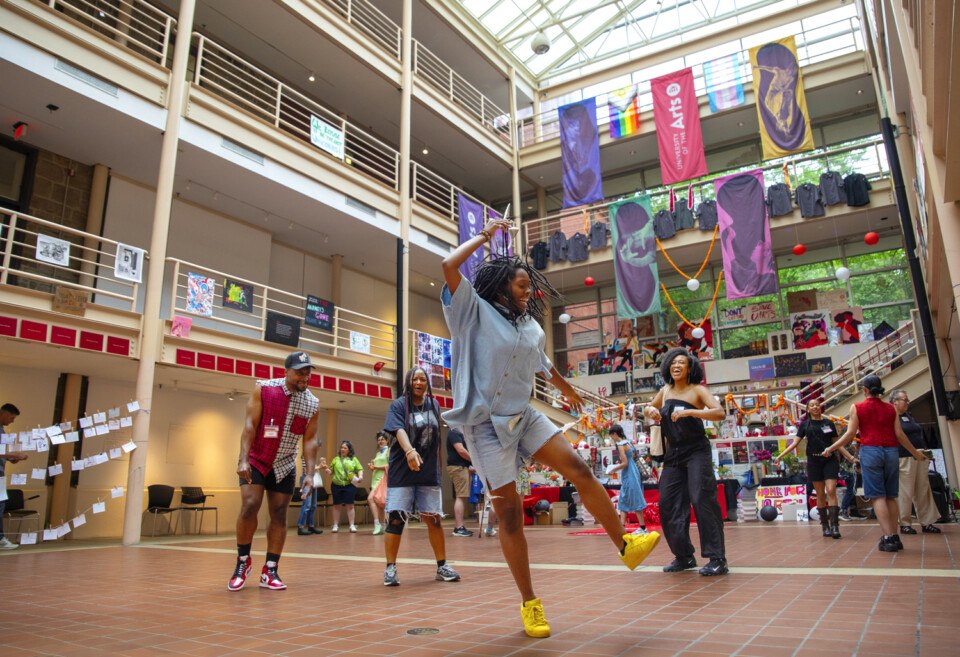
A performance during the Celebration of Life event / Photograph by Shoshana Isaacs
The overwhelmingly positive public reaction to her idea was staggering, if not surprising. The school’s abrupt shuttering had prompted protests from members of the UArts community, most of whom were seeking some sort of closure.
“It was my biggest surprise to see over a thousand people show up, and to see things that I thought would never leave this building — things that would have cost us a lot of money to get rid of and would create a lot of landfill — go home to people,” Abitol says. “I saw this woman tear up because she got to take the room sign off of a studio that she’d taught in for 20 years. I think about all these objects that in traditional renovations would have been trash.”
There were a lot of objects. The school announced its closure on a Friday; the doors were locked one week later. Left behind: 60,000 sheets of letterhead, 10,000 UArts-branded envelopes, tools, artwork, unfired clay pieces, transcripts, desks, chairs, computers, hundreds of pens and pencils. “It was like Pompeii in here, everything enshrined in place,” Abitol says. “With the way the school shut down, nobody had time to take anything. Offices still had coffee mugs and papers on the desks, computers on, pens out. Studios still had wet clay.”
One year later, all of that is gone. Hamilton Hall is mostly empty. Coils of wire lie like snakes in corners. Ladders lean against walls smeared with spackle. Bulging black contractor bags slump on dusty floors. Scannapieco runs her hand over a wall, gently knocks it with her knuckles.
“This wall is made of Homasote. You can just tack into it. I joke that my next house is going to be covered in Homasote so I can just tack everything up.” By all accounts, it seems that Scannapieco’s good-natured Australian husband, Sandy, would gamely accept this.
“He’s always like, ‘Can’t we just go to Wyoming?’” Scannapieco says of their family trips, which always end up becoming architectural and urban design pilgrimages. She encourages her team to take these journeys too, to inform their work. Instead of throwing an elaborate party for Scout’s 10-year anniversary last year, she gave everyone on staff a stipend to take an inspiration trip of their choice, and then had them present on it.
Scannapieco points out what each space will be as she glides through the buildings: the former admissions office will be the new headquarters of the Philadelphia chapter of the American Institute of Architects; a row of half-walled cubicles will be mini artist studios; the 45 former dormitory rooms in the Furness building will be subsidized apartments for artists, potentially with a few furnished units available for visiting artists so that, she explains, “if you’re, say, a set designer in town working at the Kimmel, you can come here instead of staying at a hotel, so that you can be adjacent to Philadelphia artists and be a part of this community.”
This is Scannapieco’s singular magic. It’s one thing to develop a building; it’s another to create and nurture a whole ecosystem. In a town crowded with powerful developers who have excelled at selling their polished visions, Scannapieco’s approach, the way she finds beauty and promise in the found condition of neglected spaces, is radically, meaningfully different.
“It’s not typical that real estate developers look at projects in a more holistic way,” offers developer Ken Weinstein, president of Philly Office Retail. “It’s not an easy thing to do, to look at a whole neighborhood and community while developing. It’s easier to just focus on the building, which is what most people do.” Weinstein’s firm, based in Germantown, focuses on historic preservation and adaptive reuse. “I admire her focus on what she calls the intersection of art and real estate.”
It’s also hard, he says, to resist the urge to over-improve projects, especially in neighborhoods like South Philly and Center City, where slicked-up spaces could easily command higher rents. So, for instance, the old lockers that still line Bok’s drab terrazzo hallways and the chalkboards that still dot its walls aren’t just remnants of preserved history; they’re impressive displays of restraint, and of Scannapieco’s oft-repeated motto: “Use it up, wear it out, make it do, or do without.” They’re also why people — many of whom are renting workspace for the very first time — can afford Bok’s short-term leases, available for spaces as small as 52 square feet and starting below $500 a month. (And why there are some 400 inquiries a year from prospective tenants.)
It’s why Scannapieco isn’t doing much to the grand atrium of Hamilton Hall, even though, she says, “it’s very ’80s.” Standing in this atrium, it’s easy to imagine what a different sort of developer might do in here. Tear it down; make it new. They might do something similar to the five outbuildings that were included in the purchase of Hamilton and Furness halls: a woodshop, a foundry, a ceramic studio, a metal shop, and a carriage house. But we’re in Scannapieco’s dream world now, where, she hopes, this cluster will become a “making/baking wing,” with public-facing studios, gardens, and a cafe, inviting anyone to wander in.
“The idea that you can have working artists in the heart of our city, on the Avenue of the Arts,” she says, “showing people how things actually get made — that, I think, is going to be the magic.”
Other people see the magic too. When Weinstein was approaching lenders last year for his new project in Nicetown — a tired seven-story industrial building that he plans to convert into flex spaces for artists, makers, start-ups, and nonprofits — he had plenty of well-known adaptive reuse projects to reference. There was the Crane Arts Building, a massive century-old Kensington warehouse that David Gleeson turned into a mix of studio and exhibition space in 2006. There was also Globe Dye Works in Frankford, a historic former textile factory that was transformed into a hub of art and industrial studios, production facilities, event space, and residential units by Globe Development Group in 2007.
Yet Weinstein found that the best way to convince his lenders was to informally christen his idea a “mini-Bok,” with Scannapieco’s blessing.
“I think if we had to start from scratch and explain what we were trying to do, the lenders would have shown us the door,” he says. “Instead, we are able to refer to the Bok Building, and lenders who know Philadelphia understand exactly what we’re attempting to do.”
It’s not lost on Weinstein that he — a man with 38 years of development experience — is walking a path carved anew by a woman 30 years his junior. He sees the stark lack of diversity in the field, which, according to recent studies, looks something like this: Approximately 38 percent of commercial real estate developers are women; fewer than one percent are Black. It’s part of the reason he developed Jumpstart Germantown 11 years ago, a program that trains, mentors, and provides financing to aspiring developers in the area. More than 85 percent of Jumpstart’s roughly 2,000 graduates are people of color, and more than 50 percent are women.
“Development requires a person to spearhead it, but ultimately, for it to be a community space, a lot of people have to feel like they are able to own it and have agency in it,” Scannapieco says. “I think having a woman-led team has allowed us to take a more relational approach versus a transactional approach in a lot of our work. I think you feel that in our spaces.”
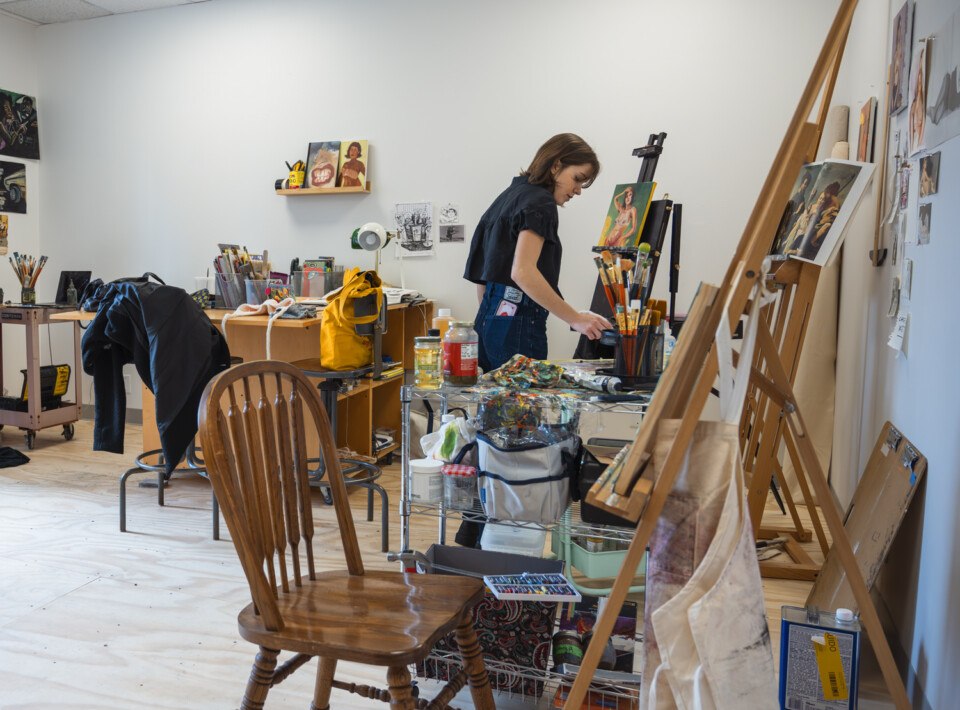
Artist Madeline Guido working in their painting studio at VIA / Photograph by Linette Messina
You certainly feel it in Bok, where tenants see Scannapieco not as a landlord, but as a quiet, constant source of support. “I trust Lindsey with our community. I trust her with our world and our orbit,” says Megan Stover, a ceramist who was one of Bok’s first tenants. “And she’s not out here just to be the face of it. She’s building it and then staying back and letting us do our thing. The level of trust she has in the community — that’s what makes her such a strong ally.”
“Projects take time,” Scannapieco explains. “You put the elements in, you plant the seeds, and you let them grow. The best thing we can do sometimes is get out of the way.”
Scannapieco has scattered seeds all across the city, even if no one realizes it: “She’s created the [pop-up sauna] Ebba Sparre Sauna Collective on the steps of the American Swedish Historical Museum in FDR Park. She’s written five-figure checks so that Philadelphia could have ‘free’ public concerts. Nobody thinks about who wrote that check. They just expect it to be free. Lindsey is who made it free,” says Mark Kuhn, the CEO of creative engineering firm Oat Foundry and a friend of Scannapieco’s. “There is a real cost to projects like these that isn’t financial. It’s time and emotional toil and love pinned to a purpose: to make a space better, a life better, a city better.” (Says Conrad Benner: “I think she’ll have a mural one day.”)
Meanwhile, Scannapieco is taking her place-making magic on the road, scattering seeds elsewhere, like in Providence, Rhode Island, where Scout is turning a former industrial factory into a creative workspace. There’s potential for projects in the U.K. and in Los Angeles, she says, and, yes, another in Philly. But right now, Scannapieco is focused on VIA, where, at present, she’s tackling the 521 historic windows that need fixing. True to form, she’s working with what she’s got: Scout established a woodshop and hired two people full time to restore them. They’ve invited YouthBuild Charter School in North Philly to come see how it’s done, upholding the school’s legacy of education. They’ll need a few hundred knobs, too, for cabinets in the apartments. The plan is to commission artists to make them. After all, there’s a working foundry out back. Why not use it?
On the day last March when Scannapieco got the keys to Hamilton Hall (which they’ve since rechristened Haviland Hall for the building’s architect), she stood in its grand, barren atrium. A table covered with a pretty flowered tablecloth had been set up. On it was a spread of coffee, bagels, and pastries. There was also a vase of tulips, a symbol of new life. Rebirth.
Scannapieco pulled out her phone, on which she had written a few words. A gray scarf looped around her neck and draped over her pregnant belly. (She had the baby a handful of months later, a boy named George.) The Scout team gathered around Scannapieco. Sunlight streamed in through the atrium’s glass ceiling, the one she wouldn’t be changing. Scannapieco wasn’t — isn’t — concerned with glass ceilings. She stands on rooftops.
She addressed her team: “Here we stand, at the threshold of something new. It will not be easy, but may it have magic. It will demand much of us: our knowledge, our creativity, our openness, our teamwork. Some of us will walk the whole path, and some will pass the torch along the way. But in this moment, we are all here. We stand on sacred ground: a place shaped by 130 years of artistry, curiosity, and learning. A space that once taught, and still will teach us. A space that once inspired, and we hope will still inspire. May we honor what came before. May we add our voices to the chorus of those who made, who dreamed, who delivered. May we bring forth something bold, something beautiful, something true. And may we, in turn, be transformed.”
And then there was only one thing left to say. “Let’s begin.”
Published as “Built Different” in the May 2026 issue of Philadelphia magazine.